

11.3 Programs
149
Bulirsch’s Elliptic Integral cel
cel is a complete integral and includes all complete integrals of first, second, and
third kind,
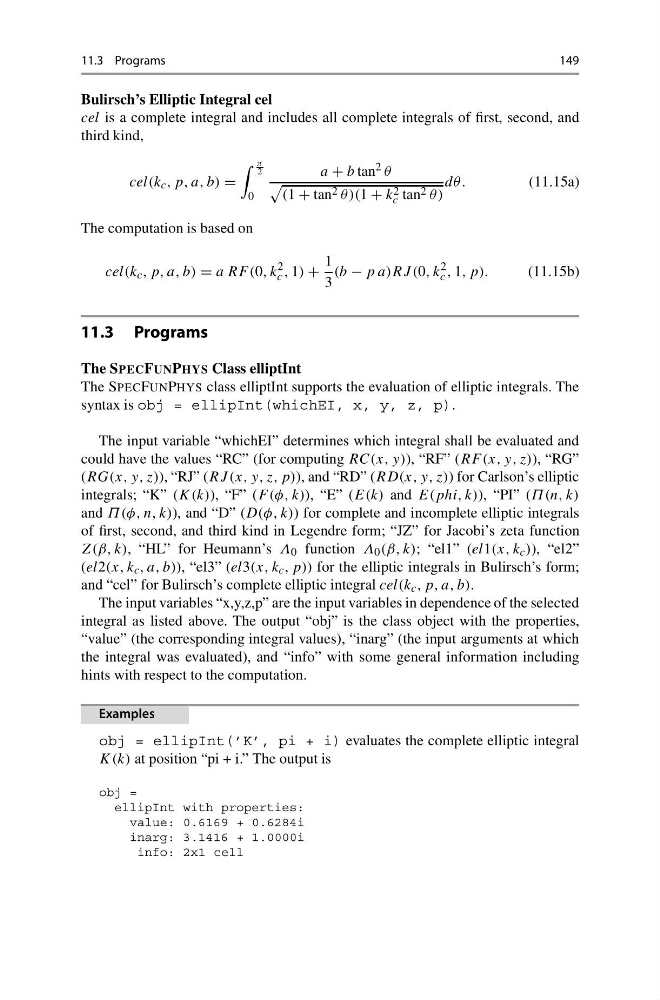
cel(k c , p, a, b) =
π
2
0
a + b tan 2 θ
(1 + tan 2 θ)(1 + k 2
c tan 2 θ)
dθ.
(11.15a)
The computation is based on
cel(k c , p, a, b) = a RF (0, k
2
c , 1) +
1
3
(b − p a)RJ (0, k
2
c , 1, p).
(11.15b)
11.3 Programs
The SPECFUNPHYS Class elliptInt
The SPECFUNPHYS class elliptInt supports the evaluation of elliptic integrals. The
syntax is obj = ellipInt(whichEI, x, y, z, p).
The input variable “whichEI” determines which integral shall be evaluated and
could have the values “RC” (for computing RC(x, y)), “RF” (RF (x, y, z)), “RG”
(RG(x, y, z)), “RJ” (RJ (x, y, z, p)), and “RD” (RD(x, y, z)) for Carlson’s elliptic
integrals; “K” (K(k)), “F” (F (φ, k)), “E” (E(k) and E(phi, k)), “PI” (Π(n, k)
and Π(φ, n, k)), and “D” (D(φ, k)) for complete and incomplete elliptic integrals
of first, second, and third kind in Legendre form; “JZ” for Jacobi’s zeta function
Z(β, k), “HL” for Heumann’s Λ 0 function Λ 0 (β, k); “el1” (el1(x, k c )), “el2”
(el2(x, k c , a, b)), “el3” (el3(x, k c , p)) for the elliptic integrals in Bulirsch’s form;
and “cel” for Bulirsch’s complete elliptic integral cel(k c , p, a, b).
The input variables “x,y,z,p” are the input variables in dependence of the selected
integral as listed above. The output “obj” is the class object with the properties,
“value” (the corresponding integral values), “inarg” (the input arguments at which
the integral was evaluated), and “info” with some general information including
hints with respect to the computation.
Examples
obj = ellipInt(’K’, pi + i) evaluates the complete elliptic integral
K(k) at position “pi + i.” The output is
obj =
ellipInt with properties:
value: 0.6169 + 0.6284i
inarg: 3.1416 + 1.0000i
info: 2x1 cell
149
Bulirsch’s Elliptic Integral cel
cel is a complete integral and includes all complete integrals of first, second, and
third kind,
cel(k c , p, a, b) =
π
2
0
a + b tan 2 θ
(1 + tan 2 θ)(1 + k 2
c tan 2 θ)
dθ.
(11.15a)
The computation is based on
cel(k c , p, a, b) = a RF (0, k
2
c , 1) +
1
3
(b − p a)RJ (0, k
2
c , 1, p).
(11.15b)
11.3 Programs
The SPECFUNPHYS Class elliptInt
The SPECFUNPHYS class elliptInt supports the evaluation of elliptic integrals. The
syntax is obj = ellipInt(whichEI, x, y, z, p).
The input variable “whichEI” determines which integral shall be evaluated and
could have the values “RC” (for computing RC(x, y)), “RF” (RF (x, y, z)), “RG”
(RG(x, y, z)), “RJ” (RJ (x, y, z, p)), and “RD” (RD(x, y, z)) for Carlson’s elliptic
integrals; “K” (K(k)), “F” (F (φ, k)), “E” (E(k) and E(phi, k)), “PI” (Π(n, k)
and Π(φ, n, k)), and “D” (D(φ, k)) for complete and incomplete elliptic integrals
of first, second, and third kind in Legendre form; “JZ” for Jacobi’s zeta function
Z(β, k), “HL” for Heumann’s Λ 0 function Λ 0 (β, k); “el1” (el1(x, k c )), “el2”
(el2(x, k c , a, b)), “el3” (el3(x, k c , p)) for the elliptic integrals in Bulirsch’s form;
and “cel” for Bulirsch’s complete elliptic integral cel(k c , p, a, b).
The input variables “x,y,z,p” are the input variables in dependence of the selected
integral as listed above. The output “obj” is the class object with the properties,
“value” (the corresponding integral values), “inarg” (the input arguments at which
the integral was evaluated), and “info” with some general information including
hints with respect to the computation.
Examples
obj = ellipInt(’K’, pi + i) evaluates the complete elliptic integral
K(k) at position “pi + i.” The output is
obj =
ellipInt with properties:
value: 0.6169 + 0.6284i
inarg: 3.1416 + 1.0000i
info: 2x1 cell