

146
11 Elliptic Integrals
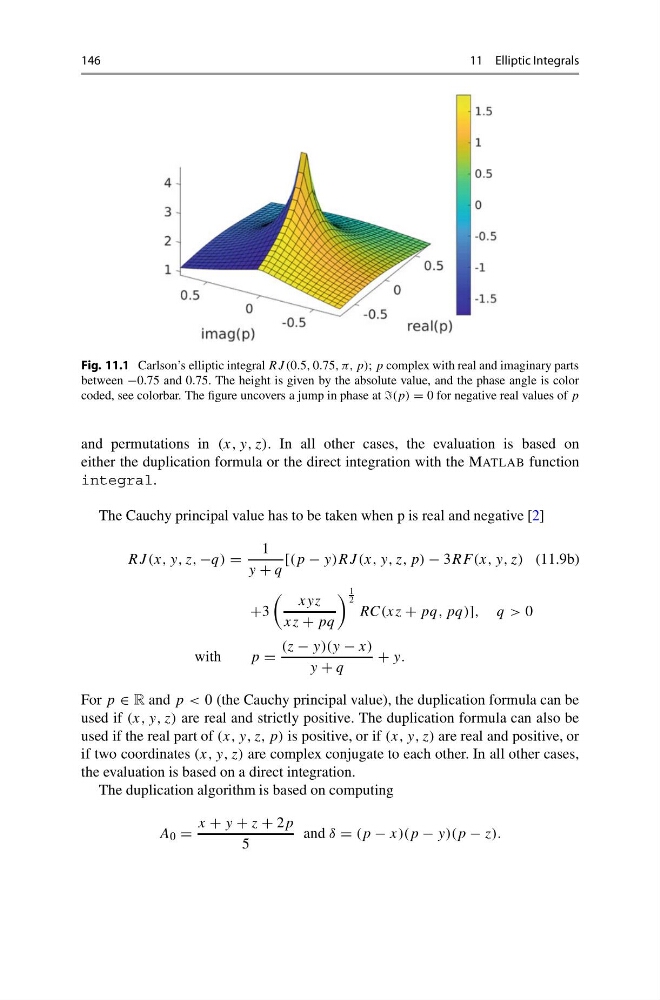
Fig. 11.1 Carlson’s elliptic integral RJ (0.5, 0.75, π, p); p complex with real and imaginary parts
between −0.75 and 0.75. The height is given by the absolute value, and the phase angle is color
coded, see colorbar. The figure uncovers a jump in phase at (p) = 0 for negative real values of p
and permutations in (x, y, z). In all other cases, the evaluation is based on
either the duplication formula or the direct integration with the MATLAB function
integral.
The Cauchy principal value has to be taken when p is real and negative [2]
RJ (x, y, z, −q) =
1
y + q
[(p − y)RJ (x, y, z, p) − 3RF (x, y, z) (11.9b)
+3
xyz
xz + pq
1
2
RC(xz + pq, pq)], q > 0
with
p =
(z − y)(y − x)
y + q
+ y.
For p ∈ R and p < 0 (the Cauchy principal value), the duplication formula can be
used if (x, y, z) are real and strictly positive. The duplication formula can also be
used if the real part of (x, y, z, p) is positive, or if (x, y, z) are real and positive, or
if two coordinates (x, y, z) are complex conjugate to each other. In all other cases,
the evaluation is based on a direct integration.
The duplication algorithm is based on computing
A 0 =
x + y + z + 2p
5
and δ = (p − x)(p − y)(p − z).
11 Elliptic Integrals
Fig. 11.1 Carlson’s elliptic integral RJ (0.5, 0.75, π, p); p complex with real and imaginary parts
between −0.75 and 0.75. The height is given by the absolute value, and the phase angle is color
coded, see colorbar. The figure uncovers a jump in phase at (p) = 0 for negative real values of p
and permutations in (x, y, z). In all other cases, the evaluation is based on
either the duplication formula or the direct integration with the MATLAB function
integral.
The Cauchy principal value has to be taken when p is real and negative [2]
RJ (x, y, z, −q) =
1
y + q
[(p − y)RJ (x, y, z, p) − 3RF (x, y, z) (11.9b)
+3
xyz
xz + pq
1
2
RC(xz + pq, pq)], q > 0
with
p =
(z − y)(y − x)
y + q
+ y.
For p ∈ R and p < 0 (the Cauchy principal value), the duplication formula can be
used if (x, y, z) are real and strictly positive. The duplication formula can also be
used if the real part of (x, y, z, p) is positive, or if (x, y, z) are real and positive, or
if two coordinates (x, y, z) are complex conjugate to each other. In all other cases,
the evaluation is based on a direct integration.
The duplication algorithm is based on computing
A 0 =
x + y + z + 2p
5
and δ = (p − x)(p − y)(p − z).