

132
10 Jacobi Elliptic Functions
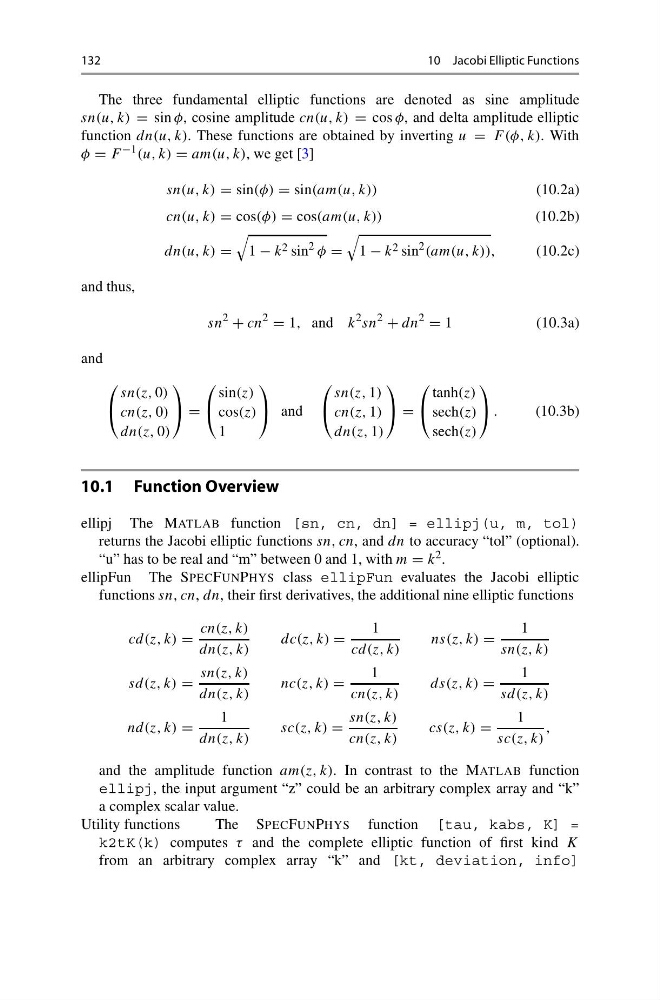
The three fundamental elliptic functions are denoted as sine amplitude
sn(u, k) = sin φ, cosine amplitude cn(u, k) = cos φ, and delta amplitude elliptic
function dn(u, k). These functions are obtained by inverting u = F (φ, k). With
φ = F −1 (u, k) = am(u, k), we get [3]
sn(u, k) = sin(φ) = sin(am(u, k))
(10.2a)
cn(u, k) = cos(φ) = cos(am(u, k))
(10.2b)
dn(u, k) =
1 − k 2 sin
2 φ =
1 − k 2 sin
2 (am(u, k)),
(10.2c)
and thus,
sn
2
+ cn
2
= 1, and k
2 sn
2
+ dn
2
= 1
(10.3a)
and
⎛
⎝
sn(z, 0)
cn(z, 0)
dn(z, 0)
⎞
⎠ =
⎛
⎝
sin(z)
cos(z)
1
⎞
⎠ and
⎛
⎝
sn(z, 1)
cn(z, 1)
dn(z, 1)
⎞
⎠ =
⎛
⎝
tanh(z)
sech(z)
sech(z)
⎞
⎠ .
(10.3b)
10.1 Function Overview
ellipj The MATLAB function [sn, cn, dn] = ellipj(u, m, tol)
returns the Jacobi elliptic functions sn, cn, and dn to accuracy “tol” (optional).
“u” has to be real and “m” between 0 and 1, with m = k 2 .
ellipFun The SPECFUNPHYS class ellipFun evaluates the Jacobi elliptic
functions sn, cn, dn, their first derivatives, the additional nine elliptic functions
cd(z, k) =
cn(z, k)
dn(z, k)
dc(z, k) =
1
cd(z, k)
ns(z, k) =
1
sn(z, k)
sd(z, k) =
sn(z, k)
dn(z, k)
nc(z, k) =
1
cn(z, k)
ds(z, k) =
1
sd(z, k)
nd(z, k) =
1
dn(z, k)
sc(z, k) =
sn(z, k)
cn(z, k)
cs(z, k) =
1
sc(z, k)
,
and the amplitude function am(z, k). In contrast to the MATLAB function
ellipj, the input argument “z” could be an arbitrary complex array and “k”
a complex scalar value.
Utility functions
The SPECFUNPHYS function [tau, kabs, K] =
k2tK(k) computes τ and the complete elliptic function of first kind K
from an arbitrary complex array “k” and [kt, deviation, info]
10 Jacobi Elliptic Functions
The three fundamental elliptic functions are denoted as sine amplitude
sn(u, k) = sin φ, cosine amplitude cn(u, k) = cos φ, and delta amplitude elliptic
function dn(u, k). These functions are obtained by inverting u = F (φ, k). With
φ = F −1 (u, k) = am(u, k), we get [3]
sn(u, k) = sin(φ) = sin(am(u, k))
(10.2a)
cn(u, k) = cos(φ) = cos(am(u, k))
(10.2b)
dn(u, k) =
1 − k 2 sin
2 φ =
1 − k 2 sin
2 (am(u, k)),
(10.2c)
and thus,
sn
2
+ cn
2
= 1, and k
2 sn
2
+ dn
2
= 1
(10.3a)
and
⎛
⎝
sn(z, 0)
cn(z, 0)
dn(z, 0)
⎞
⎠ =
⎛
⎝
sin(z)
cos(z)
1
⎞
⎠ and
⎛
⎝
sn(z, 1)
cn(z, 1)
dn(z, 1)
⎞
⎠ =
⎛
⎝
tanh(z)
sech(z)
sech(z)
⎞
⎠ .
(10.3b)
10.1 Function Overview
ellipj The MATLAB function [sn, cn, dn] = ellipj(u, m, tol)
returns the Jacobi elliptic functions sn, cn, and dn to accuracy “tol” (optional).
“u” has to be real and “m” between 0 and 1, with m = k 2 .
ellipFun The SPECFUNPHYS class ellipFun evaluates the Jacobi elliptic
functions sn, cn, dn, their first derivatives, the additional nine elliptic functions
cd(z, k) =
cn(z, k)
dn(z, k)
dc(z, k) =
1
cd(z, k)
ns(z, k) =
1
sn(z, k)
sd(z, k) =
sn(z, k)
dn(z, k)
nc(z, k) =
1
cn(z, k)
ds(z, k) =
1
sd(z, k)
nd(z, k) =
1
dn(z, k)
sc(z, k) =
sn(z, k)
cn(z, k)
cs(z, k) =
1
sc(z, k)
,
and the amplitude function am(z, k). In contrast to the MATLAB function
ellipj, the input argument “z” could be an arbitrary complex array and “k”
a complex scalar value.
Utility functions
The SPECFUNPHYS function [tau, kabs, K] =
k2tK(k) computes τ and the complete elliptic function of first kind K
from an arbitrary complex array “k” and [kt, deviation, info]