

8.1 The Hypergeometric Series
115
2 F 1 (a, b; c; z) =
Γ (c)Γ (b − a)
Γ (b)Γ (c − a)
(−1) −a z −a
2 F 1 (a, 1 − c + a; 1 − b + a;
1
z
) (8.8)
+
Γ (c)Γ (a − b)
Γ (a)Γ (c − b)
(−1) −b z −b
2 F 1 (b, 1 − c + b; 1 − a + b;
1
z
)
2 F 1 (a, b; c; z) =
Γ (c)Γ (b − a)
Γ (b)Γ (c − a)
(1 − z) −a
2 F 1 (a, c − b; 1 − b + a;
1
1 − z
) (8.9)
+
Γ (c)Γ (a − b)
Γ (a)Γ (c − b)
(1 − z) −b
2 F 1 (b, c − a; 1 − a + b;
1
1 − z
)
2 F 1 (a, b; c; z) =
Γ (c)Γ (c − a − b)
Γ (c − a)Γ (c − b)
z −a
× 2 F 1 (a, a − c + 1; a + b − c + 1; 1 −
1
z
)
(8.10)
+
Γ (c)Γ (a + b − c)
Γ (a)Γ (b)
(1 − z) c−a−b z a−c
× 2 F 1 (c − a, 1 − a; c − a − b + 1; 1 −
1
z
).
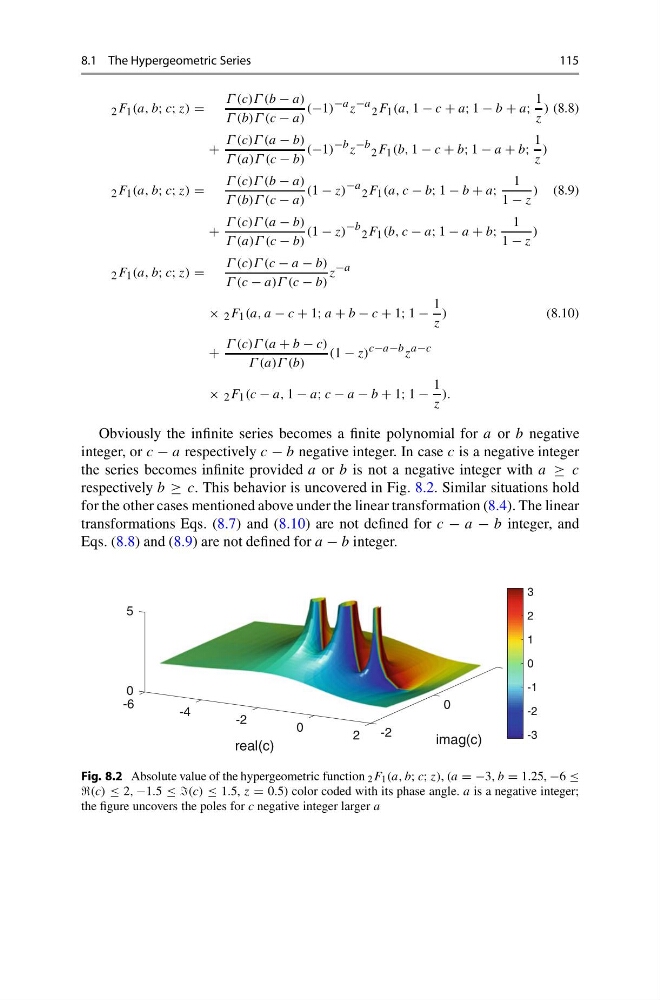
Obviously the infinite series becomes a finite polynomial for a or b negative
integer, or c − a respectively c − b negative integer. In case c is a negative integer
the series becomes infinite provided a or b is not a negative integer with a ≥ c
respectively b ≥ c. This behavior is uncovered in Fig. 8.2. Similar situations hold
for the other cases mentioned above under the linear transformation (8.4). The linear
transformations Eqs. (8.7) and (8.10) are not defined for c − a − b integer, and
Eqs. (8.8) and (8.9) are not defined for a − b integer.
2
0
imag(c)
-6
0
-4
real(c)
-2
0
-2
2
5
-3
-2
-1
0
1
2
3
Fig. 8.2 Absolute value of the hypergeometric function 2 F 1 (a, b; c; z), (a = −3, b = 1.25, −6 ≤
(c) ≤ 2, −1.5 ≤ ≤(c) ≤ 1.5, z = 0.5) color coded with its phase angle. a is a negative integer;
the figure uncovers the poles for c negative integer larger a
115
2 F 1 (a, b; c; z) =
Γ (c)Γ (b − a)
Γ (b)Γ (c − a)
(−1) −a z −a
2 F 1 (a, 1 − c + a; 1 − b + a;
1
z
) (8.8)
+
Γ (c)Γ (a − b)
Γ (a)Γ (c − b)
(−1) −b z −b
2 F 1 (b, 1 − c + b; 1 − a + b;
1
z
)
2 F 1 (a, b; c; z) =
Γ (c)Γ (b − a)
Γ (b)Γ (c − a)
(1 − z) −a
2 F 1 (a, c − b; 1 − b + a;
1
1 − z
) (8.9)
+
Γ (c)Γ (a − b)
Γ (a)Γ (c − b)
(1 − z) −b
2 F 1 (b, c − a; 1 − a + b;
1
1 − z
)
2 F 1 (a, b; c; z) =
Γ (c)Γ (c − a − b)
Γ (c − a)Γ (c − b)
z −a
× 2 F 1 (a, a − c + 1; a + b − c + 1; 1 −
1
z
)
(8.10)
+
Γ (c)Γ (a + b − c)
Γ (a)Γ (b)
(1 − z) c−a−b z a−c
× 2 F 1 (c − a, 1 − a; c − a − b + 1; 1 −
1
z
).
Obviously the infinite series becomes a finite polynomial for a or b negative
integer, or c − a respectively c − b negative integer. In case c is a negative integer
the series becomes infinite provided a or b is not a negative integer with a ≥ c
respectively b ≥ c. This behavior is uncovered in Fig. 8.2. Similar situations hold
for the other cases mentioned above under the linear transformation (8.4). The linear
transformations Eqs. (8.7) and (8.10) are not defined for c − a − b integer, and
Eqs. (8.8) and (8.9) are not defined for a − b integer.
2
0
imag(c)
-6
0
-4
real(c)
-2
0
-2
2
5
-3
-2
-1
0
1
2
3
Fig. 8.2 Absolute value of the hypergeometric function 2 F 1 (a, b; c; z), (a = −3, b = 1.25, −6 ≤
(c) ≤ 2, −1.5 ≤ ≤(c) ≤ 1.5, z = 0.5) color coded with its phase angle. a is a negative integer;
the figure uncovers the poles for c negative integer larger a