

References
111
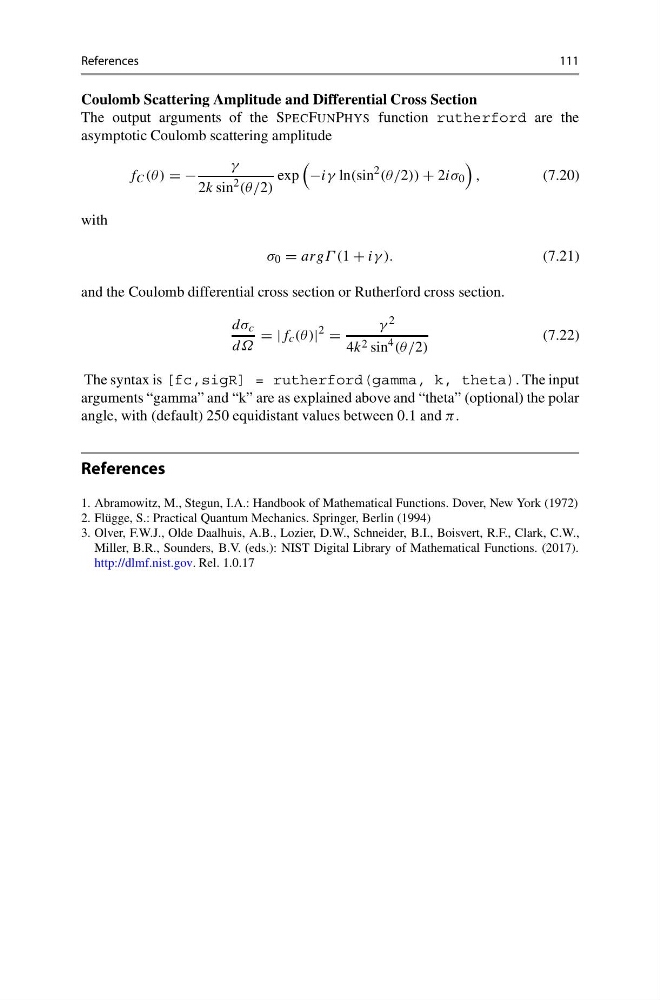
Coulomb Scattering Amplitude and Differential Cross Section
The output arguments of the SPECFUNPHYS function rutherford are the
asymptotic Coulomb scattering amplitude
f C (θ ) = −
γ
2k sin 2 (θ/2)
exp
−iγ ln(sin
2 (θ/2)) + 2iσ 0
,
(7.20)
with
σ 0 = argΓ (1 + iγ ).
(7.21)
and the Coulomb differential cross section or Rutherford cross section.
dσ c
dΩ
= |f c (θ )|
2
=
γ 2
4k 2 sin
4 (θ/2)
(7.22)
The syntax is [fc,sigR] = rutherford(gamma, k, theta). The input
arguments “gamma” and “k” are as explained above and “theta” (optional) the polar
angle, with (default) 250 equidistant values between 0.1 and π.
References
1. Abramowitz, M., Stegun, I.A.: Handbook of Mathematical Functions. Dover, New York (1972)
2. Flügge, S.: Practical Quantum Mechanics. Springer, Berlin (1994)
3. Olver, F.W.J., Olde Daalhuis, A.B., Lozier, D.W., Schneider, B.I., Boisvert, R.F., Clark, C.W.,
Miller, B.R., Sounders, B.V. (eds.): NIST Digital Library of Mathematical Functions. (2017).
http://dlmf.nist.gov. Rel. 1.0.17
111
Coulomb Scattering Amplitude and Differential Cross Section
The output arguments of the SPECFUNPHYS function rutherford are the
asymptotic Coulomb scattering amplitude
f C (θ ) = −
γ
2k sin 2 (θ/2)
exp
−iγ ln(sin
2 (θ/2)) + 2iσ 0
,
(7.20)
with
σ 0 = argΓ (1 + iγ ).
(7.21)
and the Coulomb differential cross section or Rutherford cross section.
dσ c
dΩ
= |f c (θ )|
2
=
γ 2
4k 2 sin
4 (θ/2)
(7.22)
The syntax is [fc,sigR] = rutherford(gamma, k, theta). The input
arguments “gamma” and “k” are as explained above and “theta” (optional) the polar
angle, with (default) 250 equidistant values between 0.1 and π.
References
1. Abramowitz, M., Stegun, I.A.: Handbook of Mathematical Functions. Dover, New York (1972)
2. Flügge, S.: Practical Quantum Mechanics. Springer, Berlin (1994)
3. Olver, F.W.J., Olde Daalhuis, A.B., Lozier, D.W., Schneider, B.I., Boisvert, R.F., Clark, C.W.,
Miller, B.R., Sounders, B.V. (eds.): NIST Digital Library of Mathematical Functions. (2017).
http://dlmf.nist.gov. Rel. 1.0.17