

References
99
0
5
10
15
20
0
20
40
60
80
100
120
140
160
180
200
1
F
1
0
5
10
15
20
-2
-1.5
-1
-0.5
0
0.5
1
1.5
2
M
10
5
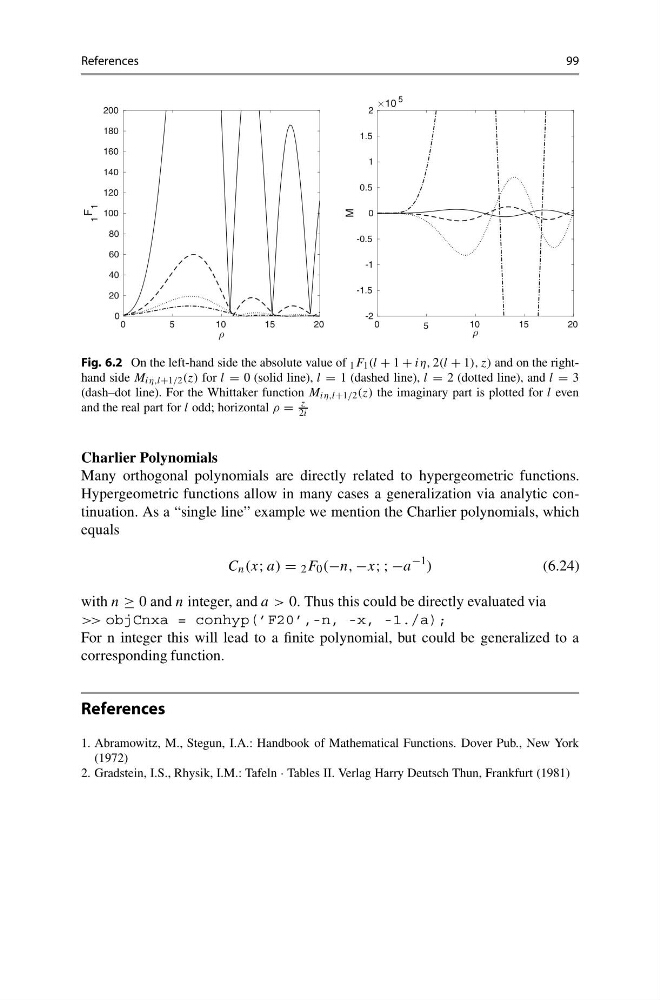
Fig. 6.2 On the left-hand side the absolute value of 1 F 1 (l + 1 + iη, 2(l + 1), z) and on the righthand side M iη,l+1/2 (z) for l = 0 (solid line), l = 1 (dashed line), l = 2 (dotted line), and l = 3
(dash–dot line). For the Whittaker function M iη,l+1/2 (z) the imaginary part is plotted for l even
and the real part for l odd; horizontal ρ =
z
2i
Charlier Polynomials
Many orthogonal polynomials are directly related to hypergeometric functions.
Hypergeometric functions allow in many cases a generalization via analytic continuation. As a “single line” example we mention the Charlier polynomials, which
equals
C n (x; a) = 2 F 0 (−n, −x; ; −a
−1 )
(6.24)
with n ≥ 0 and n integer, and a > 0. Thus this could be directly evaluated via
>> objCnxa = conhyp(’F20’,-n, -x, -1./a);
For n integer this will lead to a finite polynomial, but could be generalized to a
corresponding function.
References
1. Abramowitz, M., Stegun, I.A.: Handbook of Mathematical Functions. Dover Pub., New York
(1972)
2. Gradstein, I.S., Rhysik, I.M.: Tafeln · Tables II. Verlag Harry Deutsch Thun, Frankfurt (1981)
99
0
5
10
15
20
0
20
40
60
80
100
120
140
160
180
200
1
F
1
0
5
10
15
20
-2
-1.5
-1
-0.5
0
0.5
1
1.5
2
M
10
5
Fig. 6.2 On the left-hand side the absolute value of 1 F 1 (l + 1 + iη, 2(l + 1), z) and on the righthand side M iη,l+1/2 (z) for l = 0 (solid line), l = 1 (dashed line), l = 2 (dotted line), and l = 3
(dash–dot line). For the Whittaker function M iη,l+1/2 (z) the imaginary part is plotted for l even
and the real part for l odd; horizontal ρ =
z
2i
Charlier Polynomials
Many orthogonal polynomials are directly related to hypergeometric functions.
Hypergeometric functions allow in many cases a generalization via analytic continuation. As a “single line” example we mention the Charlier polynomials, which
equals
C n (x; a) = 2 F 0 (−n, −x; ; −a
−1 )
(6.24)
with n ≥ 0 and n integer, and a > 0. Thus this could be directly evaluated via
>> objCnxa = conhyp(’F20’,-n, -x, -1./a);
For n integer this will lead to a finite polynomial, but could be generalized to a
corresponding function.
References
1. Abramowitz, M., Stegun, I.A.: Handbook of Mathematical Functions. Dover Pub., New York
(1972)
2. Gradstein, I.S., Rhysik, I.M.: Tafeln · Tables II. Verlag Harry Deutsch Thun, Frankfurt (1981)