

6.4 The SPECFUNPHYS Class conhyp
97
and holds in addition
0 F 1
;
3
2
; −
z 2
4
=
sin(z)
z
(6.20a)
0 F 1
;
1
2
; −
z 2
4
= cos(z).
(6.20b)
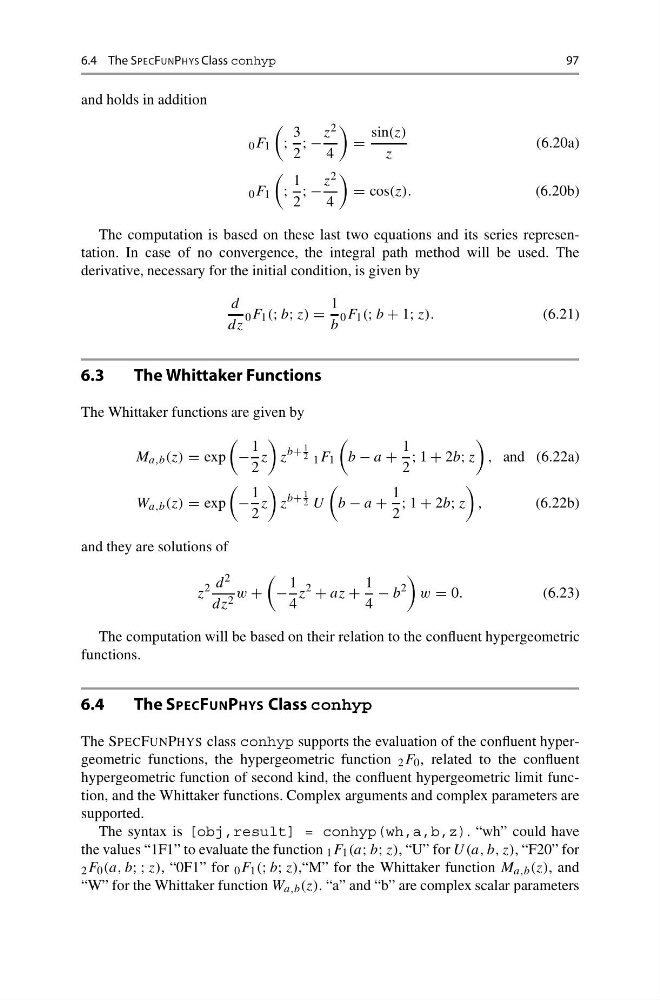
The computation is based on these last two equations and its series representation. In case of no convergence, the integral path method will be used. The
derivative, necessary for the initial condition, is given by
d
dz
0 F 1 (; b; z) =
1
b
0 F 1 (; b + 1; z).
(6.21)
6.3
The Whittaker Functions
The Whittaker functions are given by
M a,b (z) = exp
−
1
2
z
z
b+
1
2 1 F 1
b − a +
1
2
; 1 + 2b; z
, and (6.22a)
W a,b (z) = exp
−
1
2
z
z
b+
1
2 U
b − a +
1
2
; 1 + 2b; z
,
(6.22b)
and they are solutions of
z
2 d 2
dz 2 w +
−
1
4
z
2
+ az +
1
4
− b
2
w = 0.
(6.23)
The computation will be based on their relation to the confluent hypergeometric
functions.
6.4
The SPECFUNPHYS Class conhyp
The SPECFUNPHYS class conhyp supports the evaluation of the confluent hypergeometric functions, the hypergeometric function 2 F 0 , related to the confluent
hypergeometric function of second kind, the confluent hypergeometric limit function, and the Whittaker functions. Complex arguments and complex parameters are
supported.
The syntax is [obj,result] = conhyp(wh,a,b,z). “wh” could have
the values “1F1” to evaluate the function 1 F 1 (a; b; z), “U” for U(a, b, z), “F20” for
2 F 0 (a, b; ; z), “0F1” for 0 F 1 (; b; z),“M” for the Whittaker function M a,b (z), and
“W” for the Whittaker function W a,b (z). “a” and “b” are complex scalar parameters
97
and holds in addition
0 F 1
;
3
2
; −
z 2
4
=
sin(z)
z
(6.20a)
0 F 1
;
1
2
; −
z 2
4
= cos(z).
(6.20b)
The computation is based on these last two equations and its series representation. In case of no convergence, the integral path method will be used. The
derivative, necessary for the initial condition, is given by
d
dz
0 F 1 (; b; z) =
1
b
0 F 1 (; b + 1; z).
(6.21)
6.3
The Whittaker Functions
The Whittaker functions are given by
M a,b (z) = exp
−
1
2
z
z
b+
1
2 1 F 1
b − a +
1
2
; 1 + 2b; z
, and (6.22a)
W a,b (z) = exp
−
1
2
z
z
b+
1
2 U
b − a +
1
2
; 1 + 2b; z
,
(6.22b)
and they are solutions of
z
2 d 2
dz 2 w +
−
1
4
z
2
+ az +
1
4
− b
2
w = 0.
(6.23)
The computation will be based on their relation to the confluent hypergeometric
functions.
6.4
The SPECFUNPHYS Class conhyp
The SPECFUNPHYS class conhyp supports the evaluation of the confluent hypergeometric functions, the hypergeometric function 2 F 0 , related to the confluent
hypergeometric function of second kind, the confluent hypergeometric limit function, and the Whittaker functions. Complex arguments and complex parameters are
supported.
The syntax is [obj,result] = conhyp(wh,a,b,z). “wh” could have
the values “1F1” to evaluate the function 1 F 1 (a; b; z), “U” for U(a, b, z), “F20” for
2 F 0 (a, b; ; z), “0F1” for 0 F 1 (; b; z),“M” for the Whittaker function M a,b (z), and
“W” for the Whittaker function W a,b (z). “a” and “b” are complex scalar parameters