

5.12 Dead Time of Geiger–Müller Counter
87
The actual dead time (T D ) corresponds to a condition when the anode potential
has been lowered down to a value “x”, and the recovery time (T R ) corresponds to
the time that anode would require to regain its original potential from the value “x”.
5.12.3 Correction of Lost Counts
One would appreciate the impact of such dead time on counting a radioactive material
if we take an example. A sample was recorded with a G.M. counter, and its activity
was found to be 40,000 cpm. The counter had a dead time of 400 ms. We know by
the definition, that after every one count recorded by the G.M. counter, the counter
is dead for 400 ms. Therefore, while recording the counts of 40,000 cpm, counter
would have been dead for 40,000 × 400 ms = 16 s. This means that 40,000 counts
were actually observed only in (60 − 16 = 44 s) and not in 60 s. Therefore, actual
number of counts recorded in 60 s should have been (40,000 × 60/44) = 54545.4
cpm. In other words, 54545.4 cpm is the actual count rate recorded by the counter, if
there was no dead time of 400 ms. Therefore, if dead time correction is not made, one
would loose (54545.4 − 40,000 = 15, 454.6 cpm), i.e., a loss of activity by 28.3%.
It is for this reason, that one should find out the dead time of the counter accurately
and then correct the observed count rate by using the Eq. (5.3) as given here:
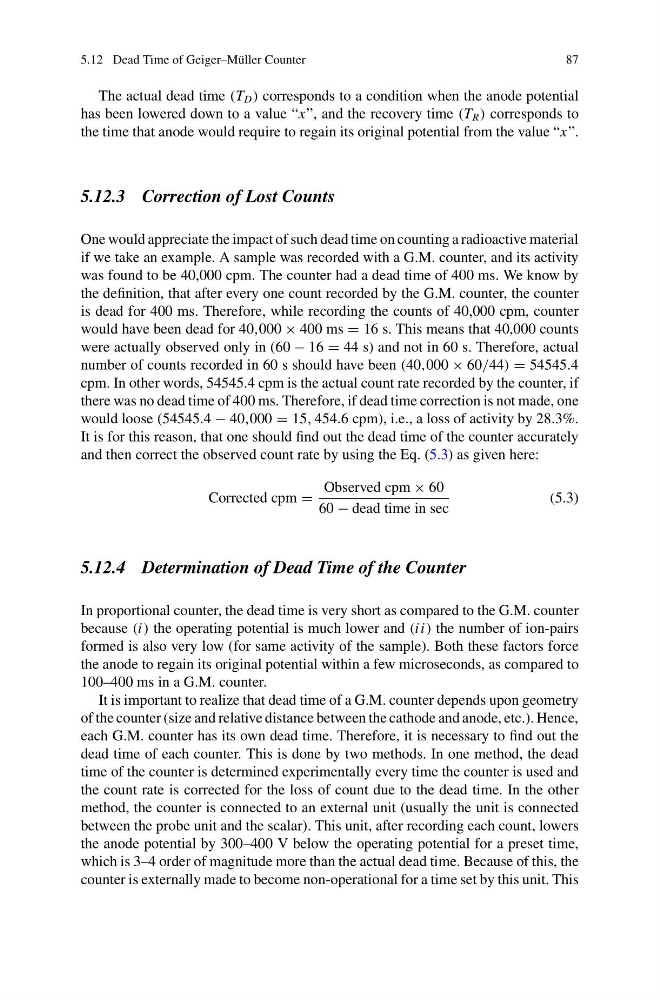
Corrected cpm =
Observed cpm × 60
60 − dead time in sec
(5.3)
5.12.4 Determination of Dead Time of the Counter
In proportional counter, the dead time is very short as compared to the G.M. counter
because (i) the operating potential is much lower and (ii) the number of ion-pairs
formed is also very low (for same activity of the sample). Both these factors force
the anode to regain its original potential within a few microseconds, as compared to
100–400 ms in a G.M. counter.
It is important to realize that dead time of a G.M. counter depends upon geometry
of the counter (size and relative distance between the cathode and anode, etc.). Hence,
each G.M. counter has its own dead time. Therefore, it is necessary to find out the
dead time of each counter. This is done by two methods. In one method, the dead
time of the counter is determined experimentally every time the counter is used and
the count rate is corrected for the loss of count due to the dead time. In the other
method, the counter is connected to an external unit (usually the unit is connected
between the probe unit and the scalar). This unit, after recording each count, lowers
the anode potential by 300–400 V below the operating potential for a preset time,
which is 3–4 order of magnitude more than the actual dead time. Because of this, the
counter is externally made to become non-operational for a time set by this unit. This
87
The actual dead time (T D ) corresponds to a condition when the anode potential
has been lowered down to a value “x”, and the recovery time (T R ) corresponds to
the time that anode would require to regain its original potential from the value “x”.
5.12.3 Correction of Lost Counts
One would appreciate the impact of such dead time on counting a radioactive material
if we take an example. A sample was recorded with a G.M. counter, and its activity
was found to be 40,000 cpm. The counter had a dead time of 400 ms. We know by
the definition, that after every one count recorded by the G.M. counter, the counter
is dead for 400 ms. Therefore, while recording the counts of 40,000 cpm, counter
would have been dead for 40,000 × 400 ms = 16 s. This means that 40,000 counts
were actually observed only in (60 − 16 = 44 s) and not in 60 s. Therefore, actual
number of counts recorded in 60 s should have been (40,000 × 60/44) = 54545.4
cpm. In other words, 54545.4 cpm is the actual count rate recorded by the counter, if
there was no dead time of 400 ms. Therefore, if dead time correction is not made, one
would loose (54545.4 − 40,000 = 15, 454.6 cpm), i.e., a loss of activity by 28.3%.
It is for this reason, that one should find out the dead time of the counter accurately
and then correct the observed count rate by using the Eq. (5.3) as given here:
Corrected cpm =
Observed cpm × 60
60 − dead time in sec
(5.3)
5.12.4 Determination of Dead Time of the Counter
In proportional counter, the dead time is very short as compared to the G.M. counter
because (i) the operating potential is much lower and (ii) the number of ion-pairs
formed is also very low (for same activity of the sample). Both these factors force
the anode to regain its original potential within a few microseconds, as compared to
100–400 ms in a G.M. counter.
It is important to realize that dead time of a G.M. counter depends upon geometry
of the counter (size and relative distance between the cathode and anode, etc.). Hence,
each G.M. counter has its own dead time. Therefore, it is necessary to find out the
dead time of each counter. This is done by two methods. In one method, the dead
time of the counter is determined experimentally every time the counter is used and
the count rate is corrected for the loss of count due to the dead time. In the other
method, the counter is connected to an external unit (usually the unit is connected
between the probe unit and the scalar). This unit, after recording each count, lowers
the anode potential by 300–400 V below the operating potential for a preset time,
which is 3–4 order of magnitude more than the actual dead time. Because of this, the
counter is externally made to become non-operational for a time set by this unit. This