

5.12 Dead Time of Geiger–Müller Counter
85
5.12.2 Impact of Dead Time on the Anode
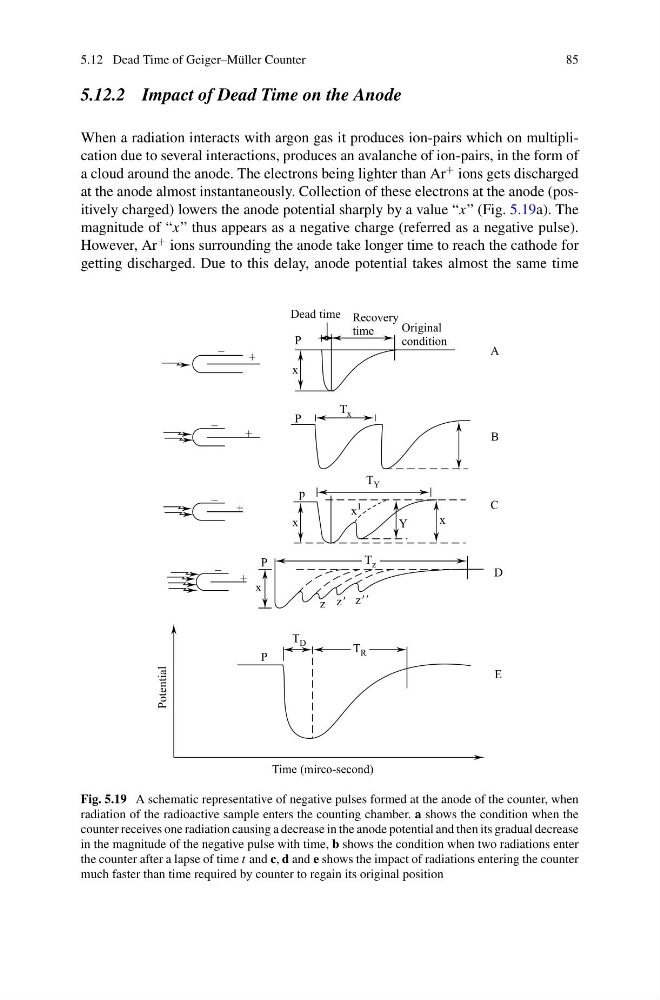
When a radiation interacts with argon gas it produces ion-pairs which on multiplication due to several interactions, produces an avalanche of ion-pairs, in the form of
a cloud around the anode. The electrons being lighter than Ar
+ ions gets discharged
at the anode almost instantaneously. Collection of these electrons at the anode (positively charged) lowers the anode potential sharply by a value “x” (Fig. 5.19a). The
magnitude of “x” thus appears as a negative charge (referred as a negative pulse).
However, Ar
+ ions surrounding the anode take longer time to reach the cathode for
getting discharged. Due to this delay, anode potential takes almost the same time
–
+
Y
x
x
1
x
p
T Y
C
–
+
P
T x
B
–
+
x
P
Dead time Recovery
time
Original
condition
A
T D
T R
E
Time (mirco-second)
Potential
P
T z
P
x
z z z
D
–
+
Fig. 5.19 A schematic representative of negative pulses formed at the anode of the counter, when
radiation of the radioactive sample enters the counting chamber. a shows the condition when the
counter receives one radiation causing a decrease in the anode potential and then its gradual decrease
in the magnitude of the negative pulse with time, b shows the condition when two radiations enter
the counter after a lapse of time t and c, d and e shows the impact of radiations entering the counter
much faster than time required by counter to regain its original position
85
5.12.2 Impact of Dead Time on the Anode
When a radiation interacts with argon gas it produces ion-pairs which on multiplication due to several interactions, produces an avalanche of ion-pairs, in the form of
a cloud around the anode. The electrons being lighter than Ar
+ ions gets discharged
at the anode almost instantaneously. Collection of these electrons at the anode (positively charged) lowers the anode potential sharply by a value “x” (Fig. 5.19a). The
magnitude of “x” thus appears as a negative charge (referred as a negative pulse).
However, Ar
+ ions surrounding the anode take longer time to reach the cathode for
getting discharged. Due to this delay, anode potential takes almost the same time
–
+
Y
x
x
1
x
p
T Y
C
–
+
P
T x
B
–
+
x
P
Dead time Recovery
time
Original
condition
A
T D
T R
E
Time (mirco-second)
Potential
P
T z
P
x
z z z
D
–
+
Fig. 5.19 A schematic representative of negative pulses formed at the anode of the counter, when
radiation of the radioactive sample enters the counting chamber. a shows the condition when the
counter receives one radiation causing a decrease in the anode potential and then its gradual decrease
in the magnitude of the negative pulse with time, b shows the condition when two radiations enter
the counter after a lapse of time t and c, d and e shows the impact of radiations entering the counter
much faster than time required by counter to regain its original position