

76
5 Ionization Counters
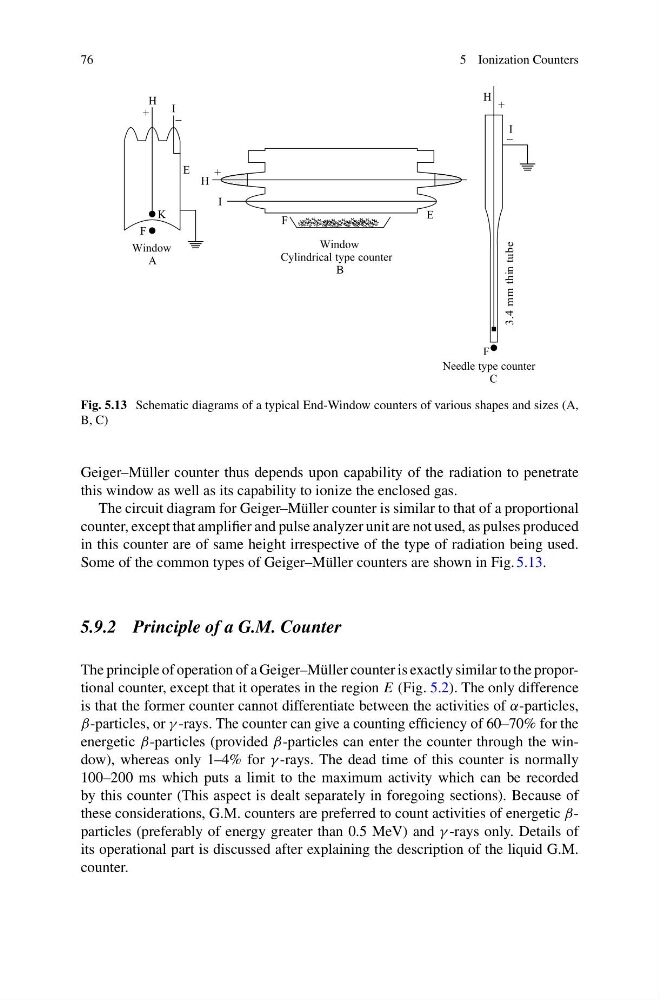
Fig. 5.13 Schematic diagrams of a typical End-Window counters of various shapes and sizes (A,
B, C)
Geiger–Müller counter thus depends upon capability of the radiation to penetrate
this window as well as its capability to ionize the enclosed gas.
The circuit diagram for Geiger–Müller counter is similar to that of a proportional
counter, except that amplifier and pulse analyzer unit are not used, as pulses produced
in this counter are of same height irrespective of the type of radiation being used.
Some of the common types of Geiger–Müller counters are shown in Fig. 5.13.
5.9.2 Principle of a G.M. Counter
The principle of operation of a Geiger–Müller counter is exactly similar to the proportional counter, except that it operates in the region E (Fig. 5.2). The only difference
is that the former counter cannot differentiate between the activities of α-particles,
β-particles, or γ -rays. The counter can give a counting efficiency of 60–70% for the
energetic β-particles (provided β-particles can enter the counter through the window), whereas only 1–4% for γ -rays. The dead time of this counter is normally
100–200 ms which puts a limit to the maximum activity which can be recorded
by this counter (This aspect is dealt separately in foregoing sections). Because of
these considerations, G.M. counters are preferred to count activities of energetic βparticles (preferably of energy greater than 0.5 MeV) and γ -rays only. Details of
its operational part is discussed after explaining the description of the liquid G.M.
counter.
5 Ionization Counters
Fig. 5.13 Schematic diagrams of a typical End-Window counters of various shapes and sizes (A,
B, C)
Geiger–Müller counter thus depends upon capability of the radiation to penetrate
this window as well as its capability to ionize the enclosed gas.
The circuit diagram for Geiger–Müller counter is similar to that of a proportional
counter, except that amplifier and pulse analyzer unit are not used, as pulses produced
in this counter are of same height irrespective of the type of radiation being used.
Some of the common types of Geiger–Müller counters are shown in Fig. 5.13.
5.9.2 Principle of a G.M. Counter
The principle of operation of a Geiger–Müller counter is exactly similar to the proportional counter, except that it operates in the region E (Fig. 5.2). The only difference
is that the former counter cannot differentiate between the activities of α-particles,
β-particles, or γ -rays. The counter can give a counting efficiency of 60–70% for the
energetic β-particles (provided β-particles can enter the counter through the window), whereas only 1–4% for γ -rays. The dead time of this counter is normally
100–200 ms which puts a limit to the maximum activity which can be recorded
by this counter (This aspect is dealt separately in foregoing sections). Because of
these considerations, G.M. counters are preferred to count activities of energetic βparticles (preferably of energy greater than 0.5 MeV) and γ -rays only. Details of
its operational part is discussed after explaining the description of the liquid G.M.
counter.