

74
5 Ionization Counters
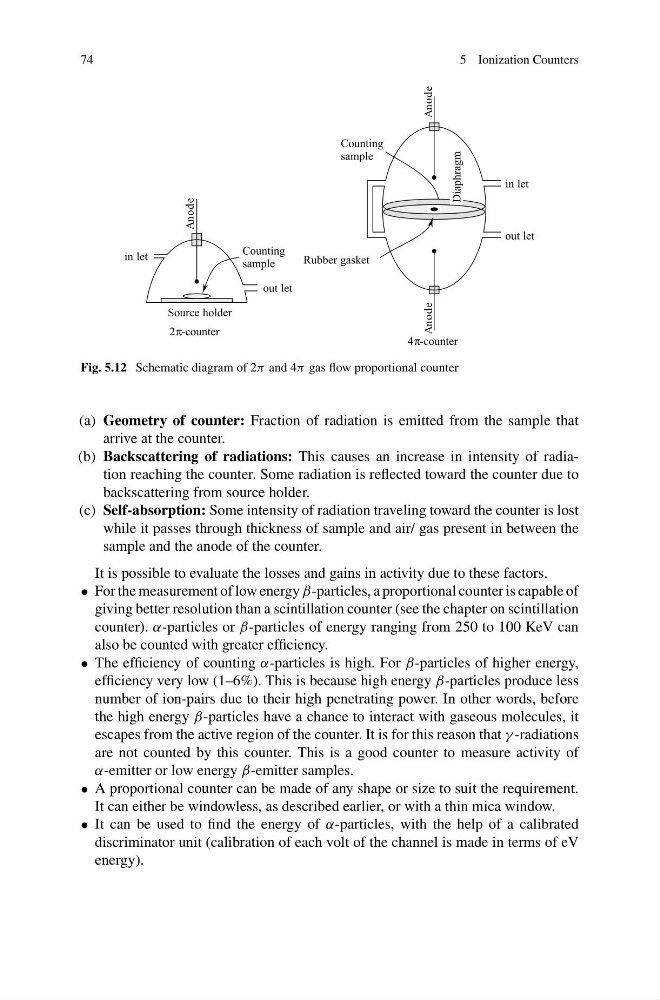
Fig. 5.12 Schematic diagram of 2π and 4π gas flow proportional counter
(a) Geometry of counter: Fraction of radiation is emitted from the sample that
arrive at the counter.
(b) Backscattering of radiations: This causes an increase in intensity of radiation reaching the counter. Some radiation is reflected toward the counter due to
backscattering from source holder.
(c) Self-absorption: Some intensity of radiation traveling toward the counter is lost
while it passes through thickness of sample and air/ gas present in between the
sample and the anode of the counter.
It is possible to evaluate the losses and gains in activity due to these factors.
• For the measurement of low energy β-particles, a proportional counter is capable of
giving better resolution than a scintillation counter (see the chapter on scintillation
counter). α-particles or β-particles of energy ranging from 250 to 100 KeV can
also be counted with greater efficiency.
• The efficiency of counting α-particles is high. For β-particles of higher energy,
efficiency very low (1–6%). This is because high energy β-particles produce less
number of ion-pairs due to their high penetrating power. In other words, before
the high energy β-particles have a chance to interact with gaseous molecules, it
escapes from the active region of the counter. It is for this reason that γ -radiations
are not counted by this counter. This is a good counter to measure activity of
α-emitter or low energy β-emitter samples.
• A proportional counter can be made of any shape or size to suit the requirement.
It can either be windowless, as described earlier, or with a thin mica window.
• It can be used to find the energy of α-particles, with the help of a calibrated
discriminator unit (calibration of each volt of the channel is made in terms of eV
energy).
5 Ionization Counters
Fig. 5.12 Schematic diagram of 2π and 4π gas flow proportional counter
(a) Geometry of counter: Fraction of radiation is emitted from the sample that
arrive at the counter.
(b) Backscattering of radiations: This causes an increase in intensity of radiation reaching the counter. Some radiation is reflected toward the counter due to
backscattering from source holder.
(c) Self-absorption: Some intensity of radiation traveling toward the counter is lost
while it passes through thickness of sample and air/ gas present in between the
sample and the anode of the counter.
It is possible to evaluate the losses and gains in activity due to these factors.
• For the measurement of low energy β-particles, a proportional counter is capable of
giving better resolution than a scintillation counter (see the chapter on scintillation
counter). α-particles or β-particles of energy ranging from 250 to 100 KeV can
also be counted with greater efficiency.
• The efficiency of counting α-particles is high. For β-particles of higher energy,
efficiency very low (1–6%). This is because high energy β-particles produce less
number of ion-pairs due to their high penetrating power. In other words, before
the high energy β-particles have a chance to interact with gaseous molecules, it
escapes from the active region of the counter. It is for this reason that γ -radiations
are not counted by this counter. This is a good counter to measure activity of
α-emitter or low energy β-emitter samples.
• A proportional counter can be made of any shape or size to suit the requirement.
It can either be windowless, as described earlier, or with a thin mica window.
• It can be used to find the energy of α-particles, with the help of a calibrated
discriminator unit (calibration of each volt of the channel is made in terms of eV
energy).