

40
3 Nuclear Reaction
Many radioactive nuclei are produced by (n, γ ) reaction in the nuclear reactor. In
such cases, atom B is isotope mixed with atom A, and its specific activity is based
on the unit weight of the target material. By interconversion of units, Eq. (3.3) can
further be written in terms of activity of atom B produced:
A B =
0.602ωφσ f
3.7 × 10 10 A
1 − e
−0.693t
t 0.5
(3.4)
where
A B = activity of nuclei B produced at time “t” in curies
ω = weight of target material
φ = isotopic abundance of nuclei which will produce the atom sought
for
A = atomic weight of target material
t = time of radiation, and
t 0.5 = half-life of isotope produced
A critical inspection of Eq. (3.4) can give a valuable information. In this equation,
the term:
0.602ωφσ f
3.7 × 10 10 A
(3.5)
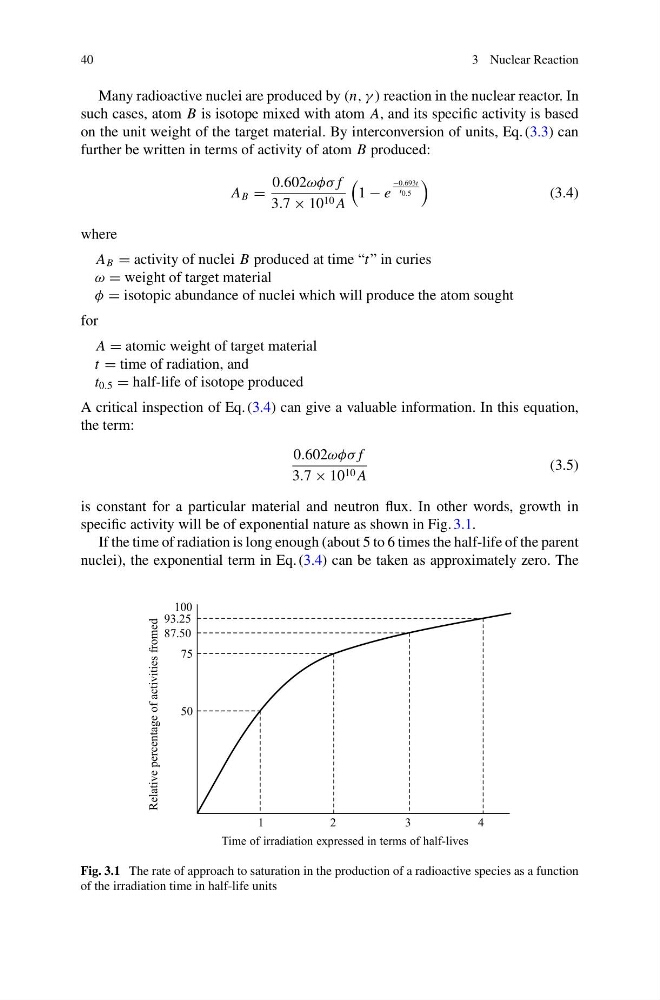
is constant for a particular material and neutron flux. In other words, growth in
specific activity will be of exponential nature as shown in Fig. 3.1.
If the time of radiation is long enough (about 5 to 6 times the half-life of the parent
nuclei), the exponential term in Eq. (3.4) can be taken as approximately zero. The
100
93.25
87.50
75
50
1
2
3
4
Time of irradiation expressed in terms of half-lives
Relative percentage of activities fromed
Fig. 3.1 The rate of approach to saturation in the production of a radioactive species as a function
of the irradiation time in half-life units
3 Nuclear Reaction
Many radioactive nuclei are produced by (n, γ ) reaction in the nuclear reactor. In
such cases, atom B is isotope mixed with atom A, and its specific activity is based
on the unit weight of the target material. By interconversion of units, Eq. (3.3) can
further be written in terms of activity of atom B produced:
A B =
0.602ωφσ f
3.7 × 10 10 A
1 − e
−0.693t
t 0.5
(3.4)
where
A B = activity of nuclei B produced at time “t” in curies
ω = weight of target material
φ = isotopic abundance of nuclei which will produce the atom sought
for
A = atomic weight of target material
t = time of radiation, and
t 0.5 = half-life of isotope produced
A critical inspection of Eq. (3.4) can give a valuable information. In this equation,
the term:
0.602ωφσ f
3.7 × 10 10 A
(3.5)
is constant for a particular material and neutron flux. In other words, growth in
specific activity will be of exponential nature as shown in Fig. 3.1.
If the time of radiation is long enough (about 5 to 6 times the half-life of the parent
nuclei), the exponential term in Eq. (3.4) can be taken as approximately zero. The
100
93.25
87.50
75
50
1
2
3
4
Time of irradiation expressed in terms of half-lives
Relative percentage of activities fromed
Fig. 3.1 The rate of approach to saturation in the production of a radioactive species as a function
of the irradiation time in half-life units