

2.6 Decay Scheme
29
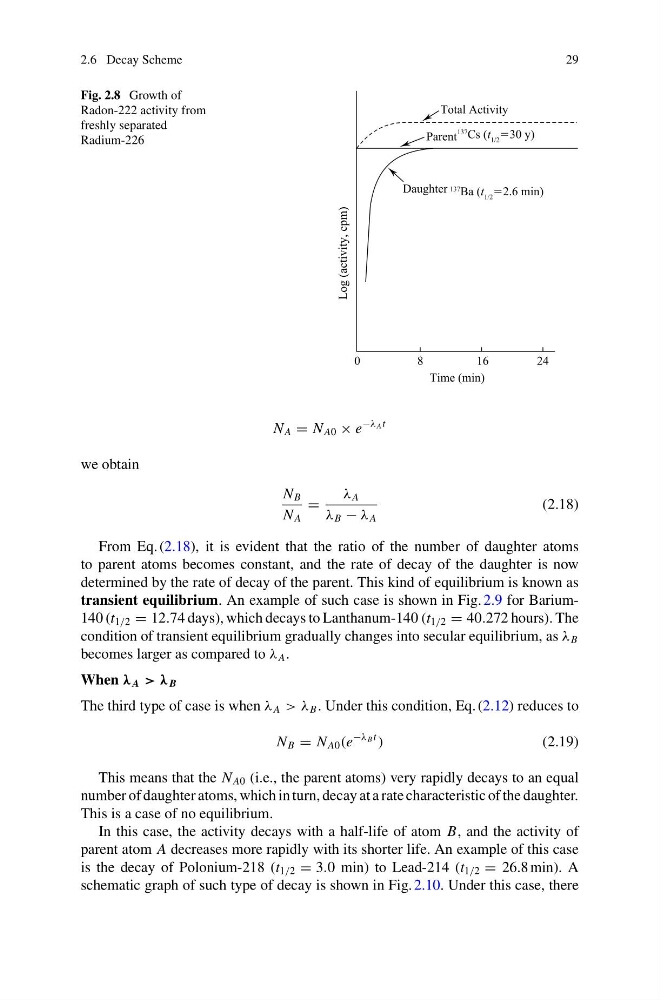
Fig. 2.8 Growth of
Radon-222 activity from
freshly separated
Radium-226
N A = N A0 × e
−λ A t
we obtain
N B
N A
=
λ A
λ B − λ A
(2.18)
From Eq. (2.18), it is evident that the ratio of the number of daughter atoms
to parent atoms becomes constant, and the rate of decay of the daughter is now
determined by the rate of decay of the parent. This kind of equilibrium is known as
transient equilibrium. An example of such case is shown in Fig. 2.9 for Barium140 (t 1/2 = 12.74 days), which decays to Lanthanum-140 (t 1/2 = 40.272 hours). The
condition of transient equilibrium gradually changes into secular equilibrium, as λ B
becomes larger as compared to λ A .
When λ A > λ B
The third type of case is when λ A > λ B . Under this condition, Eq. (2.12) reduces to
N B = N A0 (e
−λ B t
)
(2.19)
This means that the N A0 (i.e., the parent atoms) very rapidly decays to an equal
number of daughter atoms, which in turn, decay at a rate characteristic of the daughter.
This is a case of no equilibrium.
In this case, the activity decays with a half-life of atom B, and the activity of
parent atom A decreases more rapidly with its shorter life. An example of this case
is the decay of Polonium-218 (t 1/2 = 3.0 min) to Lead-214 (t 1/2 = 26.8 min). A
schematic graph of such type of decay is shown in Fig. 2.10. Under this case, there
29
Fig. 2.8 Growth of
Radon-222 activity from
freshly separated
Radium-226
N A = N A0 × e
−λ A t
we obtain
N B
N A
=
λ A
λ B − λ A
(2.18)
From Eq. (2.18), it is evident that the ratio of the number of daughter atoms
to parent atoms becomes constant, and the rate of decay of the daughter is now
determined by the rate of decay of the parent. This kind of equilibrium is known as
transient equilibrium. An example of such case is shown in Fig. 2.9 for Barium140 (t 1/2 = 12.74 days), which decays to Lanthanum-140 (t 1/2 = 40.272 hours). The
condition of transient equilibrium gradually changes into secular equilibrium, as λ B
becomes larger as compared to λ A .
When λ A > λ B
The third type of case is when λ A > λ B . Under this condition, Eq. (2.12) reduces to
N B = N A0 (e
−λ B t
)
(2.19)
This means that the N A0 (i.e., the parent atoms) very rapidly decays to an equal
number of daughter atoms, which in turn, decay at a rate characteristic of the daughter.
This is a case of no equilibrium.
In this case, the activity decays with a half-life of atom B, and the activity of
parent atom A decreases more rapidly with its shorter life. An example of this case
is the decay of Polonium-218 (t 1/2 = 3.0 min) to Lead-214 (t 1/2 = 26.8 min). A
schematic graph of such type of decay is shown in Fig. 2.10. Under this case, there