

24
2 Radioactivity
2.6 Decay Scheme
The nature of decay of many radioactive isotopes has been experimentally determined
and is available in the form of a decay scheme. A decay scheme is an energy level
diagram representing the manner in which a radioactive nucleus decays to another
species. This decay scheme helps to understand the nature of decay, energy of the
radiation emitted by the isotope, % of decay in the particular mode (because many
radioactive isotopes decay by more than one mode of decay), half- life of the isotope,
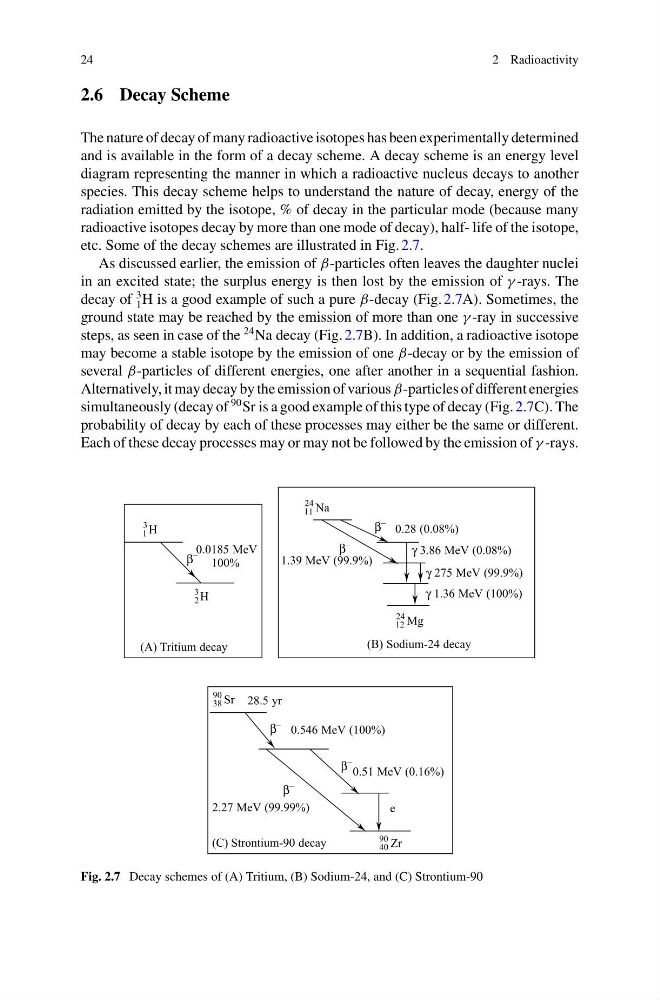
etc. Some of the decay schemes are illustrated in Fig. 2.7.
As discussed earlier, the emission of β-particles often leaves the daughter nuclei
in an excited state; the surplus energy is then lost by the emission of γ -rays. The
decay of
3
1 H is a good example of such a pure β-decay (Fig. 2.7A). Sometimes, the
ground state may be reached by the emission of more than one γ -ray in successive
steps, as seen in case of the
24 Na decay (Fig. 2.7B). In addition, a radioactive isotope
may become a stable isotope by the emission of one β-decay or by the emission of
several β-particles of different energies, one after another in a sequential fashion.
Alternatively, it may decay by the emission of various β-particles of different energies
simultaneously (decay of
90 Sr is a good example of this type of decay (Fig. 2.7C). The
probability of decay by each of these processes may either be the same or different.
Each of these decay processes may or may not be followed by the emission of γ -rays.
Fig. 2.7 Decay schemes of (A) Tritium, (B) Sodium-24, and (C) Strontium-90
2 Radioactivity
2.6 Decay Scheme
The nature of decay of many radioactive isotopes has been experimentally determined
and is available in the form of a decay scheme. A decay scheme is an energy level
diagram representing the manner in which a radioactive nucleus decays to another
species. This decay scheme helps to understand the nature of decay, energy of the
radiation emitted by the isotope, % of decay in the particular mode (because many
radioactive isotopes decay by more than one mode of decay), half- life of the isotope,
etc. Some of the decay schemes are illustrated in Fig. 2.7.
As discussed earlier, the emission of β-particles often leaves the daughter nuclei
in an excited state; the surplus energy is then lost by the emission of γ -rays. The
decay of
3
1 H is a good example of such a pure β-decay (Fig. 2.7A). Sometimes, the
ground state may be reached by the emission of more than one γ -ray in successive
steps, as seen in case of the
24 Na decay (Fig. 2.7B). In addition, a radioactive isotope
may become a stable isotope by the emission of one β-decay or by the emission of
several β-particles of different energies, one after another in a sequential fashion.
Alternatively, it may decay by the emission of various β-particles of different energies
simultaneously (decay of
90 Sr is a good example of this type of decay (Fig. 2.7C). The
probability of decay by each of these processes may either be the same or different.
Each of these decay processes may or may not be followed by the emission of γ -rays.
Fig. 2.7 Decay schemes of (A) Tritium, (B) Sodium-24, and (C) Strontium-90