

22
2 Radioactivity
0.662 MeV
B
A
Pulse height (V)
Activity (cpm)
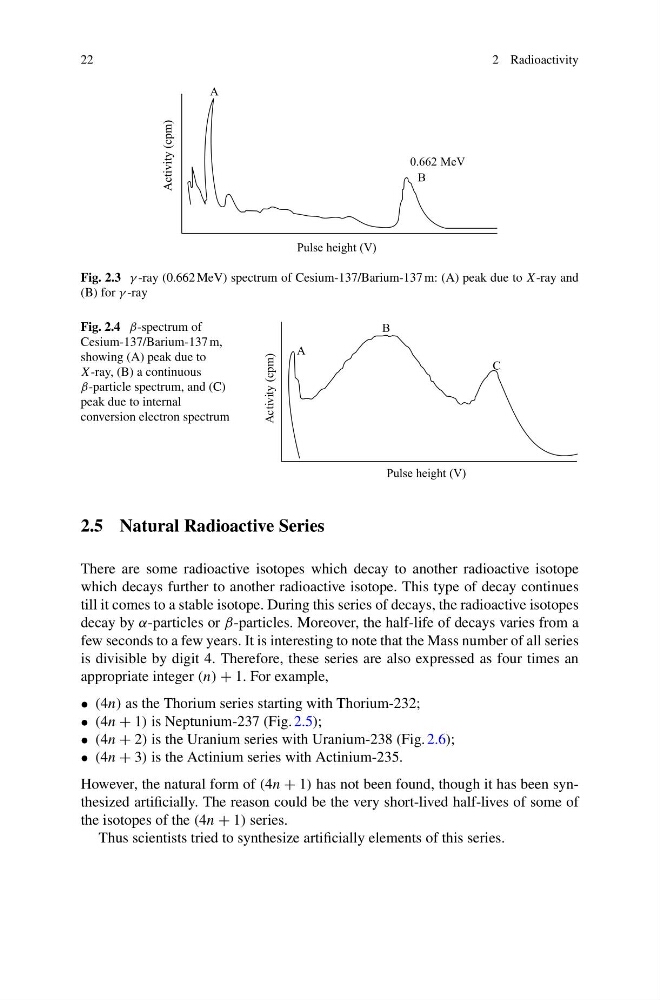
Fig. 2.3 γ -ray (0.662 MeV) spectrum of Cesium-137/Barium-137 m: (A) peak due to X -ray and
(B) for γ -ray
Fig. 2.4 β-spectrum of
Cesium-137/Barium-137 m,
showing (A) peak due to
X -ray, (B) a continuous
β-particle spectrum, and (C)
peak due to internal
conversion electron spectrum
A
B
C
)
m
p
c
(
y
Activit
Pulse height (V)
2.5 Natural Radioactive Series
There are some radioactive isotopes which decay to another radioactive isotope
which decays further to another radioactive isotope. This type of decay continues
till it comes to a stable isotope. During this series of decays, the radioactive isotopes
decay by α-particles or β-particles. Moreover, the half-life of decays varies from a
few seconds to a few years. It is interesting to note that the Mass number of all series
is divisible by digit 4. Therefore, these series are also expressed as four times an
appropriate integer (n) + 1. For example,
• (4n) as the Thorium series starting with Thorium-232;
• (4n + 1) is Neptunium-237 (Fig. 2.5);
• (4n + 2) is the Uranium series with Uranium-238 (Fig. 2.6);
• (4n + 3) is the Actinium series with Actinium-235.
However, the natural form of (4n + 1) has not been found, though it has been synthesized artificially. The reason could be the very short-lived half-lives of some of
the isotopes of the (4n + 1) series.
Thus scientists tried to synthesize artificially elements of this series.
2 Radioactivity
0.662 MeV
B
A
Pulse height (V)
Activity (cpm)
Fig. 2.3 γ -ray (0.662 MeV) spectrum of Cesium-137/Barium-137 m: (A) peak due to X -ray and
(B) for γ -ray
Fig. 2.4 β-spectrum of
Cesium-137/Barium-137 m,
showing (A) peak due to
X -ray, (B) a continuous
β-particle spectrum, and (C)
peak due to internal
conversion electron spectrum
A
B
C
)
m
p
c
(
y
Activit
Pulse height (V)
2.5 Natural Radioactive Series
There are some radioactive isotopes which decay to another radioactive isotope
which decays further to another radioactive isotope. This type of decay continues
till it comes to a stable isotope. During this series of decays, the radioactive isotopes
decay by α-particles or β-particles. Moreover, the half-life of decays varies from a
few seconds to a few years. It is interesting to note that the Mass number of all series
is divisible by digit 4. Therefore, these series are also expressed as four times an
appropriate integer (n) + 1. For example,
• (4n) as the Thorium series starting with Thorium-232;
• (4n + 1) is Neptunium-237 (Fig. 2.5);
• (4n + 2) is the Uranium series with Uranium-238 (Fig. 2.6);
• (4n + 3) is the Actinium series with Actinium-235.
However, the natural form of (4n + 1) has not been found, though it has been synthesized artificially. The reason could be the very short-lived half-lives of some of
the isotopes of the (4n + 1) series.
Thus scientists tried to synthesize artificially elements of this series.