

20
2 Radioactivity
Unknown
Eu
Sm
Pm
Pr
Nd
Ce
La
Ba
Cs
Xe
52
54
56
58
60
62
64
Neutron Number
Binding Energy (MeV)
1160
1170
1180
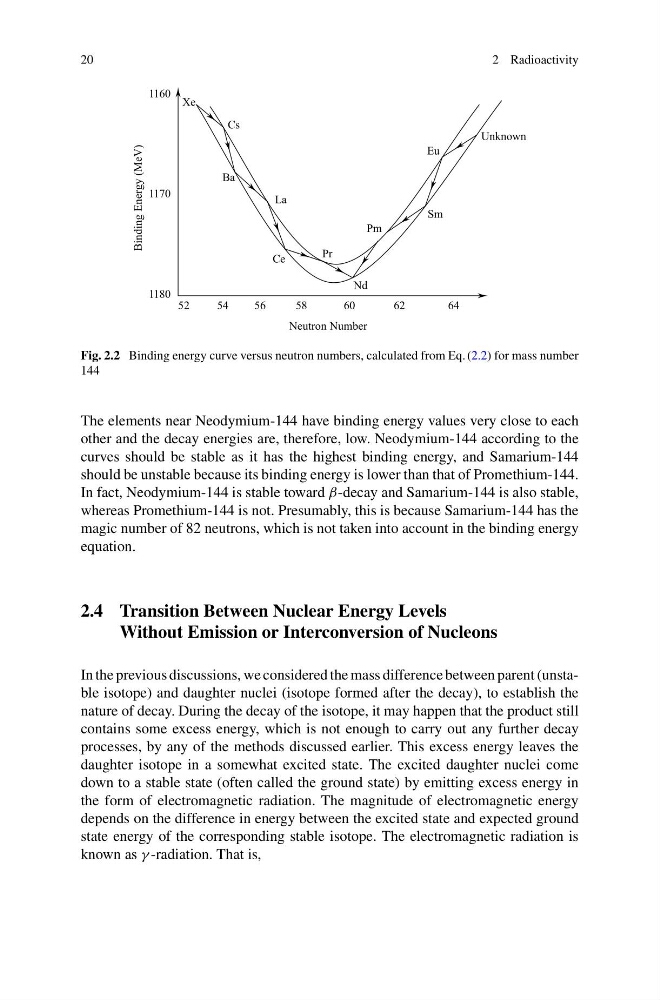
Fig. 2.2 Binding energy curve versus neutron numbers, calculated from Eq. (2.2) for mass number
144
The elements near Neodymium-144 have binding energy values very close to each
other and the decay energies are, therefore, low. Neodymium-144 according to the
curves should be stable as it has the highest binding energy, and Samarium-144
should be unstable because its binding energy is lower than that of Promethium-144.
In fact, Neodymium-144 is stable toward β-decay and Samarium-144 is also stable,
whereas Promethium-144 is not. Presumably, this is because Samarium-144 has the
magic number of 82 neutrons, which is not taken into account in the binding energy
equation.
2.4 Transition Between Nuclear Energy Levels
Without Emission or Interconversion of Nucleons
In the previous discussions, we considered the mass difference between parent (unstable isotope) and daughter nuclei (isotope formed after the decay), to establish the
nature of decay. During the decay of the isotope, it may happen that the product still
contains some excess energy, which is not enough to carry out any further decay
processes, by any of the methods discussed earlier. This excess energy leaves the
daughter isotope in a somewhat excited state. The excited daughter nuclei come
down to a stable state (often called the ground state) by emitting excess energy in
the form of electromagnetic radiation. The magnitude of electromagnetic energy
depends on the difference in energy between the excited state and expected ground
state energy of the corresponding stable isotope. The electromagnetic radiation is
known as γ -radiation. That is,
2 Radioactivity
Unknown
Eu
Sm
Pm
Pr
Nd
Ce
La
Ba
Cs
Xe
52
54
56
58
60
62
64
Neutron Number
Binding Energy (MeV)
1160
1170
1180
Fig. 2.2 Binding energy curve versus neutron numbers, calculated from Eq. (2.2) for mass number
144
The elements near Neodymium-144 have binding energy values very close to each
other and the decay energies are, therefore, low. Neodymium-144 according to the
curves should be stable as it has the highest binding energy, and Samarium-144
should be unstable because its binding energy is lower than that of Promethium-144.
In fact, Neodymium-144 is stable toward β-decay and Samarium-144 is also stable,
whereas Promethium-144 is not. Presumably, this is because Samarium-144 has the
magic number of 82 neutrons, which is not taken into account in the binding energy
equation.
2.4 Transition Between Nuclear Energy Levels
Without Emission or Interconversion of Nucleons
In the previous discussions, we considered the mass difference between parent (unstable isotope) and daughter nuclei (isotope formed after the decay), to establish the
nature of decay. During the decay of the isotope, it may happen that the product still
contains some excess energy, which is not enough to carry out any further decay
processes, by any of the methods discussed earlier. This excess energy leaves the
daughter isotope in a somewhat excited state. The excited daughter nuclei come
down to a stable state (often called the ground state) by emitting excess energy in
the form of electromagnetic radiation. The magnitude of electromagnetic energy
depends on the difference in energy between the excited state and expected ground
state energy of the corresponding stable isotope. The electromagnetic radiation is
known as γ -radiation. That is,