

10
1 Nuclear Chemistry
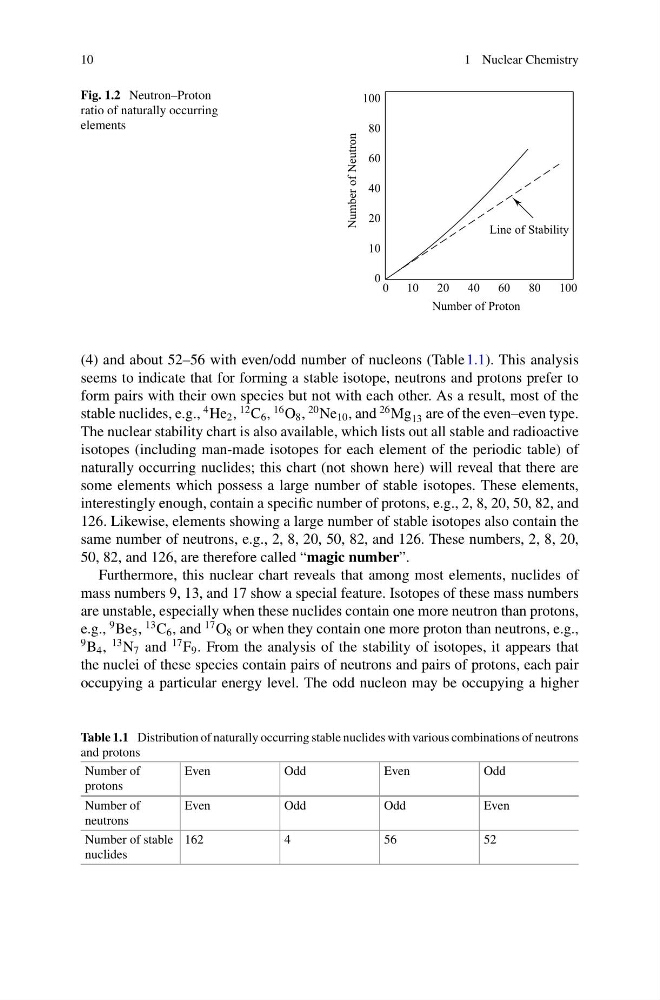
Fig. 1.2 Neutron–Proton
ratio of naturally occurring
elements
0
10
20
40
60
80
100
Line of Stability
Number of Proton
0 10
20
40
60
80
100
Number of Neutron
(4) and about 52–56 with even/odd number of nucleons (Table 1.1). This analysis
seems to indicate that for forming a stable isotope, neutrons and protons prefer to
form pairs with their own species but not with each other. As a result, most of the
stable nuclides, e.g.,
4 He 2 ,
12 C 6 ,
16 O 8 ,
20 Ne 10 , and
26 Mg 13 are of the even–even type.
The nuclear stability chart is also available, which lists out all stable and radioactive
isotopes (including man-made isotopes for each element of the periodic table) of
naturally occurring nuclides; this chart (not shown here) will reveal that there are
some elements which possess a large number of stable isotopes. These elements,
interestingly enough, contain a specific number of protons, e.g., 2, 8, 20, 50, 82, and
126. Likewise, elements showing a large number of stable isotopes also contain the
same number of neutrons, e.g., 2, 8, 20, 50, 82, and 126. These numbers, 2, 8, 20,
50, 82, and 126, are therefore called “magic number”.
Furthermore, this nuclear chart reveals that among most elements, nuclides of
mass numbers 9, 13, and 17 show a special feature. Isotopes of these mass numbers
are unstable, especially when these nuclides contain one more neutron than protons,
e.g.,
9 Be 5 ,
13 C 6 , and
17 O 8 or when they contain one more proton than neutrons, e.g.,
9 B 4 ,
13 N 7 and
17 F 9 . From the analysis of the stability of isotopes, it appears that
the nuclei of these species contain pairs of neutrons and pairs of protons, each pair
occupying a particular energy level. The odd nucleon may be occupying a higher
Table 1.1 Distribution of naturally occurring stable nuclides with various combinations of neutrons
and protons
Number of
protons
Even
Odd
Even
Odd
Number of
neutrons
Even
Odd
Odd
Even
Number of stable
nuclides
162
4
56
52
1 Nuclear Chemistry
Fig. 1.2 Neutron–Proton
ratio of naturally occurring
elements
0
10
20
40
60
80
100
Line of Stability
Number of Proton
0 10
20
40
60
80
100
Number of Neutron
(4) and about 52–56 with even/odd number of nucleons (Table 1.1). This analysis
seems to indicate that for forming a stable isotope, neutrons and protons prefer to
form pairs with their own species but not with each other. As a result, most of the
stable nuclides, e.g.,
4 He 2 ,
12 C 6 ,
16 O 8 ,
20 Ne 10 , and
26 Mg 13 are of the even–even type.
The nuclear stability chart is also available, which lists out all stable and radioactive
isotopes (including man-made isotopes for each element of the periodic table) of
naturally occurring nuclides; this chart (not shown here) will reveal that there are
some elements which possess a large number of stable isotopes. These elements,
interestingly enough, contain a specific number of protons, e.g., 2, 8, 20, 50, 82, and
126. Likewise, elements showing a large number of stable isotopes also contain the
same number of neutrons, e.g., 2, 8, 20, 50, 82, and 126. These numbers, 2, 8, 20,
50, 82, and 126, are therefore called “magic number”.
Furthermore, this nuclear chart reveals that among most elements, nuclides of
mass numbers 9, 13, and 17 show a special feature. Isotopes of these mass numbers
are unstable, especially when these nuclides contain one more neutron than protons,
e.g.,
9 Be 5 ,
13 C 6 , and
17 O 8 or when they contain one more proton than neutrons, e.g.,
9 B 4 ,
13 N 7 and
17 F 9 . From the analysis of the stability of isotopes, it appears that
the nuclei of these species contain pairs of neutrons and pairs of protons, each pair
occupying a particular energy level. The odd nucleon may be occupying a higher
Table 1.1 Distribution of naturally occurring stable nuclides with various combinations of neutrons
and protons
Number of
protons
Even
Odd
Even
Odd
Number of
neutrons
Even
Odd
Odd
Even
Number of stable
nuclides
162
4
56
52