

Problem
225
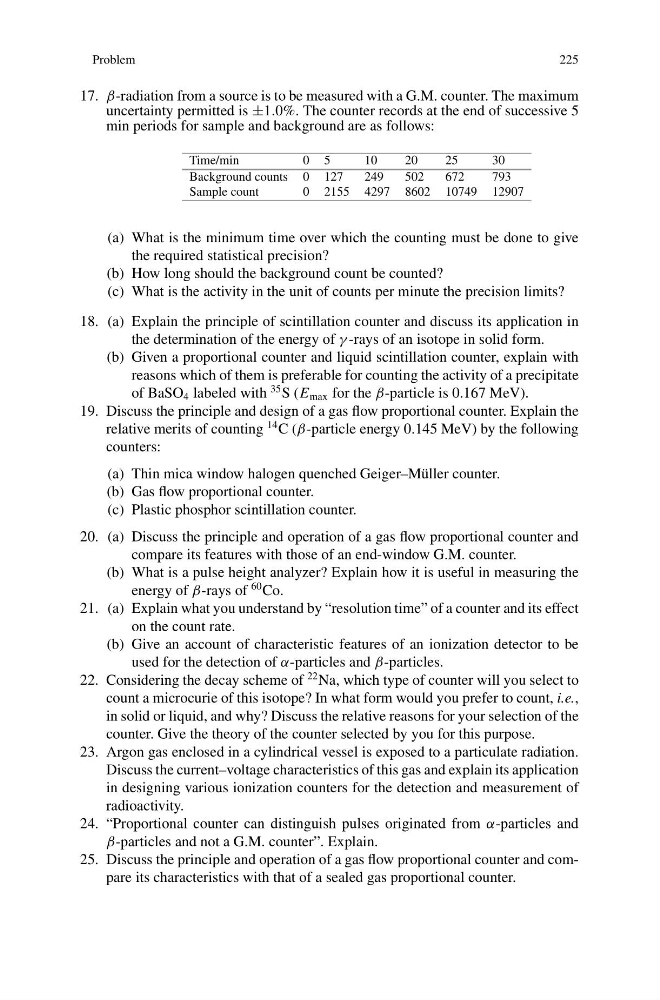
17. β-radiation from a source is to be measured with a G.M. counter. The maximum
uncertainty permitted is ±1.0%. The counter records at the end of successive 5
min periods for sample and background are as follows:
Time/min
0 5
10
20
25
30
Background counts 0 127
249
502
672
793
Sample count
0 2155 4297 8602 10749 12907
(a) What is the minimum time over which the counting must be done to give
the required statistical precision?
(b) How long should the background count be counted?
(c) What is the activity in the unit of counts per minute the precision limits?
18. (a) Explain the principle of scintillation counter and discuss its application in
the determination of the energy of γ -rays of an isotope in solid form.
(b) Given a proportional counter and liquid scintillation counter, explain with
reasons which of them is preferable for counting the activity of a precipitate
of BaSO 4 labeled with
35 S (E max for the β-particle is 0.167 MeV).
19. Discuss the principle and design of a gas flow proportional counter. Explain the
relative merits of counting
14 C (β-particle energy 0.145 MeV) by the following
counters:
(a) Thin mica window halogen quenched Geiger–Müller counter.
(b) Gas flow proportional counter.
(c) Plastic phosphor scintillation counter.
20. (a) Discuss the principle and operation of a gas flow proportional counter and
compare its features with those of an end-window G.M. counter.
(b) What is a pulse height analyzer? Explain how it is useful in measuring the
energy of β-rays of
60 Co.
21. (a) Explain what you understand by “resolution time” of a counter and its effect
on the count rate.
(b) Give an account of characteristic features of an ionization detector to be
used for the detection of α-particles and β-particles.
22. Considering the decay scheme of
22 Na, which type of counter will you select to
count a microcurie of this isotope? In what form would you prefer to count, i.e.,
in solid or liquid, and why? Discuss the relative reasons for your selection of the
counter. Give the theory of the counter selected by you for this purpose.
23. Argon gas enclosed in a cylindrical vessel is exposed to a particulate radiation.
Discuss the current–voltage characteristics of this gas and explain its application
in designing various ionization counters for the detection and measurement of
radioactivity.
24. “Proportional counter can distinguish pulses originated from α-particles and
β-particles and not a G.M. counter”. Explain.
25. Discuss the principle and operation of a gas flow proportional counter and compare its characteristics with that of a sealed gas proportional counter.
225
17. β-radiation from a source is to be measured with a G.M. counter. The maximum
uncertainty permitted is ±1.0%. The counter records at the end of successive 5
min periods for sample and background are as follows:
Time/min
0 5
10
20
25
30
Background counts 0 127
249
502
672
793
Sample count
0 2155 4297 8602 10749 12907
(a) What is the minimum time over which the counting must be done to give
the required statistical precision?
(b) How long should the background count be counted?
(c) What is the activity in the unit of counts per minute the precision limits?
18. (a) Explain the principle of scintillation counter and discuss its application in
the determination of the energy of γ -rays of an isotope in solid form.
(b) Given a proportional counter and liquid scintillation counter, explain with
reasons which of them is preferable for counting the activity of a precipitate
of BaSO 4 labeled with
35 S (E max for the β-particle is 0.167 MeV).
19. Discuss the principle and design of a gas flow proportional counter. Explain the
relative merits of counting
14 C (β-particle energy 0.145 MeV) by the following
counters:
(a) Thin mica window halogen quenched Geiger–Müller counter.
(b) Gas flow proportional counter.
(c) Plastic phosphor scintillation counter.
20. (a) Discuss the principle and operation of a gas flow proportional counter and
compare its features with those of an end-window G.M. counter.
(b) What is a pulse height analyzer? Explain how it is useful in measuring the
energy of β-rays of
60 Co.
21. (a) Explain what you understand by “resolution time” of a counter and its effect
on the count rate.
(b) Give an account of characteristic features of an ionization detector to be
used for the detection of α-particles and β-particles.
22. Considering the decay scheme of
22 Na, which type of counter will you select to
count a microcurie of this isotope? In what form would you prefer to count, i.e.,
in solid or liquid, and why? Discuss the relative reasons for your selection of the
counter. Give the theory of the counter selected by you for this purpose.
23. Argon gas enclosed in a cylindrical vessel is exposed to a particulate radiation.
Discuss the current–voltage characteristics of this gas and explain its application
in designing various ionization counters for the detection and measurement of
radioactivity.
24. “Proportional counter can distinguish pulses originated from α-particles and
β-particles and not a G.M. counter”. Explain.
25. Discuss the principle and operation of a gas flow proportional counter and compare its characteristics with that of a sealed gas proportional counter.