

214
13 Radiochemical Separation Techniques
Sometimes, the nuclear data for the isotope or the exact neutron flux is not easily
available. For such cases, along with the sample, a standard sample (i.e., an element
which is expected to be present in the unknown sample) are irradiated together and
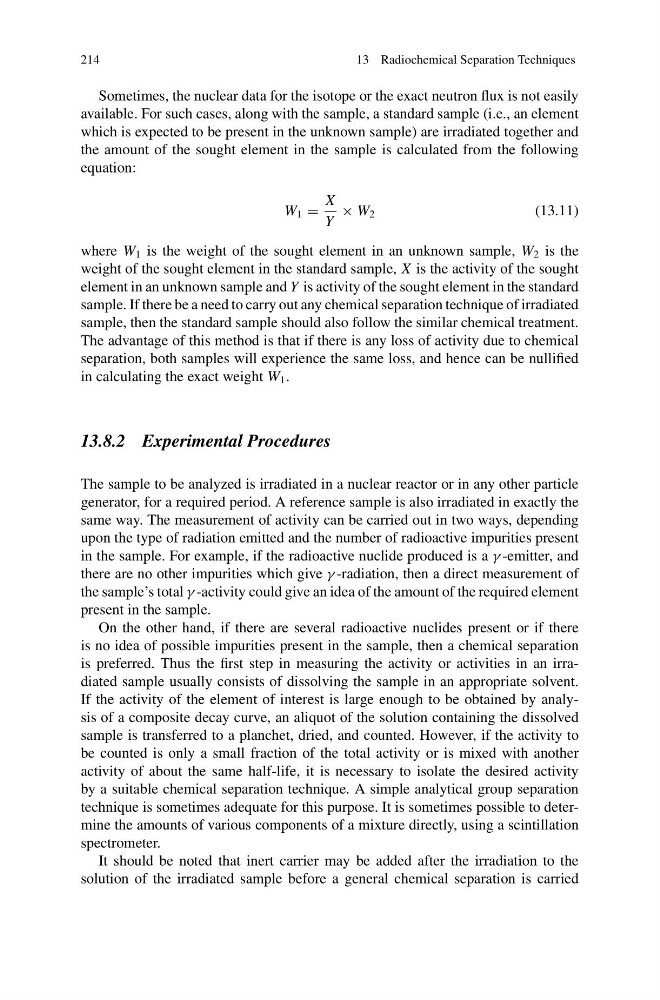
the amount of the sought element in the sample is calculated from the following
equation:
W 1 =
X
Y
× W 2
(13.11)
where W 1 is the weight of the sought element in an unknown sample, W 2 is the
weight of the sought element in the standard sample, X is the activity of the sought
element in an unknown sample and Y is activity of the sought element in the standard
sample. If there be a need to carry out any chemical separation technique of irradiated
sample, then the standard sample should also follow the similar chemical treatment.
The advantage of this method is that if there is any loss of activity due to chemical
separation, both samples will experience the same loss, and hence can be nullified
in calculating the exact weight W 1 .
13.8.2 Experimental Procedures
The sample to be analyzed is irradiated in a nuclear reactor or in any other particle
generator, for a required period. A reference sample is also irradiated in exactly the
same way. The measurement of activity can be carried out in two ways, depending
upon the type of radiation emitted and the number of radioactive impurities present
in the sample. For example, if the radioactive nuclide produced is a γ -emitter, and
there are no other impurities which give γ -radiation, then a direct measurement of
the sample’s total γ -activity could give an idea of the amount of the required element
present in the sample.
On the other hand, if there are several radioactive nuclides present or if there
is no idea of possible impurities present in the sample, then a chemical separation
is preferred. Thus the first step in measuring the activity or activities in an irradiated sample usually consists of dissolving the sample in an appropriate solvent.
If the activity of the element of interest is large enough to be obtained by analysis of a composite decay curve, an aliquot of the solution containing the dissolved
sample is transferred to a planchet, dried, and counted. However, if the activity to
be counted is only a small fraction of the total activity or is mixed with another
activity of about the same half-life, it is necessary to isolate the desired activity
by a suitable chemical separation technique. A simple analytical group separation
technique is sometimes adequate for this purpose. It is sometimes possible to determine the amounts of various components of a mixture directly, using a scintillation
spectrometer.
It should be noted that inert carrier may be added after the irradiation to the
solution of the irradiated sample before a general chemical separation is carried
13 Radiochemical Separation Techniques
Sometimes, the nuclear data for the isotope or the exact neutron flux is not easily
available. For such cases, along with the sample, a standard sample (i.e., an element
which is expected to be present in the unknown sample) are irradiated together and
the amount of the sought element in the sample is calculated from the following
equation:
W 1 =
X
Y
× W 2
(13.11)
where W 1 is the weight of the sought element in an unknown sample, W 2 is the
weight of the sought element in the standard sample, X is the activity of the sought
element in an unknown sample and Y is activity of the sought element in the standard
sample. If there be a need to carry out any chemical separation technique of irradiated
sample, then the standard sample should also follow the similar chemical treatment.
The advantage of this method is that if there is any loss of activity due to chemical
separation, both samples will experience the same loss, and hence can be nullified
in calculating the exact weight W 1 .
13.8.2 Experimental Procedures
The sample to be analyzed is irradiated in a nuclear reactor or in any other particle
generator, for a required period. A reference sample is also irradiated in exactly the
same way. The measurement of activity can be carried out in two ways, depending
upon the type of radiation emitted and the number of radioactive impurities present
in the sample. For example, if the radioactive nuclide produced is a γ -emitter, and
there are no other impurities which give γ -radiation, then a direct measurement of
the sample’s total γ -activity could give an idea of the amount of the required element
present in the sample.
On the other hand, if there are several radioactive nuclides present or if there
is no idea of possible impurities present in the sample, then a chemical separation
is preferred. Thus the first step in measuring the activity or activities in an irradiated sample usually consists of dissolving the sample in an appropriate solvent.
If the activity of the element of interest is large enough to be obtained by analysis of a composite decay curve, an aliquot of the solution containing the dissolved
sample is transferred to a planchet, dried, and counted. However, if the activity to
be counted is only a small fraction of the total activity or is mixed with another
activity of about the same half-life, it is necessary to isolate the desired activity
by a suitable chemical separation technique. A simple analytical group separation
technique is sometimes adequate for this purpose. It is sometimes possible to determine the amounts of various components of a mixture directly, using a scintillation
spectrometer.
It should be noted that inert carrier may be added after the irradiation to the
solution of the irradiated sample before a general chemical separation is carried