

212
13 Radiochemical Separation Techniques
2. One can measure the activity and hence its energy, or half-life of the isotope
without performing any chemical separation.
3. One can analyze the content of the material without destroying the form of the
sample.
13.8.1 Theory of the Activation Analysis Technique
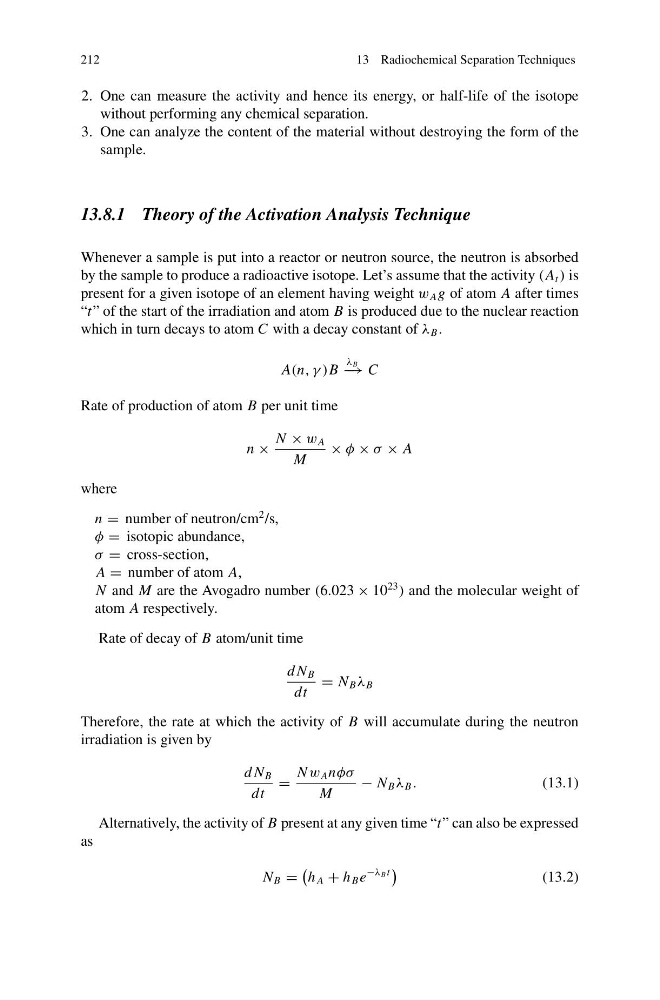
Whenever a sample is put into a reactor or neutron source, the neutron is absorbed
by the sample to produce a radioactive isotope. Let’s assume that the activity (A t ) is
present for a given isotope of an element having weight w A g of atom A after times
“t” of the start of the irradiation and atom B is produced due to the nuclear reaction
which in turn decays to atom C with a decay constant of λ B .
A(n, γ )B
λ B
− → C
Rate of production of atom B per unit time
n ×
N × w A
M
× φ × σ × A
where
n = number of neutron/cm
2 /s,
φ = isotopic abundance,
σ = cross-section,
A = number of atom A,
N and M are the Avogadro number (6.023 × 10
23
) and the molecular weight of
atom A respectively.
Rate of decay of B atom/unit time
d N B
dt
= N B λ B
Therefore, the rate at which the activity of B will accumulate during the neutron
irradiation is given by
d N B
dt
=
N w A nφσ
M
− N B λ B .
(13.1)
Alternatively, the activity of B present at any given time “t” can also be expressed
as
N B =
h A + h B e
−λ B t
(13.2)
13 Radiochemical Separation Techniques
2. One can measure the activity and hence its energy, or half-life of the isotope
without performing any chemical separation.
3. One can analyze the content of the material without destroying the form of the
sample.
13.8.1 Theory of the Activation Analysis Technique
Whenever a sample is put into a reactor or neutron source, the neutron is absorbed
by the sample to produce a radioactive isotope. Let’s assume that the activity (A t ) is
present for a given isotope of an element having weight w A g of atom A after times
“t” of the start of the irradiation and atom B is produced due to the nuclear reaction
which in turn decays to atom C with a decay constant of λ B .
A(n, γ )B
λ B
− → C
Rate of production of atom B per unit time
n ×
N × w A
M
× φ × σ × A
where
n = number of neutron/cm
2 /s,
φ = isotopic abundance,
σ = cross-section,
A = number of atom A,
N and M are the Avogadro number (6.023 × 10
23
) and the molecular weight of
atom A respectively.
Rate of decay of B atom/unit time
d N B
dt
= N B λ B
Therefore, the rate at which the activity of B will accumulate during the neutron
irradiation is given by
d N B
dt
=
N w A nφσ
M
− N B λ B .
(13.1)
Alternatively, the activity of B present at any given time “t” can also be expressed
as
N B =
h A + h B e
−λ B t
(13.2)