

210
13 Radiochemical Separation Techniques
Eluent
Ion-exchange
coloumn
Eluent fraction (ml)
Activity if sample (cpm)
X
B
C
D
A
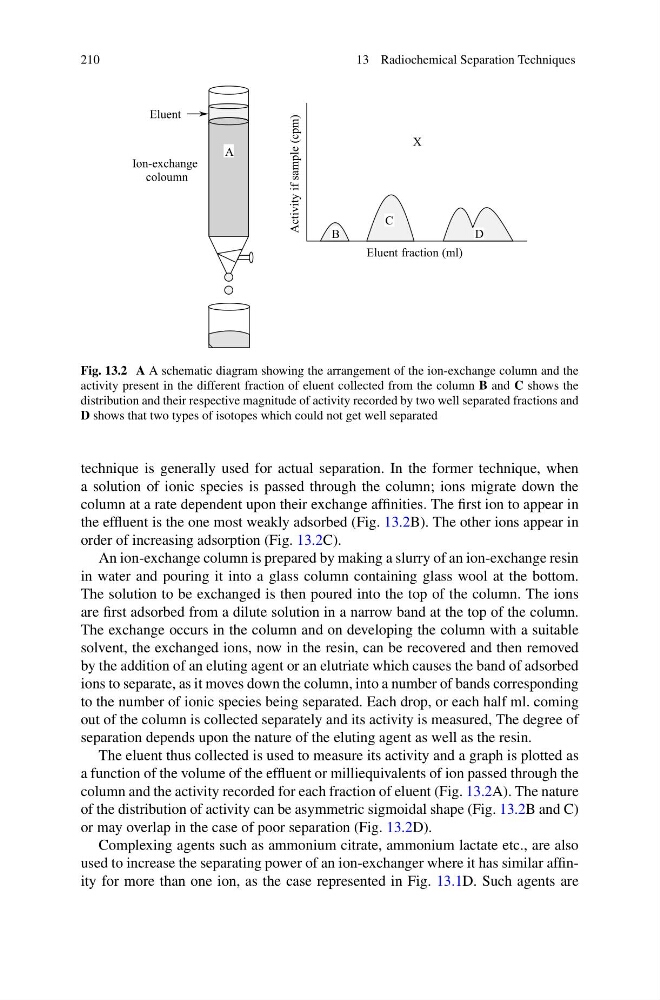
Fig. 13.2 A A schematic diagram showing the arrangement of the ion-exchange column and the
activity present in the different fraction of eluent collected from the column B and C shows the
distribution and their respective magnitude of activity recorded by two well separated fractions and
D shows that two types of isotopes which could not get well separated
technique is generally used for actual separation. In the former technique, when
a solution of ionic species is passed through the column; ions migrate down the
column at a rate dependent upon their exchange affinities. The first ion to appear in
the effluent is the one most weakly adsorbed (Fig. 13.2B). The other ions appear in
order of increasing adsorption (Fig. 13.2C).
An ion-exchange column is prepared by making a slurry of an ion-exchange resin
in water and pouring it into a glass column containing glass wool at the bottom.
The solution to be exchanged is then poured into the top of the column. The ions
are first adsorbed from a dilute solution in a narrow band at the top of the column.
The exchange occurs in the column and on developing the column with a suitable
solvent, the exchanged ions, now in the resin, can be recovered and then removed
by the addition of an eluting agent or an elutriate which causes the band of adsorbed
ions to separate, as it moves down the column, into a number of bands corresponding
to the number of ionic species being separated. Each drop, or each half ml. coming
out of the column is collected separately and its activity is measured, The degree of
separation depends upon the nature of the eluting agent as well as the resin.
The eluent thus collected is used to measure its activity and a graph is plotted as
a function of the volume of the effluent or milliequivalents of ion passed through the
column and the activity recorded for each fraction of eluent (Fig. 13.2A). The nature
of the distribution of activity can be asymmetric sigmoidal shape (Fig. 13.2B and C)
or may overlap in the case of poor separation (Fig. 13.2D).
Complexing agents such as ammonium citrate, ammonium lactate etc., are also
used to increase the separating power of an ion-exchanger where it has similar affinity for more than one ion, as the case represented in Fig. 13.1D. Such agents are
13 Radiochemical Separation Techniques
Eluent
Ion-exchange
coloumn
Eluent fraction (ml)
Activity if sample (cpm)
X
B
C
D
A
Fig. 13.2 A A schematic diagram showing the arrangement of the ion-exchange column and the
activity present in the different fraction of eluent collected from the column B and C shows the
distribution and their respective magnitude of activity recorded by two well separated fractions and
D shows that two types of isotopes which could not get well separated
technique is generally used for actual separation. In the former technique, when
a solution of ionic species is passed through the column; ions migrate down the
column at a rate dependent upon their exchange affinities. The first ion to appear in
the effluent is the one most weakly adsorbed (Fig. 13.2B). The other ions appear in
order of increasing adsorption (Fig. 13.2C).
An ion-exchange column is prepared by making a slurry of an ion-exchange resin
in water and pouring it into a glass column containing glass wool at the bottom.
The solution to be exchanged is then poured into the top of the column. The ions
are first adsorbed from a dilute solution in a narrow band at the top of the column.
The exchange occurs in the column and on developing the column with a suitable
solvent, the exchanged ions, now in the resin, can be recovered and then removed
by the addition of an eluting agent or an elutriate which causes the band of adsorbed
ions to separate, as it moves down the column, into a number of bands corresponding
to the number of ionic species being separated. Each drop, or each half ml. coming
out of the column is collected separately and its activity is measured, The degree of
separation depends upon the nature of the eluting agent as well as the resin.
The eluent thus collected is used to measure its activity and a graph is plotted as
a function of the volume of the effluent or milliequivalents of ion passed through the
column and the activity recorded for each fraction of eluent (Fig. 13.2A). The nature
of the distribution of activity can be asymmetric sigmoidal shape (Fig. 13.2B and C)
or may overlap in the case of poor separation (Fig. 13.2D).
Complexing agents such as ammonium citrate, ammonium lactate etc., are also
used to increase the separating power of an ion-exchanger where it has similar affinity for more than one ion, as the case represented in Fig. 13.1D. Such agents are