

12.4 Internal Absorption
187
istry of potassium, is taken over the entire body causing a genetic hazard. Genetic
hazard is the most dangerous type, because its effect is observed in the offspring and
hence can be carried over to the next generation, as is being observed with people
who were affected in Japan, due to the explosion of the atomic bomb in Hiroshima
and Nagasaki. Therefore, in principle, the internal hazard due to radioactive isotopes
is highly dangerous. Since we have to work with such radioactive materials, based
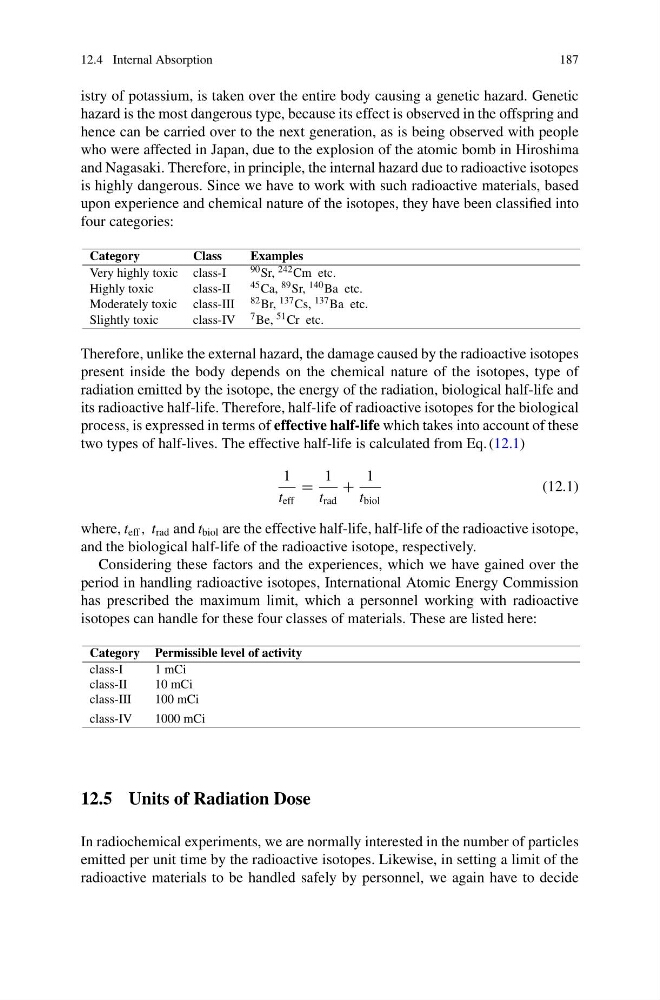
upon experience and chemical nature of the isotopes, they have been classified into
four categories:
Category
Class
Examples
Very highly toxic class-I
90 Sr, 242 Cm etc.
Highly toxic
class-II
45 Ca, 89 Sr, 140 Ba etc.
Moderately toxic class-III 82 Br, 137 Cs, 137 Ba etc.
Slightly toxic
class-IV 7 Be, 51 Cr etc.
Therefore, unlike the external hazard, the damage caused by the radioactive isotopes
present inside the body depends on the chemical nature of the isotopes, type of
radiation emitted by the isotope, the energy of the radiation, biological half-life and
its radioactive half-life. Therefore, half-life of radioactive isotopes for the biological
process, is expressed in terms of effective half-life which takes into account of these
two types of half-lives. The effective half-life is calculated from Eq. (12.1)
1
t eff
=
1
t rad
+
1
t biol
(12.1)
where, t eff , t rad and t biol are the effective half-life, half-life of the radioactive isotope,
and the biological half-life of the radioactive isotope, respectively.
Considering these factors and the experiences, which we have gained over the
period in handling radioactive isotopes, International Atomic Energy Commission
has prescribed the maximum limit, which a personnel working with radioactive
isotopes can handle for these four classes of materials. These are listed here:
Category Permissible level of activity
class-I
1 mCi
class-II
10 mCi
class-III
100 mCi
class-IV
1000 mCi
12.5 Units of Radiation Dose
In radiochemical experiments, we are normally interested in the number of particles
emitted per unit time by the radioactive isotopes. Likewise, in setting a limit of the
radioactive materials to be handled safely by personnel, we again have to decide
187
istry of potassium, is taken over the entire body causing a genetic hazard. Genetic
hazard is the most dangerous type, because its effect is observed in the offspring and
hence can be carried over to the next generation, as is being observed with people
who were affected in Japan, due to the explosion of the atomic bomb in Hiroshima
and Nagasaki. Therefore, in principle, the internal hazard due to radioactive isotopes
is highly dangerous. Since we have to work with such radioactive materials, based
upon experience and chemical nature of the isotopes, they have been classified into
four categories:
Category
Class
Examples
Very highly toxic class-I
90 Sr, 242 Cm etc.
Highly toxic
class-II
45 Ca, 89 Sr, 140 Ba etc.
Moderately toxic class-III 82 Br, 137 Cs, 137 Ba etc.
Slightly toxic
class-IV 7 Be, 51 Cr etc.
Therefore, unlike the external hazard, the damage caused by the radioactive isotopes
present inside the body depends on the chemical nature of the isotopes, type of
radiation emitted by the isotope, the energy of the radiation, biological half-life and
its radioactive half-life. Therefore, half-life of radioactive isotopes for the biological
process, is expressed in terms of effective half-life which takes into account of these
two types of half-lives. The effective half-life is calculated from Eq. (12.1)
1
t eff
=
1
t rad
+
1
t biol
(12.1)
where, t eff , t rad and t biol are the effective half-life, half-life of the radioactive isotope,
and the biological half-life of the radioactive isotope, respectively.
Considering these factors and the experiences, which we have gained over the
period in handling radioactive isotopes, International Atomic Energy Commission
has prescribed the maximum limit, which a personnel working with radioactive
isotopes can handle for these four classes of materials. These are listed here:
Category Permissible level of activity
class-I
1 mCi
class-II
10 mCi
class-III
100 mCi
class-IV
1000 mCi
12.5 Units of Radiation Dose
In radiochemical experiments, we are normally interested in the number of particles
emitted per unit time by the radioactive isotopes. Likewise, in setting a limit of the
radioactive materials to be handled safely by personnel, we again have to decide