

150
9 Factors Affecting the Counting Efficiency
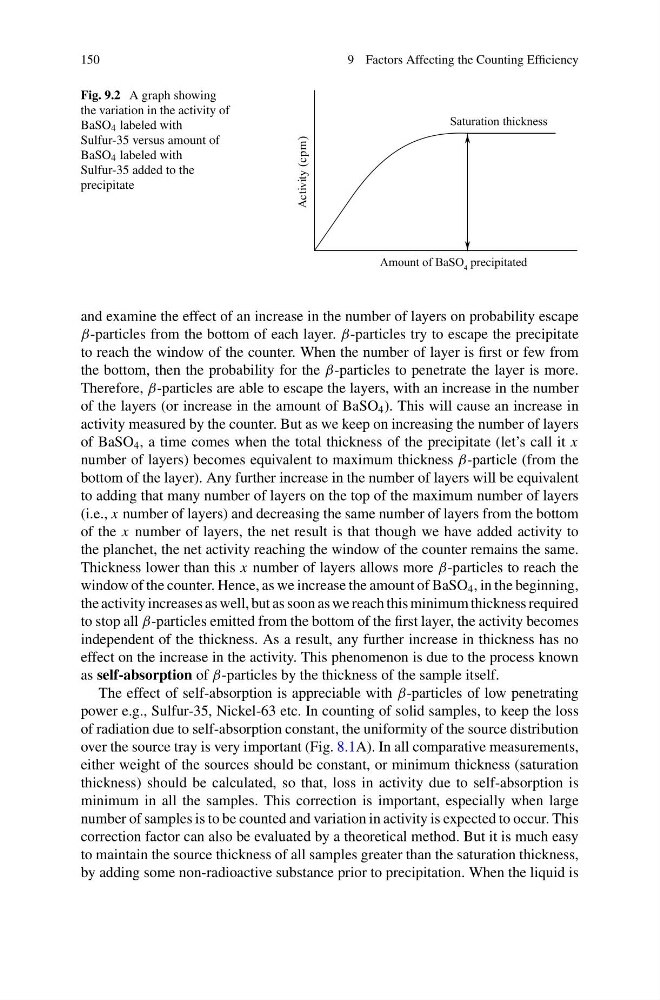
Fig. 9.2 A graph showing
the variation in the activity of
BaSO 4 labeled with
Sulfur-35 versus amount of
BaSO 4 labeled with
Sulfur-35 added to the
precipitate
and examine the effect of an increase in the number of layers on probability escape
β-particles from the bottom of each layer. β-particles try to escape the precipitate
to reach the window of the counter. When the number of layer is first or few from
the bottom, then the probability for the β-particles to penetrate the layer is more.
Therefore, β-particles are able to escape the layers, with an increase in the number
of the layers (or increase in the amount of BaSO 4 ). This will cause an increase in
activity measured by the counter. But as we keep on increasing the number of layers
of BaSO 4 , a time comes when the total thickness of the precipitate (let’s call it x
number of layers) becomes equivalent to maximum thickness β-particle (from the
bottom of the layer). Any further increase in the number of layers will be equivalent
to adding that many number of layers on the top of the maximum number of layers
(i.e., x number of layers) and decreasing the same number of layers from the bottom
of the x number of layers, the net result is that though we have added activity to
the planchet, the net activity reaching the window of the counter remains the same.
Thickness lower than this x number of layers allows more β-particles to reach the
window of the counter. Hence, as we increase the amount of BaSO 4 , in the beginning,
the activity increases as well, but as soon as we reach this minimum thickness required
to stop all β-particles emitted from the bottom of the first layer, the activity becomes
independent of the thickness. As a result, any further increase in thickness has no
effect on the increase in the activity. This phenomenon is due to the process known
as self-absorption of β-particles by the thickness of the sample itself.
The effect of self-absorption is appreciable with β-particles of low penetrating
power e.g., Sulfur-35, Nickel-63 etc. In counting of solid samples, to keep the loss
of radiation due to self-absorption constant, the uniformity of the source distribution
over the source tray is very important (Fig. 8.1A). In all comparative measurements,
either weight of the sources should be constant, or minimum thickness (saturation
thickness) should be calculated, so that, loss in activity due to self-absorption is
minimum in all the samples. This correction is important, especially when large
number of samples is to be counted and variation in activity is expected to occur. This
correction factor can also be evaluated by a theoretical method. But it is much easy
to maintain the source thickness of all samples greater than the saturation thickness,
by adding some non-radioactive substance prior to precipitation. When the liquid is
9 Factors Affecting the Counting Efficiency
Fig. 9.2 A graph showing
the variation in the activity of
BaSO 4 labeled with
Sulfur-35 versus amount of
BaSO 4 labeled with
Sulfur-35 added to the
precipitate
and examine the effect of an increase in the number of layers on probability escape
β-particles from the bottom of each layer. β-particles try to escape the precipitate
to reach the window of the counter. When the number of layer is first or few from
the bottom, then the probability for the β-particles to penetrate the layer is more.
Therefore, β-particles are able to escape the layers, with an increase in the number
of the layers (or increase in the amount of BaSO 4 ). This will cause an increase in
activity measured by the counter. But as we keep on increasing the number of layers
of BaSO 4 , a time comes when the total thickness of the precipitate (let’s call it x
number of layers) becomes equivalent to maximum thickness β-particle (from the
bottom of the layer). Any further increase in the number of layers will be equivalent
to adding that many number of layers on the top of the maximum number of layers
(i.e., x number of layers) and decreasing the same number of layers from the bottom
of the x number of layers, the net result is that though we have added activity to
the planchet, the net activity reaching the window of the counter remains the same.
Thickness lower than this x number of layers allows more β-particles to reach the
window of the counter. Hence, as we increase the amount of BaSO 4 , in the beginning,
the activity increases as well, but as soon as we reach this minimum thickness required
to stop all β-particles emitted from the bottom of the first layer, the activity becomes
independent of the thickness. As a result, any further increase in thickness has no
effect on the increase in the activity. This phenomenon is due to the process known
as self-absorption of β-particles by the thickness of the sample itself.
The effect of self-absorption is appreciable with β-particles of low penetrating
power e.g., Sulfur-35, Nickel-63 etc. In counting of solid samples, to keep the loss
of radiation due to self-absorption constant, the uniformity of the source distribution
over the source tray is very important (Fig. 8.1A). In all comparative measurements,
either weight of the sources should be constant, or minimum thickness (saturation
thickness) should be calculated, so that, loss in activity due to self-absorption is
minimum in all the samples. This correction is important, especially when large
number of samples is to be counted and variation in activity is expected to occur. This
correction factor can also be evaluated by a theoretical method. But it is much easy
to maintain the source thickness of all samples greater than the saturation thickness,
by adding some non-radioactive substance prior to precipitation. When the liquid is