

148
9 Factors Affecting the Counting Efficiency
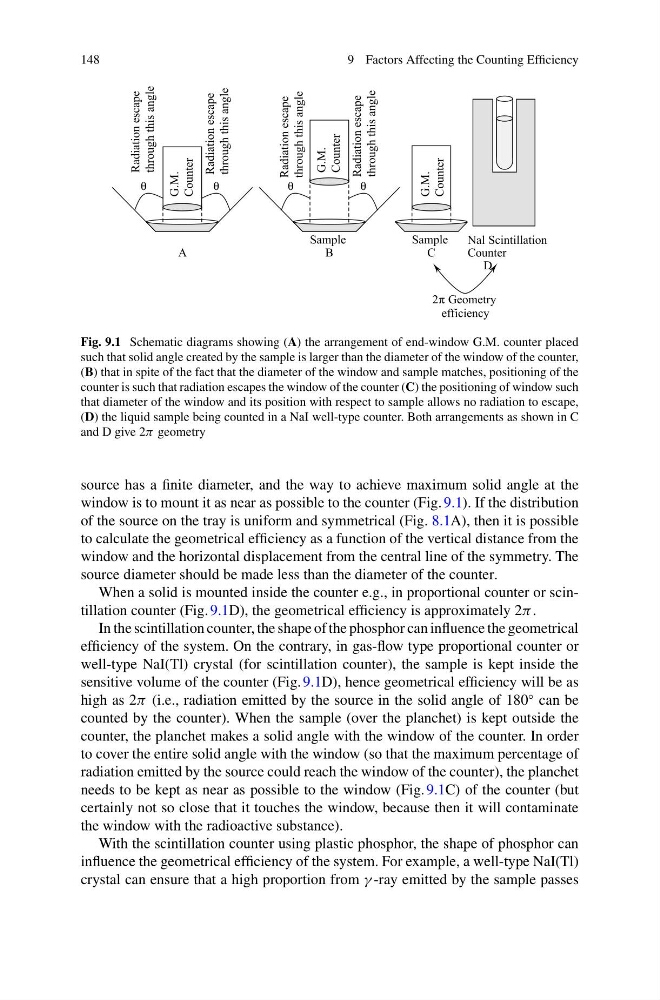
Fig. 9.1 Schematic diagrams showing (A) the arrangement of end-window G.M. counter placed
such that solid angle created by the sample is larger than the diameter of the window of the counter,
(B) that in spite of the fact that the diameter of the window and sample matches, positioning of the
counter is such that radiation escapes the window of the counter (C) the positioning of window such
that diameter of the window and its position with respect to sample allows no radiation to escape,
(D) the liquid sample being counted in a NaI well-type counter. Both arrangements as shown in C
and D give 2π geometry
source has a finite diameter, and the way to achieve maximum solid angle at the
window is to mount it as near as possible to the counter (Fig. 9.1). If the distribution
of the source on the tray is uniform and symmetrical (Fig. 8.1A), then it is possible
to calculate the geometrical efficiency as a function of the vertical distance from the
window and the horizontal displacement from the central line of the symmetry. The
source diameter should be made less than the diameter of the counter.
When a solid is mounted inside the counter e.g., in proportional counter or scintillation counter (Fig. 9.1D), the geometrical efficiency is approximately 2π .
In the scintillation counter, the shape of the phosphor can influence the geometrical
efficiency of the system. On the contrary, in gas-flow type proportional counter or
well-type NaI(Tl) crystal (for scintillation counter), the sample is kept inside the
sensitive volume of the counter (Fig. 9.1D), hence geometrical efficiency will be as
high as 2π (i.e., radiation emitted by the source in the solid angle of 180
◦ can be
counted by the counter). When the sample (over the planchet) is kept outside the
counter, the planchet makes a solid angle with the window of the counter. In order
to cover the entire solid angle with the window (so that the maximum percentage of
radiation emitted by the source could reach the window of the counter), the planchet
needs to be kept as near as possible to the window (Fig. 9.1C) of the counter (but
certainly not so close that it touches the window, because then it will contaminate
the window with the radioactive substance).
With the scintillation counter using plastic phosphor, the shape of phosphor can
influence the geometrical efficiency of the system. For example, a well-type NaI(Tl)
crystal can ensure that a high proportion from γ -ray emitted by the sample passes
9 Factors Affecting the Counting Efficiency
Fig. 9.1 Schematic diagrams showing (A) the arrangement of end-window G.M. counter placed
such that solid angle created by the sample is larger than the diameter of the window of the counter,
(B) that in spite of the fact that the diameter of the window and sample matches, positioning of the
counter is such that radiation escapes the window of the counter (C) the positioning of window such
that diameter of the window and its position with respect to sample allows no radiation to escape,
(D) the liquid sample being counted in a NaI well-type counter. Both arrangements as shown in C
and D give 2π geometry
source has a finite diameter, and the way to achieve maximum solid angle at the
window is to mount it as near as possible to the counter (Fig. 9.1). If the distribution
of the source on the tray is uniform and symmetrical (Fig. 8.1A), then it is possible
to calculate the geometrical efficiency as a function of the vertical distance from the
window and the horizontal displacement from the central line of the symmetry. The
source diameter should be made less than the diameter of the counter.
When a solid is mounted inside the counter e.g., in proportional counter or scintillation counter (Fig. 9.1D), the geometrical efficiency is approximately 2π .
In the scintillation counter, the shape of the phosphor can influence the geometrical
efficiency of the system. On the contrary, in gas-flow type proportional counter or
well-type NaI(Tl) crystal (for scintillation counter), the sample is kept inside the
sensitive volume of the counter (Fig. 9.1D), hence geometrical efficiency will be as
high as 2π (i.e., radiation emitted by the source in the solid angle of 180
◦ can be
counted by the counter). When the sample (over the planchet) is kept outside the
counter, the planchet makes a solid angle with the window of the counter. In order
to cover the entire solid angle with the window (so that the maximum percentage of
radiation emitted by the source could reach the window of the counter), the planchet
needs to be kept as near as possible to the window (Fig. 9.1C) of the counter (but
certainly not so close that it touches the window, because then it will contaminate
the window with the radioactive substance).
With the scintillation counter using plastic phosphor, the shape of phosphor can
influence the geometrical efficiency of the system. For example, a well-type NaI(Tl)
crystal can ensure that a high proportion from γ -ray emitted by the sample passes