

136
7 Non-conventional Detection Techniques
G.M. Counter
E.H.T.
Anticoincidence
unit
Scaler
Discriminator
Amplifier
Probe
E.H.T.
Photomultiplier tube
+
Probe
Scintillator (liquid)
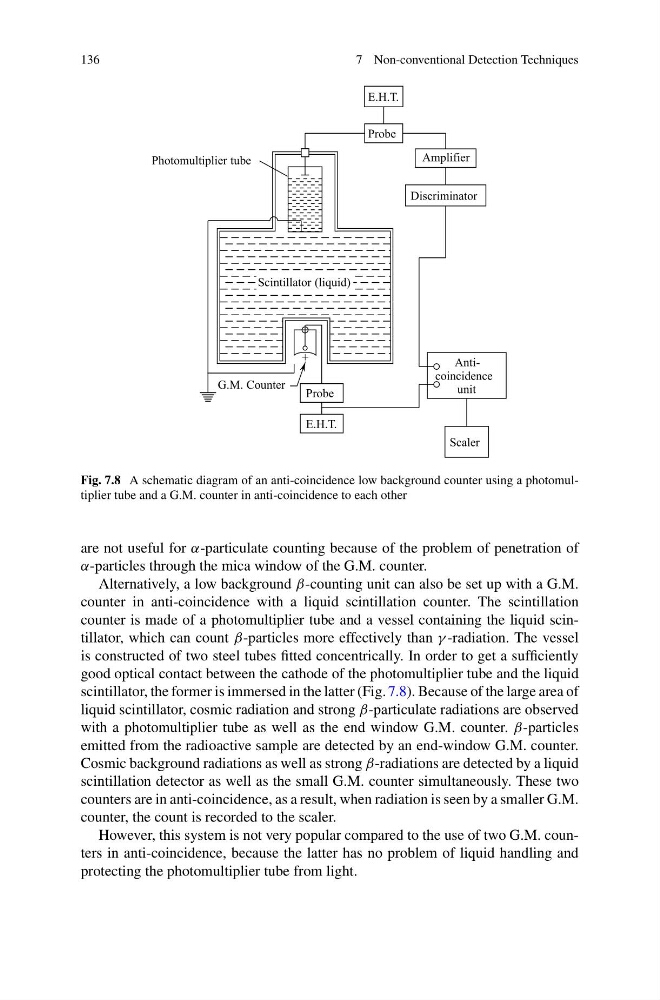
Fig. 7.8 A schematic diagram of an anti-coincidence low background counter using a photomultiplier tube and a G.M. counter in anti-coincidence to each other
are not useful for α-particulate counting because of the problem of penetration of
α-particles through the mica window of the G.M. counter.
Alternatively, a low background β-counting unit can also be set up with a G.M.
counter in anti-coincidence with a liquid scintillation counter. The scintillation
counter is made of a photomultiplier tube and a vessel containing the liquid scintillator, which can count β-particles more effectively than γ -radiation. The vessel
is constructed of two steel tubes fitted concentrically. In order to get a sufficiently
good optical contact between the cathode of the photomultiplier tube and the liquid
scintillator, the former is immersed in the latter (Fig. 7.8). Because of the large area of
liquid scintillator, cosmic radiation and strong β-particulate radiations are observed
with a photomultiplier tube as well as the end window G.M. counter. β-particles
emitted from the radioactive sample are detected by an end-window G.M. counter.
Cosmic background radiations as well as strong β-radiations are detected by a liquid
scintillation detector as well as the small G.M. counter simultaneously. These two
counters are in anti-coincidence, as a result, when radiation is seen by a smaller G.M.
counter, the count is recorded to the scaler.
However, this system is not very popular compared to the use of two G.M. counters in anti-coincidence, because the latter has no problem of liquid handling and
protecting the photomultiplier tube from light.
7 Non-conventional Detection Techniques
G.M. Counter
E.H.T.
Anticoincidence
unit
Scaler
Discriminator
Amplifier
Probe
E.H.T.
Photomultiplier tube
+
Probe
Scintillator (liquid)
Fig. 7.8 A schematic diagram of an anti-coincidence low background counter using a photomultiplier tube and a G.M. counter in anti-coincidence to each other
are not useful for α-particulate counting because of the problem of penetration of
α-particles through the mica window of the G.M. counter.
Alternatively, a low background β-counting unit can also be set up with a G.M.
counter in anti-coincidence with a liquid scintillation counter. The scintillation
counter is made of a photomultiplier tube and a vessel containing the liquid scintillator, which can count β-particles more effectively than γ -radiation. The vessel
is constructed of two steel tubes fitted concentrically. In order to get a sufficiently
good optical contact between the cathode of the photomultiplier tube and the liquid
scintillator, the former is immersed in the latter (Fig. 7.8). Because of the large area of
liquid scintillator, cosmic radiation and strong β-particulate radiations are observed
with a photomultiplier tube as well as the end window G.M. counter. β-particles
emitted from the radioactive sample are detected by an end-window G.M. counter.
Cosmic background radiations as well as strong β-radiations are detected by a liquid
scintillation detector as well as the small G.M. counter simultaneously. These two
counters are in anti-coincidence, as a result, when radiation is seen by a smaller G.M.
counter, the count is recorded to the scaler.
However, this system is not very popular compared to the use of two G.M. counters in anti-coincidence, because the latter has no problem of liquid handling and
protecting the photomultiplier tube from light.