

7.7 Nuclear Emulsion Techniques
133
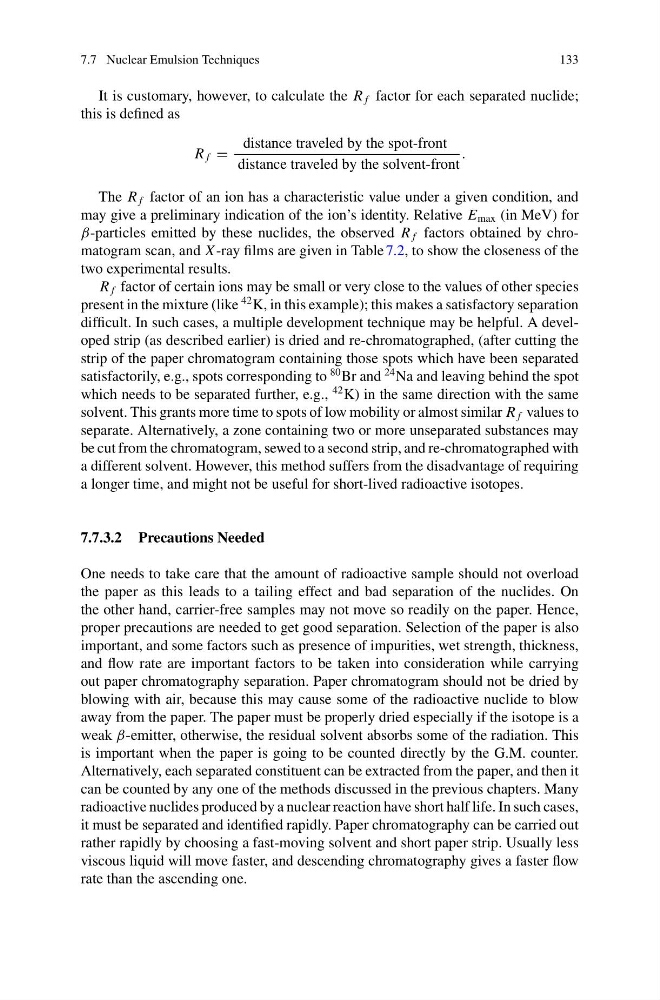
It is customary, however, to calculate the R f factor for each separated nuclide;
this is defined as
R f =
distance traveled by the spot-front
distance traveled by the solvent-front
.
The R f factor of an ion has a characteristic value under a given condition, and
may give a preliminary indication of the ion’s identity. Relative E max (in MeV) for
β-particles emitted by these nuclides, the observed R f factors obtained by chromatogram scan, and X -ray films are given in Table 7.2, to show the closeness of the
two experimental results.
R f factor of certain ions may be small or very close to the values of other species
present in the mixture (like
42 K, in this example); this makes a satisfactory separation
difficult. In such cases, a multiple development technique may be helpful. A developed strip (as described earlier) is dried and re-chromatographed, (after cutting the
strip of the paper chromatogram containing those spots which have been separated
satisfactorily, e.g., spots corresponding to
80 Br and
24 Na and leaving behind the spot
which needs to be separated further, e.g.,
42 K) in the same direction with the same
solvent. This grants more time to spots of low mobility or almost similar R f values to
separate. Alternatively, a zone containing two or more unseparated substances may
be cut from the chromatogram, sewed to a second strip, and re-chromatographed with
a different solvent. However, this method suffers from the disadvantage of requiring
a longer time, and might not be useful for short-lived radioactive isotopes.
7.7.3.2 Precautions Needed
One needs to take care that the amount of radioactive sample should not overload
the paper as this leads to a tailing effect and bad separation of the nuclides. On
the other hand, carrier-free samples may not move so readily on the paper. Hence,
proper precautions are needed to get good separation. Selection of the paper is also
important, and some factors such as presence of impurities, wet strength, thickness,
and flow rate are important factors to be taken into consideration while carrying
out paper chromatography separation. Paper chromatogram should not be dried by
blowing with air, because this may cause some of the radioactive nuclide to blow
away from the paper. The paper must be properly dried especially if the isotope is a
weak β-emitter, otherwise, the residual solvent absorbs some of the radiation. This
is important when the paper is going to be counted directly by the G.M. counter.
Alternatively, each separated constituent can be extracted from the paper, and then it
can be counted by any one of the methods discussed in the previous chapters. Many
radioactive nuclides produced by a nuclear reaction have short half life. In such cases,
it must be separated and identified rapidly. Paper chromatography can be carried out
rather rapidly by choosing a fast-moving solvent and short paper strip. Usually less
viscous liquid will move faster, and descending chromatography gives a faster flow
rate than the ascending one.
133
It is customary, however, to calculate the R f factor for each separated nuclide;
this is defined as
R f =
distance traveled by the spot-front
distance traveled by the solvent-front
.
The R f factor of an ion has a characteristic value under a given condition, and
may give a preliminary indication of the ion’s identity. Relative E max (in MeV) for
β-particles emitted by these nuclides, the observed R f factors obtained by chromatogram scan, and X -ray films are given in Table 7.2, to show the closeness of the
two experimental results.
R f factor of certain ions may be small or very close to the values of other species
present in the mixture (like
42 K, in this example); this makes a satisfactory separation
difficult. In such cases, a multiple development technique may be helpful. A developed strip (as described earlier) is dried and re-chromatographed, (after cutting the
strip of the paper chromatogram containing those spots which have been separated
satisfactorily, e.g., spots corresponding to
80 Br and
24 Na and leaving behind the spot
which needs to be separated further, e.g.,
42 K) in the same direction with the same
solvent. This grants more time to spots of low mobility or almost similar R f values to
separate. Alternatively, a zone containing two or more unseparated substances may
be cut from the chromatogram, sewed to a second strip, and re-chromatographed with
a different solvent. However, this method suffers from the disadvantage of requiring
a longer time, and might not be useful for short-lived radioactive isotopes.
7.7.3.2 Precautions Needed
One needs to take care that the amount of radioactive sample should not overload
the paper as this leads to a tailing effect and bad separation of the nuclides. On
the other hand, carrier-free samples may not move so readily on the paper. Hence,
proper precautions are needed to get good separation. Selection of the paper is also
important, and some factors such as presence of impurities, wet strength, thickness,
and flow rate are important factors to be taken into consideration while carrying
out paper chromatography separation. Paper chromatogram should not be dried by
blowing with air, because this may cause some of the radioactive nuclide to blow
away from the paper. The paper must be properly dried especially if the isotope is a
weak β-emitter, otherwise, the residual solvent absorbs some of the radiation. This
is important when the paper is going to be counted directly by the G.M. counter.
Alternatively, each separated constituent can be extracted from the paper, and then it
can be counted by any one of the methods discussed in the previous chapters. Many
radioactive nuclides produced by a nuclear reaction have short half life. In such cases,
it must be separated and identified rapidly. Paper chromatography can be carried out
rather rapidly by choosing a fast-moving solvent and short paper strip. Usually less
viscous liquid will move faster, and descending chromatography gives a faster flow
rate than the ascending one.