

130
7 Non-conventional Detection Techniques
7.7.2 X-ray Film Badges
The photographic film is widely used to monitor the dose of X -ray, γ -rays, or βparticular radiation received by the personnel. For this purpose, a new unexposed
film is worn by a worker and developed to measure the blackening density after a
period of time. On comparison of the blackening density with a calibrated curve, the
amount of dose received by the person can be deduced. For calibration purpose, a
photographic film (X -ray film) is exposed to various amounts of known radiation for
a definite time (to calculate the dose rate). The exposed film is developed and the
density of the blackening of the film is measured. A graph is plotted between the
density of the blackening of film and the amount of dose given to the film. This graph
is used as a calibration graph to find out the amount of dose received by a person
wearing the film.
Film badges are covered with a light protector as well as with small metallic
plates of different thickness made of different materials. Material is selected such
that it stops radiation entering the film to a different degree depending upon the
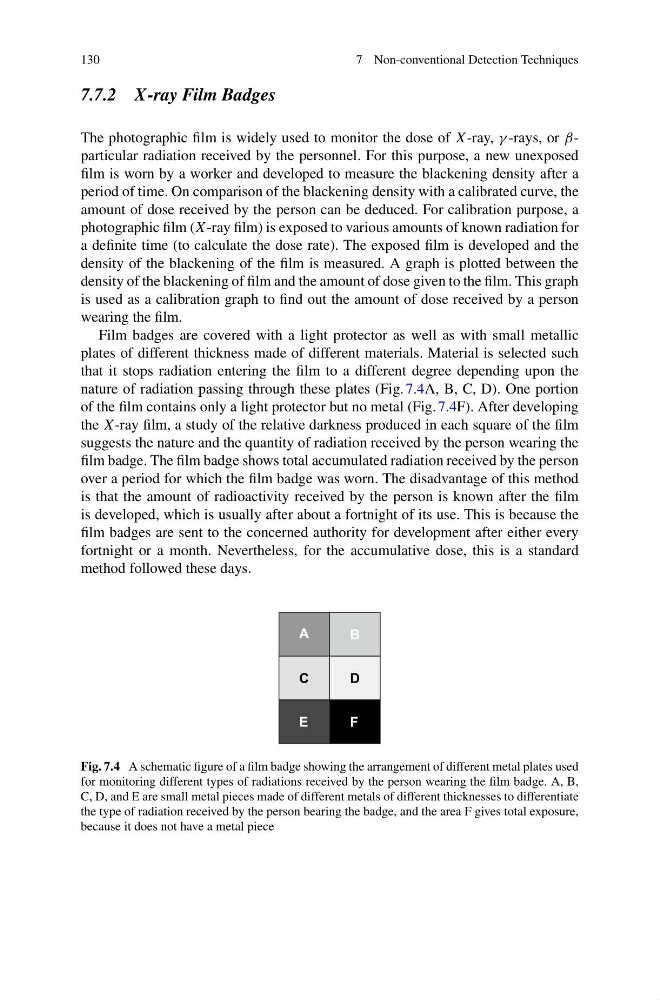
nature of radiation passing through these plates (Fig. 7.4A, B, C, D). One portion
of the film contains only a light protector but no metal (Fig. 7.4F). After developing
the X -ray film, a study of the relative darkness produced in each square of the film
suggests the nature and the quantity of radiation received by the person wearing the
film badge. The film badge shows total accumulated radiation received by the person
over a period for which the film badge was worn. The disadvantage of this method
is that the amount of radioactivity received by the person is known after the film
is developed, which is usually after about a fortnight of its use. This is because the
film badges are sent to the concerned authority for development after either every
fortnight or a month. Nevertheless, for the accumulative dose, this is a standard
method followed these days.
Fig. 7.4 A schematic figure of a film badge showing the arrangement of different metal plates used
for monitoring different types of radiations received by the person wearing the film badge. A, B,
C, D, and E are small metal pieces made of different metals of different thicknesses to differentiate
the type of radiation received by the person bearing the badge, and the area F gives total exposure,
because it does not have a metal piece
7 Non-conventional Detection Techniques
7.7.2 X-ray Film Badges
The photographic film is widely used to monitor the dose of X -ray, γ -rays, or βparticular radiation received by the personnel. For this purpose, a new unexposed
film is worn by a worker and developed to measure the blackening density after a
period of time. On comparison of the blackening density with a calibrated curve, the
amount of dose received by the person can be deduced. For calibration purpose, a
photographic film (X -ray film) is exposed to various amounts of known radiation for
a definite time (to calculate the dose rate). The exposed film is developed and the
density of the blackening of the film is measured. A graph is plotted between the
density of the blackening of film and the amount of dose given to the film. This graph
is used as a calibration graph to find out the amount of dose received by a person
wearing the film.
Film badges are covered with a light protector as well as with small metallic
plates of different thickness made of different materials. Material is selected such
that it stops radiation entering the film to a different degree depending upon the
nature of radiation passing through these plates (Fig. 7.4A, B, C, D). One portion
of the film contains only a light protector but no metal (Fig. 7.4F). After developing
the X -ray film, a study of the relative darkness produced in each square of the film
suggests the nature and the quantity of radiation received by the person wearing the
film badge. The film badge shows total accumulated radiation received by the person
over a period for which the film badge was worn. The disadvantage of this method
is that the amount of radioactivity received by the person is known after the film
is developed, which is usually after about a fortnight of its use. This is because the
film badges are sent to the concerned authority for development after either every
fortnight or a month. Nevertheless, for the accumulative dose, this is a standard
method followed these days.
Fig. 7.4 A schematic figure of a film badge showing the arrangement of different metal plates used
for monitoring different types of radiations received by the person wearing the film badge. A, B,
C, D, and E are small metal pieces made of different metals of different thicknesses to differentiate
the type of radiation received by the person bearing the badge, and the area F gives total exposure,
because it does not have a metal piece