

128
7 Non-conventional Detection Techniques
Table 7.1 Energy of radiation required to create electron/hole pairs with some materials. The
energy of radiation to be counted should be greater than band gap
Material
Energy required for ionization/eV
Silicon
3.23
Germanium
2.24
Indium antimonate
0.06
Cadmium sulfide
5.2
Gray tin
0.1
height analyzer, and then to the counter, in a similar fashion as was done with a
proportional counter.
7.5.2 Advantage of a Semiconductor Detector
Semiconductor detectors have a very thin window due to the thin film of gold and
the thin layer of n-type (in the present case, but it can be p-type as well for the
n : p junction). Therefore, even weak β-particles, soft X -rays or α-particles can be
counted with high accuracy. Since the detector needs only about 1.5 V as its operating
voltage, there would hardly be any spurious pulses produced, as normally observed
in scintillation counting systems or proportional counters, i.e., noise-to-signal ratio
is very low. Since the size of the detector is very small (about 3 × 2 cm
2 ), its effective
area of the detector is very small. Hence, background activity due to cosmic radiation
is also very low. For α-counting, shielding is not required as pulses for α-particles are
much larger than that produced by cosmic radiation. The resolution of β-peak is also
very good. 4π geometry counting can also be easily achieved with this type of counter
without making the counting assembly bulky. Moreover, dead time for such detector
is of the order of 10
−7 –10
−8 s, indicating that one can count radioactive materials with
a high activity using this detector. Some common types of semiconductor detectors
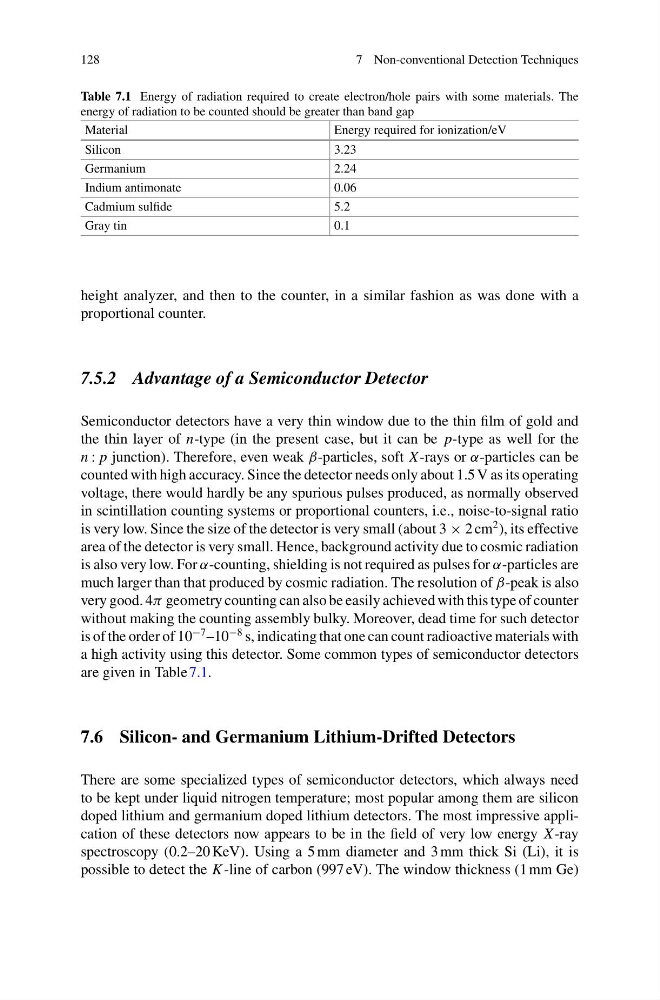
are given in Table 7.1.
7.6 Silicon- and Germanium Lithium-Drifted Detectors
There are some specialized types of semiconductor detectors, which always need
to be kept under liquid nitrogen temperature; most popular among them are silicon
doped lithium and germanium doped lithium detectors. The most impressive application of these detectors now appears to be in the field of very low energy X -ray
spectroscopy (0.2–20 KeV). Using a 5 mm diameter and 3 mm thick Si (Li), it is
possible to detect the K -line of carbon (997 eV). The window thickness (1 mm Ge)
7 Non-conventional Detection Techniques
Table 7.1 Energy of radiation required to create electron/hole pairs with some materials. The
energy of radiation to be counted should be greater than band gap
Material
Energy required for ionization/eV
Silicon
3.23
Germanium
2.24
Indium antimonate
0.06
Cadmium sulfide
5.2
Gray tin
0.1
height analyzer, and then to the counter, in a similar fashion as was done with a
proportional counter.
7.5.2 Advantage of a Semiconductor Detector
Semiconductor detectors have a very thin window due to the thin film of gold and
the thin layer of n-type (in the present case, but it can be p-type as well for the
n : p junction). Therefore, even weak β-particles, soft X -rays or α-particles can be
counted with high accuracy. Since the detector needs only about 1.5 V as its operating
voltage, there would hardly be any spurious pulses produced, as normally observed
in scintillation counting systems or proportional counters, i.e., noise-to-signal ratio
is very low. Since the size of the detector is very small (about 3 × 2 cm
2 ), its effective
area of the detector is very small. Hence, background activity due to cosmic radiation
is also very low. For α-counting, shielding is not required as pulses for α-particles are
much larger than that produced by cosmic radiation. The resolution of β-peak is also
very good. 4π geometry counting can also be easily achieved with this type of counter
without making the counting assembly bulky. Moreover, dead time for such detector
is of the order of 10
−7 –10
−8 s, indicating that one can count radioactive materials with
a high activity using this detector. Some common types of semiconductor detectors
are given in Table 7.1.
7.6 Silicon- and Germanium Lithium-Drifted Detectors
There are some specialized types of semiconductor detectors, which always need
to be kept under liquid nitrogen temperature; most popular among them are silicon
doped lithium and germanium doped lithium detectors. The most impressive application of these detectors now appears to be in the field of very low energy X -ray
spectroscopy (0.2–20 KeV). Using a 5 mm diameter and 3 mm thick Si (Li), it is
possible to detect the K -line of carbon (997 eV). The window thickness (1 mm Ge)