

120
7 Non-conventional Detection Techniques
of each silicon atoms. Because of this interaction, energy levels of each electron of
different atoms take two new energy levels, valence and conduction energy levels.
Why do they form two new energy levels? Electrons of an atom in isolation experience one kind of electrical force, which is due to the interaction of a positively
charged nucleus with electrons as well as electron–electron interaction of the same
atom. The energy of an electron of this isolated atom settles down to one equilibrium
energy level. At this stage, the electron presumes that in its universe, there exist
only one positive charge and its negative charge. This situation changes when more
than one atom comes close to each other. Under this condition, electrons of both the
atoms are surprise to experience the presence of another positively charged nucleus
surrounded by other sets of electrons. This situation forces electrons to re-adjust
their energies into two different energies levels: one higher than its initial value and
the other lower than its initial value. For example, the reader of this chapter might
be engrossed in reading this chapter, and their mind might have attained an equilibrium energy level. But as soon as you come to know that there is a very beautiful girl
standing next to you, then certainly you get perturbed. If we can alter our equilibrium
levels in such type of situation, then why not electrons?
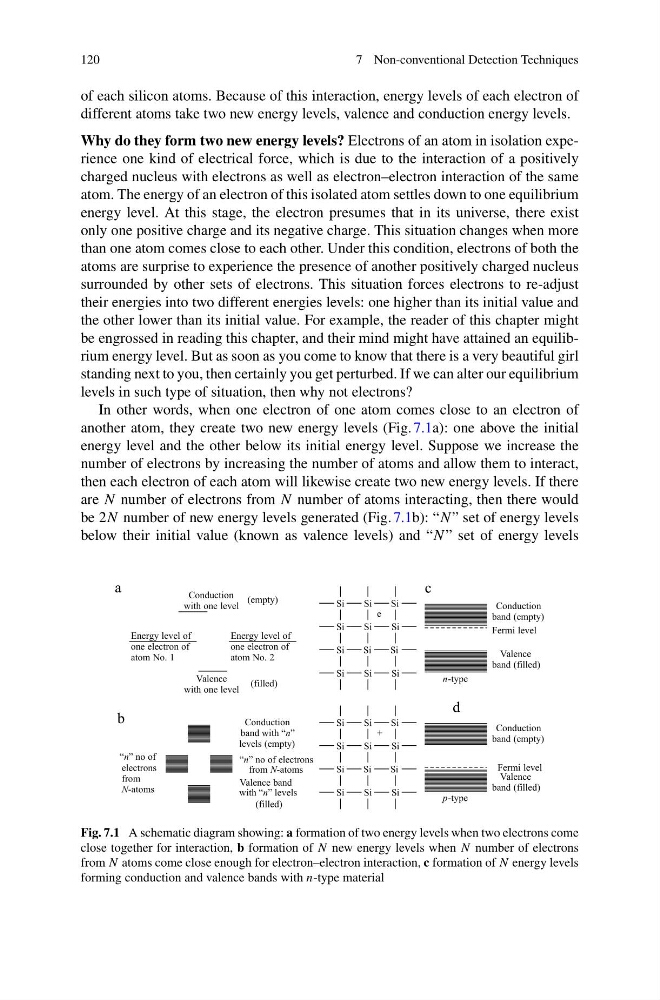
In other words, when one electron of one atom comes close to an electron of
another atom, they create two new energy levels (Fig. 7.1a): one above the initial
energy level and the other below its initial energy level. Suppose we increase the
number of electrons by increasing the number of atoms and allow them to interact,
then each electron of each atom will likewise create two new energy levels. If there
are N number of electrons from N number of atoms interacting, then there would
be 2N number of new energy levels generated (Fig. 7.1b): “N ” set of energy levels
below their initial value (known as valence levels) and “N ” set of energy levels
Energy level of
one electron of
atom No. 1
Energy level of
one electron of
atom No. 2
Conduction
with one level
Valence
with one level
(empty)
(filled)
a
Si
Si
Si
i
S
i
S
i
S
Si
Si
Si
i
S
i
S
i
S
e
Conduction
band (empty)
Fermi level
Valence
band (filled)
n-type
c
“n” no of
electrons
from
N-atoms
b
Conduction
band with “n”
levels (empty)
“n” no of electrons
from N-atoms
Valence band
with “n” levels
(filled)
Si
Si
Si
i
S
i
S
i
S
Si
Si
Si
i
S
i
S
i
S
+
Conduction
band (empty)
Fermi level
Valence
band (filled)
p-type
d
Fig. 7.1 A schematic diagram showing: a formation of two energy levels when two electrons come
close together for interaction, b formation of N new energy levels when N number of electrons
from N atoms come close enough for electron–electron interaction, c formation of N energy levels
forming conduction and valence bands with n-type material
7 Non-conventional Detection Techniques
of each silicon atoms. Because of this interaction, energy levels of each electron of
different atoms take two new energy levels, valence and conduction energy levels.
Why do they form two new energy levels? Electrons of an atom in isolation experience one kind of electrical force, which is due to the interaction of a positively
charged nucleus with electrons as well as electron–electron interaction of the same
atom. The energy of an electron of this isolated atom settles down to one equilibrium
energy level. At this stage, the electron presumes that in its universe, there exist
only one positive charge and its negative charge. This situation changes when more
than one atom comes close to each other. Under this condition, electrons of both the
atoms are surprise to experience the presence of another positively charged nucleus
surrounded by other sets of electrons. This situation forces electrons to re-adjust
their energies into two different energies levels: one higher than its initial value and
the other lower than its initial value. For example, the reader of this chapter might
be engrossed in reading this chapter, and their mind might have attained an equilibrium energy level. But as soon as you come to know that there is a very beautiful girl
standing next to you, then certainly you get perturbed. If we can alter our equilibrium
levels in such type of situation, then why not electrons?
In other words, when one electron of one atom comes close to an electron of
another atom, they create two new energy levels (Fig. 7.1a): one above the initial
energy level and the other below its initial energy level. Suppose we increase the
number of electrons by increasing the number of atoms and allow them to interact,
then each electron of each atom will likewise create two new energy levels. If there
are N number of electrons from N number of atoms interacting, then there would
be 2N number of new energy levels generated (Fig. 7.1b): “N ” set of energy levels
below their initial value (known as valence levels) and “N ” set of energy levels
Energy level of
one electron of
atom No. 1
Energy level of
one electron of
atom No. 2
Conduction
with one level
Valence
with one level
(empty)
(filled)
a
Si
Si
Si
i
S
i
S
i
S
Si
Si
Si
i
S
i
S
i
S
e
Conduction
band (empty)
Fermi level
Valence
band (filled)
n-type
c
“n” no of
electrons
from
N-atoms
b
Conduction
band with “n”
levels (empty)
“n” no of electrons
from N-atoms
Valence band
with “n” levels
(filled)
Si
Si
Si
i
S
i
S
i
S
Si
Si
Si
i
S
i
S
i
S
+
Conduction
band (empty)
Fermi level
Valence
band (filled)
p-type
d
Fig. 7.1 A schematic diagram showing: a formation of two energy levels when two electrons come
close together for interaction, b formation of N new energy levels when N number of electrons
from N atoms come close enough for electron–electron interaction, c formation of N energy levels
forming conduction and valence bands with n-type material