

6.9 Filter Paper Soaked with Scintillator
105
cone grease. The assembly is then set, as shown in Fig. 6.1, and counting is done, as
described earlier.
This method is used for samples, which are colorless and insoluble in solvent
(which does not quench). Preferably, amount of solid is kept to a minimum quantity
in order to minimize the loss of activity due to self-absorption of radiation by the
sample.
6.10 Parameters Controlling The Scintillation Counter
In counting a radioactive sample containing a γ -emitter or an α-emitter usually
one has a dual interest. Firstly identification of radioactive material, by knowing
its energy spectrum of the radiation. Secondly, measuring total activity either at
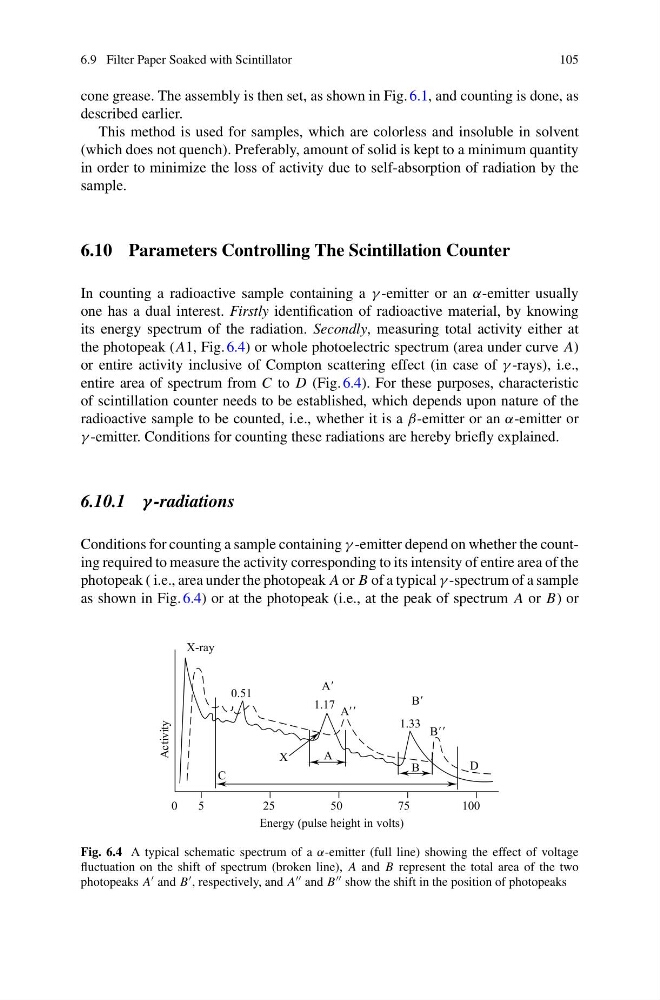
the photopeak (A1, Fig. 6.4) or whole photoelectric spectrum (area under curve A)
or entire activity inclusive of Compton scattering effect (in case of γ -rays), i.e.,
entire area of spectrum from C to D (Fig. 6.4). For these purposes, characteristic
of scintillation counter needs to be established, which depends upon nature of the
radioactive sample to be counted, i.e., whether it is a β-emitter or an α-emitter or
γ -emitter. Conditions for counting these radiations are hereby briefly explained.
6.10.1 γ -radiations
Conditions for counting a sample containing γ -emitter depend on whether the counting required to measure the activity corresponding to its intensity of entire area of the
photopeak ( i.e., area under the photopeak A or B of a typical γ -spectrum of a sample
as shown in Fig. 6.4) or at the photopeak (i.e., at the peak of spectrum A or B) or
Fig. 6.4 A typical schematic spectrum of a α-emitter (full line) showing the effect of voltage
fluctuation on the shift of spectrum (broken line), A and B represent the total area of the two
photopeaks A and B , respectively, and A and B show the shift in the position of photopeaks
105
cone grease. The assembly is then set, as shown in Fig. 6.1, and counting is done, as
described earlier.
This method is used for samples, which are colorless and insoluble in solvent
(which does not quench). Preferably, amount of solid is kept to a minimum quantity
in order to minimize the loss of activity due to self-absorption of radiation by the
sample.
6.10 Parameters Controlling The Scintillation Counter
In counting a radioactive sample containing a γ -emitter or an α-emitter usually
one has a dual interest. Firstly identification of radioactive material, by knowing
its energy spectrum of the radiation. Secondly, measuring total activity either at
the photopeak (A1, Fig. 6.4) or whole photoelectric spectrum (area under curve A)
or entire activity inclusive of Compton scattering effect (in case of γ -rays), i.e.,
entire area of spectrum from C to D (Fig. 6.4). For these purposes, characteristic
of scintillation counter needs to be established, which depends upon nature of the
radioactive sample to be counted, i.e., whether it is a β-emitter or an α-emitter or
γ -emitter. Conditions for counting these radiations are hereby briefly explained.
6.10.1 γ -radiations
Conditions for counting a sample containing γ -emitter depend on whether the counting required to measure the activity corresponding to its intensity of entire area of the
photopeak ( i.e., area under the photopeak A or B of a typical γ -spectrum of a sample
as shown in Fig. 6.4) or at the photopeak (i.e., at the peak of spectrum A or B) or
Fig. 6.4 A typical schematic spectrum of a α-emitter (full line) showing the effect of voltage
fluctuation on the shift of spectrum (broken line), A and B represent the total area of the two
photopeaks A and B , respectively, and A and B show the shift in the position of photopeaks