

6.7 Precautions Liquid Scintillation
103
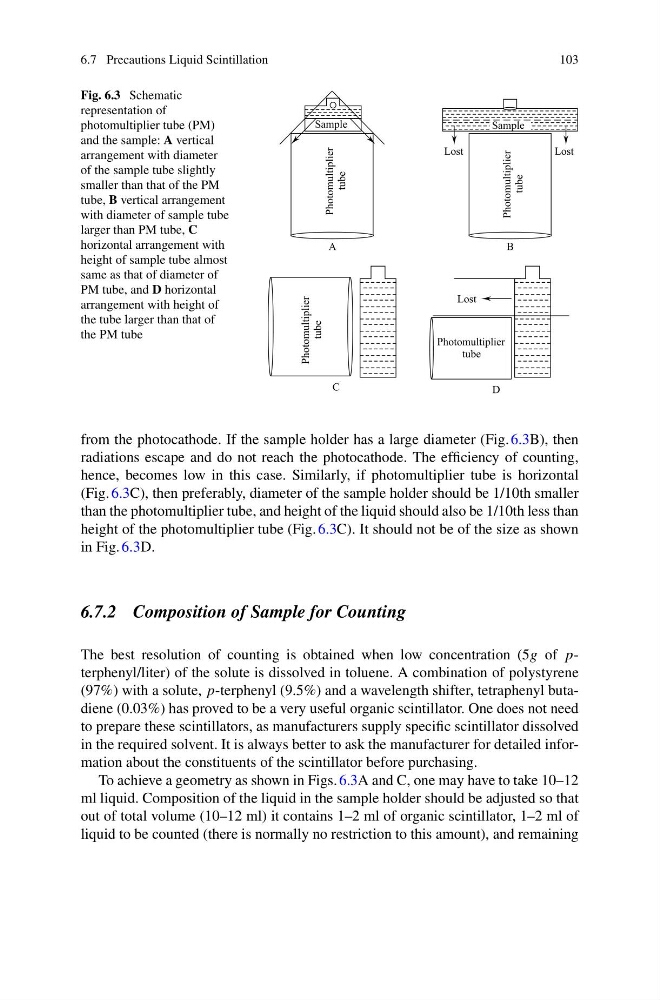
Fig. 6.3 Schematic
representation of
photomultiplier tube (PM)
and the sample: A vertical
arrangement with diameter
of the sample tube slightly
smaller than that of the PM
tube, B vertical arrangement
with diameter of sample tube
larger than PM tube, C
horizontal arrangement with
height of sample tube almost
same as that of diameter of
PM tube, and D horizontal
arrangement with height of
the tube larger than that of
the PM tube
from the photocathode. If the sample holder has a large diameter (Fig. 6.3B), then
radiations escape and do not reach the photocathode. The efficiency of counting,
hence, becomes low in this case. Similarly, if photomultiplier tube is horizontal
(Fig. 6.3C), then preferably, diameter of the sample holder should be 1/10th smaller
than the photomultiplier tube, and height of the liquid should also be 1/10th less than
height of the photomultiplier tube (Fig. 6.3C). It should not be of the size as shown
in Fig. 6.3D.
6.7.2 Composition of Sample for Counting
The best resolution of counting is obtained when low concentration (5g of pterphenyl/liter) of the solute is dissolved in toluene. A combination of polystyrene
(97%) with a solute, p-terphenyl (9.5%) and a wavelength shifter, tetraphenyl butadiene (0.03%) has proved to be a very useful organic scintillator. One does not need
to prepare these scintillators, as manufacturers supply specific scintillator dissolved
in the required solvent. It is always better to ask the manufacturer for detailed information about the constituents of the scintillator before purchasing.
To achieve a geometry as shown in Figs. 6.3A and C, one may have to take 10–12
ml liquid. Composition of the liquid in the sample holder should be adjusted so that
out of total volume (10–12 ml) it contains 1–2 ml of organic scintillator, 1–2 ml of
liquid to be counted (there is normally no restriction to this amount), and remaining
103
Fig. 6.3 Schematic
representation of
photomultiplier tube (PM)
and the sample: A vertical
arrangement with diameter
of the sample tube slightly
smaller than that of the PM
tube, B vertical arrangement
with diameter of sample tube
larger than PM tube, C
horizontal arrangement with
height of sample tube almost
same as that of diameter of
PM tube, and D horizontal
arrangement with height of
the tube larger than that of
the PM tube
from the photocathode. If the sample holder has a large diameter (Fig. 6.3B), then
radiations escape and do not reach the photocathode. The efficiency of counting,
hence, becomes low in this case. Similarly, if photomultiplier tube is horizontal
(Fig. 6.3C), then preferably, diameter of the sample holder should be 1/10th smaller
than the photomultiplier tube, and height of the liquid should also be 1/10th less than
height of the photomultiplier tube (Fig. 6.3C). It should not be of the size as shown
in Fig. 6.3D.
6.7.2 Composition of Sample for Counting
The best resolution of counting is obtained when low concentration (5g of pterphenyl/liter) of the solute is dissolved in toluene. A combination of polystyrene
(97%) with a solute, p-terphenyl (9.5%) and a wavelength shifter, tetraphenyl butadiene (0.03%) has proved to be a very useful organic scintillator. One does not need
to prepare these scintillators, as manufacturers supply specific scintillator dissolved
in the required solvent. It is always better to ask the manufacturer for detailed information about the constituents of the scintillator before purchasing.
To achieve a geometry as shown in Figs. 6.3A and C, one may have to take 10–12
ml liquid. Composition of the liquid in the sample holder should be adjusted so that
out of total volume (10–12 ml) it contains 1–2 ml of organic scintillator, 1–2 ml of
liquid to be counted (there is normally no restriction to this amount), and remaining