

96
6 Scintillation Counter
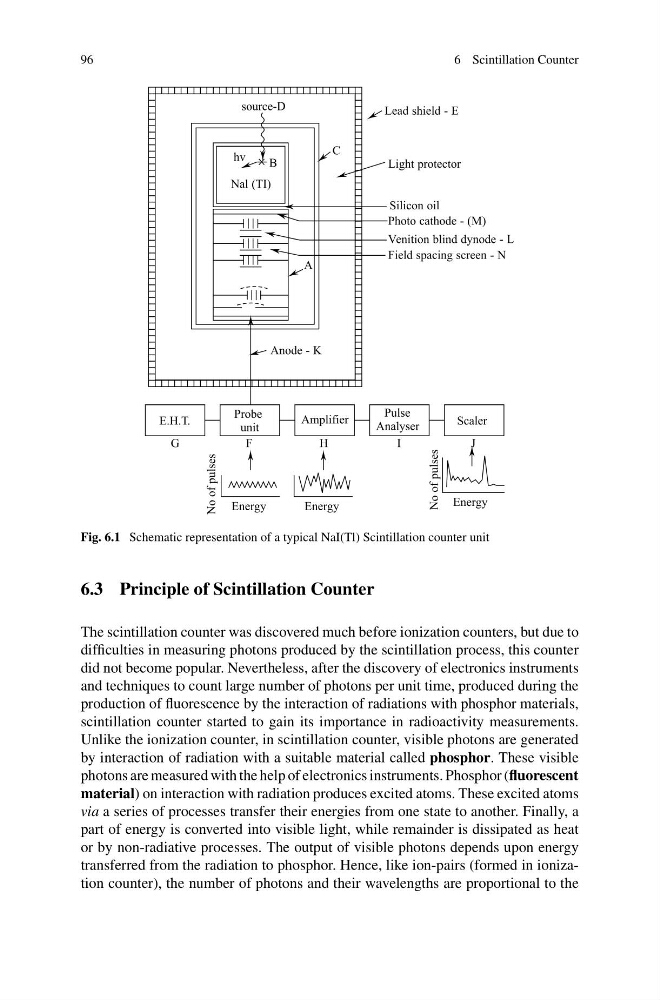
Fig. 6.1 Schematic representation of a typical NaI(Tl) Scintillation counter unit
6.3 Principle of Scintillation Counter
The scintillation counter was discovered much before ionization counters, but due to
difficulties in measuring photons produced by the scintillation process, this counter
did not become popular. Nevertheless, after the discovery of electronics instruments
and techniques to count large number of photons per unit time, produced during the
production of fluorescence by the interaction of radiations with phosphor materials,
scintillation counter started to gain its importance in radioactivity measurements.
Unlike the ionization counter, in scintillation counter, visible photons are generated
by interaction of radiation with a suitable material called phosphor. These visible
photons are measured with the help of electronics instruments. Phosphor (fluorescent
material) on interaction with radiation produces excited atoms. These excited atoms
via a series of processes transfer their energies from one state to another. Finally, a
part of energy is converted into visible light, while remainder is dissipated as heat
or by non-radiative processes. The output of visible photons depends upon energy
transferred from the radiation to phosphor. Hence, like ion-pairs (formed in ionization counter), the number of photons and their wavelengths are proportional to the
6 Scintillation Counter
Fig. 6.1 Schematic representation of a typical NaI(Tl) Scintillation counter unit
6.3 Principle of Scintillation Counter
The scintillation counter was discovered much before ionization counters, but due to
difficulties in measuring photons produced by the scintillation process, this counter
did not become popular. Nevertheless, after the discovery of electronics instruments
and techniques to count large number of photons per unit time, produced during the
production of fluorescence by the interaction of radiations with phosphor materials,
scintillation counter started to gain its importance in radioactivity measurements.
Unlike the ionization counter, in scintillation counter, visible photons are generated
by interaction of radiation with a suitable material called phosphor. These visible
photons are measured with the help of electronics instruments. Phosphor (fluorescent
material) on interaction with radiation produces excited atoms. These excited atoms
via a series of processes transfer their energies from one state to another. Finally, a
part of energy is converted into visible light, while remainder is dissipated as heat
or by non-radiative processes. The output of visible photons depends upon energy
transferred from the radiation to phosphor. Hence, like ion-pairs (formed in ionization counter), the number of photons and their wavelengths are proportional to the