

5.13 Chemically Quenched G.M. Counter
91
5.13.2 Halogen Quenched G.M. Counter
Halogens like chlorine or bromine gases have also been used for this purpose. The
main advantage of these gases is that, in addition to provide large area for collision, the
halogen molecules after collision with charged ions produce halogen atoms, which
again recombine to give the original halogen molecule. Because of this reversible
process, unlike organic molecules, halogen gases are not consumed. This gives a
very long life to the counter. In order to make an efficient inelastic collision with Ar
+
ion, bromine being the bulkiest molecule among the halogen gases, is preferred in
these counters. Normally, this counter operates at 600–700 V. The only disadvantage
with halogen quenched G.M. counter is that after some time halogen starts corroding
the metal of the chamber. It is for this reason mica is used as window rather than
aluminum.
5.14 Window Thickness
The end-window G.M. counters are made of either aluminum or mica windows,
whereas liquid G.M. counter has a thin glass wall, 50 mg cm
−2 thick. Therefore,
thickness of these windows puts a limit on the energy and type of radiations which
can be counted with these counters. As far as γ -rays are concerned, because of
their high penetrating power, they are unable to produce ion-pairs efficiently in the
counting chamber. α-particles, on the other hand, cannot penetrate the windows of
the counter, hence they too cannot be counted efficiently, unless some modifications
are made to the window. Hence, strictly speaking we are left with β-particles only,
which can hopefully be counted with reasonable efficiency. In order to appreciate the
effect of the window thickness, percentage transmission of β-particles of different
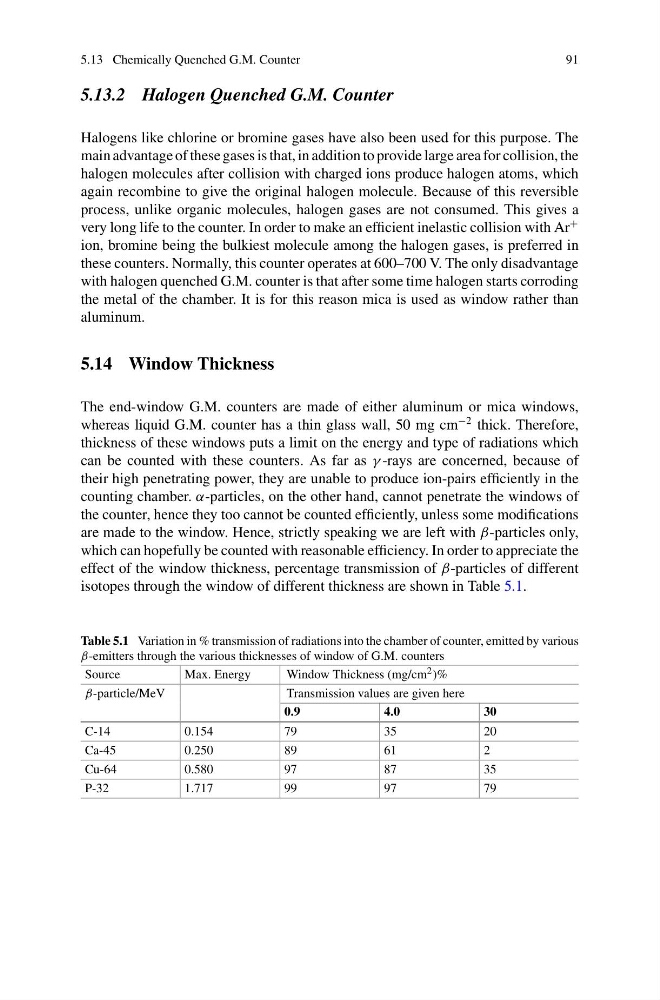
isotopes through the window of different thickness are shown in Table 5.1.
Table 5.1 Variation in % transmission of radiations into the chamber of counter, emitted by various
β-emitters through the various thicknesses of window of G.M. counters
Source
Max. Energy
Window Thickness (mg/cm 2 )%
β-particle/MeV
Transmission values are given here
0.9
4.0
30
C-14
0.154
79
35
20
Ca-45
0.250
89
61
2
Cu-64
0.580
97
87
35
P-32
1.717
99
97
79
91
5.13.2 Halogen Quenched G.M. Counter
Halogens like chlorine or bromine gases have also been used for this purpose. The
main advantage of these gases is that, in addition to provide large area for collision, the
halogen molecules after collision with charged ions produce halogen atoms, which
again recombine to give the original halogen molecule. Because of this reversible
process, unlike organic molecules, halogen gases are not consumed. This gives a
very long life to the counter. In order to make an efficient inelastic collision with Ar
+
ion, bromine being the bulkiest molecule among the halogen gases, is preferred in
these counters. Normally, this counter operates at 600–700 V. The only disadvantage
with halogen quenched G.M. counter is that after some time halogen starts corroding
the metal of the chamber. It is for this reason mica is used as window rather than
aluminum.
5.14 Window Thickness
The end-window G.M. counters are made of either aluminum or mica windows,
whereas liquid G.M. counter has a thin glass wall, 50 mg cm
−2 thick. Therefore,
thickness of these windows puts a limit on the energy and type of radiations which
can be counted with these counters. As far as γ -rays are concerned, because of
their high penetrating power, they are unable to produce ion-pairs efficiently in the
counting chamber. α-particles, on the other hand, cannot penetrate the windows of
the counter, hence they too cannot be counted efficiently, unless some modifications
are made to the window. Hence, strictly speaking we are left with β-particles only,
which can hopefully be counted with reasonable efficiency. In order to appreciate the
effect of the window thickness, percentage transmission of β-particles of different
isotopes through the window of different thickness are shown in Table 5.1.
Table 5.1 Variation in % transmission of radiations into the chamber of counter, emitted by various
β-emitters through the various thicknesses of window of G.M. counters
Source
Max. Energy
Window Thickness (mg/cm 2 )%
β-particle/MeV
Transmission values are given here
0.9
4.0
30
C-14
0.154
79
35
20
Ca-45
0.250
89
61
2
Cu-64
0.580
97
87
35
P-32
1.717
99
97
79