

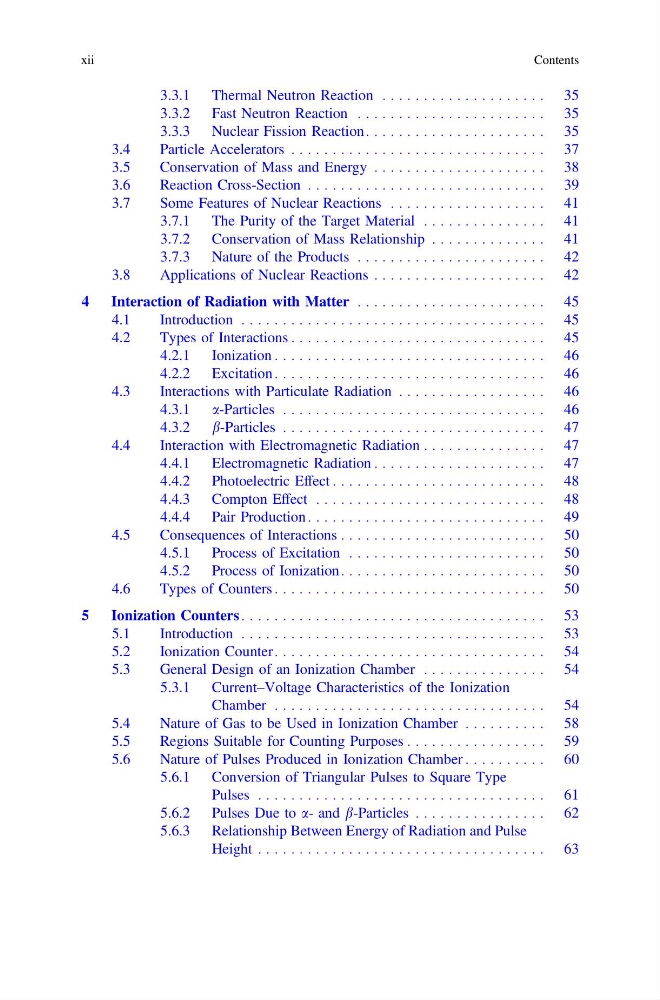
3.3.1 Thermal Neutron Reaction . . . . . . . . . . . . . . . . . . . . 35
3.3.2 Fast Neutron Reaction . . . . . . . . . . . . . . . . . . . . . . . 35
3.3.3 Nuclear Fission Reaction . . . . . . . . . . . . . . . . . . . . . . 35
3.4
Particle Accelerators . . . . . . . . . . . . . . . . . . . . . . . . . . . . . . . 37
3.5
Conservation of Mass and Energy . . . . . . . . . . . . . . . . . . . . . 38
3.6
Reaction Cross-Section . . . . . . . . . . . . . . . . . . . . . . . . . . . . . 39
3.7
Some Features of Nuclear Reactions . . . . . . . . . . . . . . . . . . . 41
3.7.1 The Purity of the Target Material . . . . . . . . . . . . . . . 41
3.7.2 Conservation of Mass Relationship . . . . . . . . . . . . . . 41
3.7.3 Nature of the Products . . . . . . . . . . . . . . . . . . . . . . . 42
3.8
Applications of Nuclear Reactions . . . . . . . . . . . . . . . . . . . . . 42
4 Interaction of Radiation with Matter . . . . . . . . . . . . . . . . . . . . . . . 45
4.1
Introduction . . . . . . . . . . . . . . . . . . . . . . . . . . . . . . . . . . . . . 45
4.2
Types of Interactions . . . . . . . . . . . . . . . . . . . . . . . . . . . . . . . 45
4.2.1 Ionization . . . . . . . . . . . . . . . . . . . . . . . . . . . . . . . . . 46
4.2.2 Excitation . . . . . . . . . . . . . . . . . . . . . . . . . . . . . . . . . 46
4.3
Interactions with Particulate Radiation . . . . . . . . . . . . . . . . . . 46
4.3.1 a-Particles . . . . . . . . . . . . . . . . . . . . . . . . . . . . . . . . 46
4.3.2 b-Particles . . . . . . . . . . . . . . . . . . . . . . . . . . . . . . . . 47
4.4
Interaction with Electromagnetic Radiation . . . . . . . . . . . . . . . 47
4.4.1 Electromagnetic Radiation . . . . . . . . . . . . . . . . . . . . . 47
4.4.2 Photoelectric Effect . . . . . . . . . . . . . . . . . . . . . . . . . . 48
4.4.3 Compton Effect . . . . . . . . . . . . . . . . . . . . . . . . . . . . 48
4.4.4 Pair Production . . . . . . . . . . . . . . . . . . . . . . . . . . . . . 49
4.5
Consequences of Interactions . . . . . . . . . . . . . . . . . . . . . . . . . 50
4.5.1 Process of Excitation . . . . . . . . . . . . . . . . . . . . . . . . 50
4.5.2 Process of Ionization . . . . . . . . . . . . . . . . . . . . . . . . . 50
4.6
Types of Counters . . . . . . . . . . . . . . . . . . . . . . . . . . . . . . . . . 50
5 Ionization Counters . . . . . . . . . . . . . . . . . . . . . . . . . . . . . . . . . . . . . 53
5.1
Introduction . . . . . . . . . . . . . . . . . . . . . . . . . . . . . . . . . . . . . 53
5.2
Ionization Counter . . . . . . . . . . . . . . . . . . . . . . . . . . . . . . . . . 54
5.3
General Design of an Ionization Chamber . . . . . . . . . . . . . . . 54
5.3.1 Current–Voltage Characteristics of the Ionization
Chamber . . . . . . . . . . . . . . . . . . . . . . . . . . . . . . . . . 54
5.4
Nature of Gas to be Used in Ionization Chamber . . . . . . . . . . 58
5.5
Regions Suitable for Counting Purposes . . . . . . . . . . . . . . . . . 59
5.6
Nature of Pulses Produced in Ionization Chamber . . . . . . . . . . 60
5.6.1 Conversion of Triangular Pulses to Square Type
Pulses . . . . . . . . . . . . . . . . . . . . . . . . . . . . . . . . . . . 61
5.6.2 Pulses Due to a- and b-Particles . . . . . . . . . . . . . . . . 62
5.6.3 Relationship Between Energy of Radiation and Pulse
Height . . . . . . . . . . . . . . . . . . . . . . . . . . . . . . . . . . . 63
xii
Contents
3.3.2 Fast Neutron Reaction . . . . . . . . . . . . . . . . . . . . . . . 35
3.3.3 Nuclear Fission Reaction . . . . . . . . . . . . . . . . . . . . . . 35
3.4
Particle Accelerators . . . . . . . . . . . . . . . . . . . . . . . . . . . . . . . 37
3.5
Conservation of Mass and Energy . . . . . . . . . . . . . . . . . . . . . 38
3.6
Reaction Cross-Section . . . . . . . . . . . . . . . . . . . . . . . . . . . . . 39
3.7
Some Features of Nuclear Reactions . . . . . . . . . . . . . . . . . . . 41
3.7.1 The Purity of the Target Material . . . . . . . . . . . . . . . 41
3.7.2 Conservation of Mass Relationship . . . . . . . . . . . . . . 41
3.7.3 Nature of the Products . . . . . . . . . . . . . . . . . . . . . . . 42
3.8
Applications of Nuclear Reactions . . . . . . . . . . . . . . . . . . . . . 42
4 Interaction of Radiation with Matter . . . . . . . . . . . . . . . . . . . . . . . 45
4.1
Introduction . . . . . . . . . . . . . . . . . . . . . . . . . . . . . . . . . . . . . 45
4.2
Types of Interactions . . . . . . . . . . . . . . . . . . . . . . . . . . . . . . . 45
4.2.1 Ionization . . . . . . . . . . . . . . . . . . . . . . . . . . . . . . . . . 46
4.2.2 Excitation . . . . . . . . . . . . . . . . . . . . . . . . . . . . . . . . . 46
4.3
Interactions with Particulate Radiation . . . . . . . . . . . . . . . . . . 46
4.3.1 a-Particles . . . . . . . . . . . . . . . . . . . . . . . . . . . . . . . . 46
4.3.2 b-Particles . . . . . . . . . . . . . . . . . . . . . . . . . . . . . . . . 47
4.4
Interaction with Electromagnetic Radiation . . . . . . . . . . . . . . . 47
4.4.1 Electromagnetic Radiation . . . . . . . . . . . . . . . . . . . . . 47
4.4.2 Photoelectric Effect . . . . . . . . . . . . . . . . . . . . . . . . . . 48
4.4.3 Compton Effect . . . . . . . . . . . . . . . . . . . . . . . . . . . . 48
4.4.4 Pair Production . . . . . . . . . . . . . . . . . . . . . . . . . . . . . 49
4.5
Consequences of Interactions . . . . . . . . . . . . . . . . . . . . . . . . . 50
4.5.1 Process of Excitation . . . . . . . . . . . . . . . . . . . . . . . . 50
4.5.2 Process of Ionization . . . . . . . . . . . . . . . . . . . . . . . . . 50
4.6
Types of Counters . . . . . . . . . . . . . . . . . . . . . . . . . . . . . . . . . 50
5 Ionization Counters . . . . . . . . . . . . . . . . . . . . . . . . . . . . . . . . . . . . . 53
5.1
Introduction . . . . . . . . . . . . . . . . . . . . . . . . . . . . . . . . . . . . . 53
5.2
Ionization Counter . . . . . . . . . . . . . . . . . . . . . . . . . . . . . . . . . 54
5.3
General Design of an Ionization Chamber . . . . . . . . . . . . . . . 54
5.3.1 Current–Voltage Characteristics of the Ionization
Chamber . . . . . . . . . . . . . . . . . . . . . . . . . . . . . . . . . 54
5.4
Nature of Gas to be Used in Ionization Chamber . . . . . . . . . . 58
5.5
Regions Suitable for Counting Purposes . . . . . . . . . . . . . . . . . 59
5.6
Nature of Pulses Produced in Ionization Chamber . . . . . . . . . . 60
5.6.1 Conversion of Triangular Pulses to Square Type
Pulses . . . . . . . . . . . . . . . . . . . . . . . . . . . . . . . . . . . 61
5.6.2 Pulses Due to a- and b-Particles . . . . . . . . . . . . . . . . 62
5.6.3 Relationship Between Energy of Radiation and Pulse
Height . . . . . . . . . . . . . . . . . . . . . . . . . . . . . . . . . . . 63
xii
Contents