

86
4 PVA Bionanocomposite Films with Different Particle …
4.3 Chemical Bonding Effect
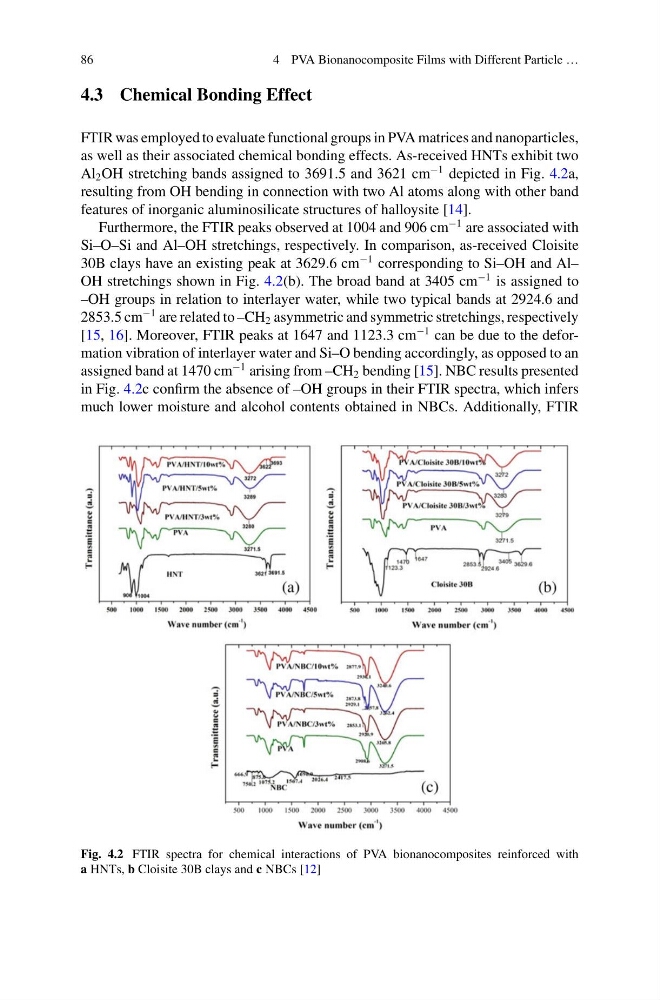
FTIR was employed to evaluate functional groups in PVA matrices and nanoparticles,
as well as their associated chemical bonding effects. As-received HNTs exhibit two
Al 2 OH stretching bands assigned to 3691.5 and 3621 cm
−1 depicted in Fig. 4.2a,
resulting from OH bending in connection with two Al atoms along with other band
features of inorganic aluminosilicate structures of halloysite [14].
Furthermore, the FTIR peaks observed at 1004 and 906 cm
−1 are associated with
Si–O–Si and Al–OH stretchings, respectively. In comparison, as-received Cloisite
30B clays have an existing peak at 3629.6 cm
−1 corresponding to Si–OH and Al–
OH stretchings shown in Fig. 4.2(b). The broad band at 3405 cm
−1 is assigned to
–OH groups in relation to interlayer water, while two typical bands at 2924.6 and
2853.5 cm
−1 are related to –CH 2 asymmetric and symmetric stretchings, respectively
[15, 16]. Moreover, FTIR peaks at 1647 and 1123.3 cm
−1 can be due to the deformation vibration of interlayer water and Si–O bending accordingly, as opposed to an
assigned band at 1470 cm
−1 arising from –CH 2 bending [15]. NBC results presented
in Fig. 4.2c confirm the absence of –OH groups in their FTIR spectra, which infers
much lower moisture and alcohol contents obtained in NBCs. Additionally, FTIR
Fig. 4.2 FTIR spectra for chemical interactions of PVA bionanocomposites reinforced with
a HNTs, b Cloisite 30B clays and c NBCs [12]
4 PVA Bionanocomposite Films with Different Particle …
4.3 Chemical Bonding Effect
FTIR was employed to evaluate functional groups in PVA matrices and nanoparticles,
as well as their associated chemical bonding effects. As-received HNTs exhibit two
Al 2 OH stretching bands assigned to 3691.5 and 3621 cm
−1 depicted in Fig. 4.2a,
resulting from OH bending in connection with two Al atoms along with other band
features of inorganic aluminosilicate structures of halloysite [14].
Furthermore, the FTIR peaks observed at 1004 and 906 cm
−1 are associated with
Si–O–Si and Al–OH stretchings, respectively. In comparison, as-received Cloisite
30B clays have an existing peak at 3629.6 cm
−1 corresponding to Si–OH and Al–
OH stretchings shown in Fig. 4.2(b). The broad band at 3405 cm
−1 is assigned to
–OH groups in relation to interlayer water, while two typical bands at 2924.6 and
2853.5 cm
−1 are related to –CH 2 asymmetric and symmetric stretchings, respectively
[15, 16]. Moreover, FTIR peaks at 1647 and 1123.3 cm
−1 can be due to the deformation vibration of interlayer water and Si–O bending accordingly, as opposed to an
assigned band at 1470 cm
−1 arising from –CH 2 bending [15]. NBC results presented
in Fig. 4.2c confirm the absence of –OH groups in their FTIR spectra, which infers
much lower moisture and alcohol contents obtained in NBCs. Additionally, FTIR
Fig. 4.2 FTIR spectra for chemical interactions of PVA bionanocomposites reinforced with
a HNTs, b Cloisite 30B clays and c NBCs [12]