

72
3 PVA/BC Bionancomposite Films with Particle Size Effect
A1
B1
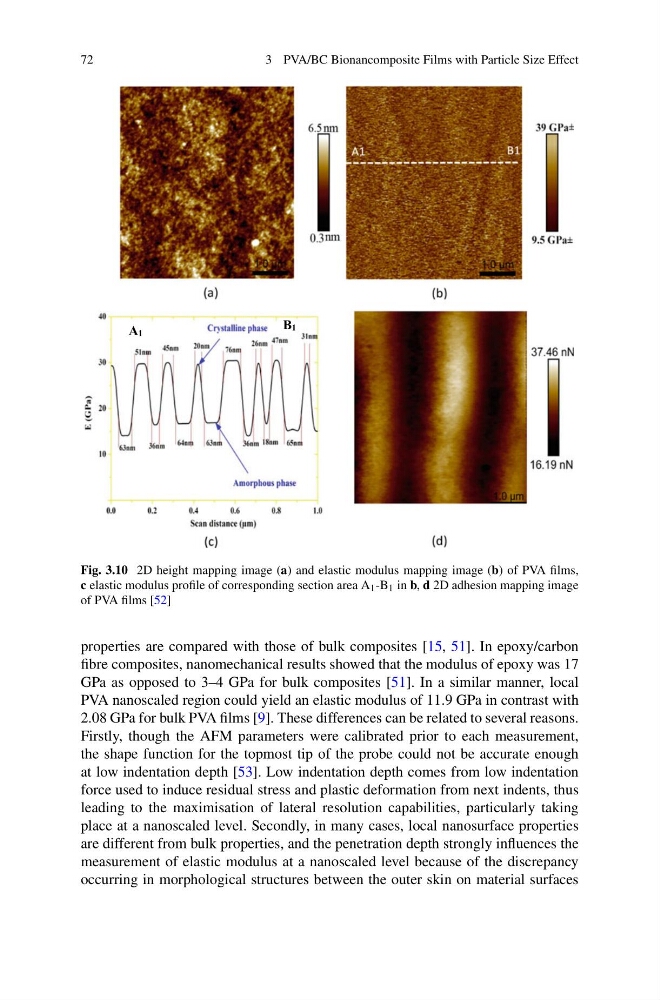
Fig. 3.10 2D height mapping image (a) and elastic modulus mapping image (b) of PVA films,
c elastic modulus profile of corresponding section area A 1 -B 1 in b, d 2D adhesion mapping image
of PVA films [52]
properties are compared with those of bulk composites [15, 51]. In epoxy/carbon
fibre composites, nanomechanical results showed that the modulus of epoxy was 17
GPa as opposed to 3–4 GPa for bulk composites [51]. In a similar manner, local
PVA nanoscaled region could yield an elastic modulus of 11.9 GPa in contrast with
2.08 GPa for bulk PVA films [9]. These differences can be related to several reasons.
Firstly, though the AFM parameters were calibrated prior to each measurement,
the shape function for the topmost tip of the probe could not be accurate enough
at low indentation depth [53]. Low indentation depth comes from low indentation
force used to induce residual stress and plastic deformation from next indents, thus
leading to the maximisation of lateral resolution capabilities, particularly taking
place at a nanoscaled level. Secondly, in many cases, local nanosurface properties
are different from bulk properties, and the penetration depth strongly influences the
measurement of elastic modulus at a nanoscaled level because of the discrepancy
occurring in morphological structures between the outer skin on material surfaces
3 PVA/BC Bionancomposite Films with Particle Size Effect
A1
B1
Fig. 3.10 2D height mapping image (a) and elastic modulus mapping image (b) of PVA films,
c elastic modulus profile of corresponding section area A 1 -B 1 in b, d 2D adhesion mapping image
of PVA films [52]
properties are compared with those of bulk composites [15, 51]. In epoxy/carbon
fibre composites, nanomechanical results showed that the modulus of epoxy was 17
GPa as opposed to 3–4 GPa for bulk composites [51]. In a similar manner, local
PVA nanoscaled region could yield an elastic modulus of 11.9 GPa in contrast with
2.08 GPa for bulk PVA films [9]. These differences can be related to several reasons.
Firstly, though the AFM parameters were calibrated prior to each measurement,
the shape function for the topmost tip of the probe could not be accurate enough
at low indentation depth [53]. Low indentation depth comes from low indentation
force used to induce residual stress and plastic deformation from next indents, thus
leading to the maximisation of lateral resolution capabilities, particularly taking
place at a nanoscaled level. Secondly, in many cases, local nanosurface properties
are different from bulk properties, and the penetration depth strongly influences the
measurement of elastic modulus at a nanoscaled level because of the discrepancy
occurring in morphological structures between the outer skin on material surfaces