

42
2 Materials, Methodology and Characterisation Techniques
In comparison, HNTs have 2D tubular structures with high aspect ratios and functional groups on their surfaces, which thus makes HNTs closely interact with PVA
molecules in PVA/HNT nanocomposites. Finally, BCs possess 3D porous structures
with the ability to absorb PVA molecules into such internal pores in order to form
both strong mechanical and chemical bondings.
2.1.2.1 Bamboo Charcoals (BCs)
Two different types of bioactive BC fillers were used in this study. The first was
denoted as microdiameter bamboo charcoals (MBCs) supplied by Jiangshan Luyi
Bamboo Charcoals Co., Ltd., China (molecular weight: 12.01 g/mol and density: 0.2–
0.5 g/cm
3 ) with their particle size being less than 800 nm [2]. The second type was
referred to as nanodiameter bamboo charcoals (NBCs) purchased from US Research
Nanomaterials, Inc. Co., USA (molecular weight: 12.01 g/mol, density: 0.43 g/cm
3
and particle size less than 100 nm [3]).
2.1.2.2 Clay Nanofillers
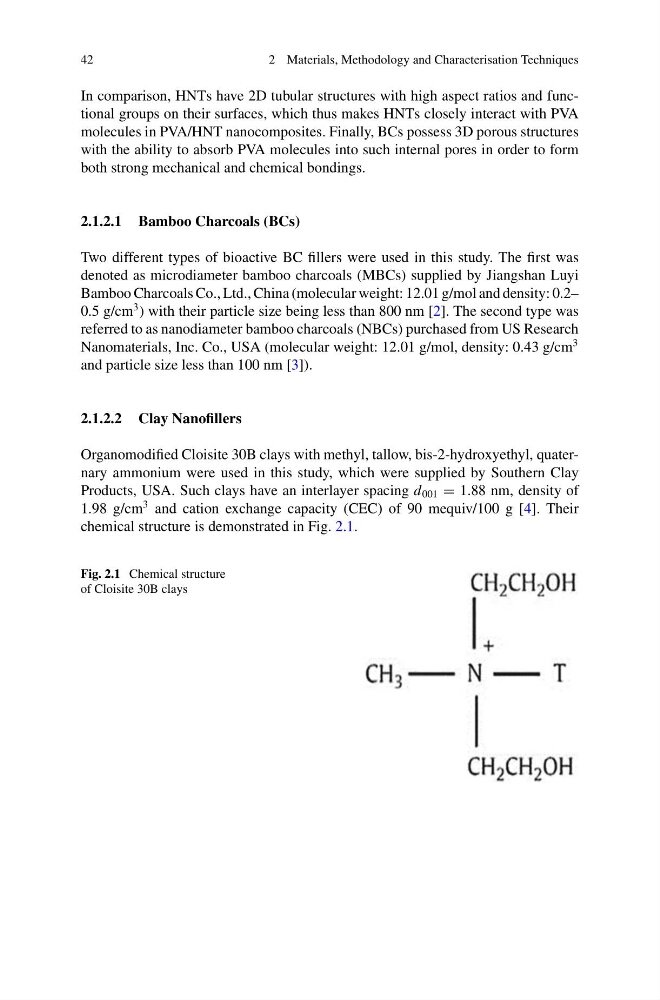
Organomodified Cloisite 30B clays with methyl, tallow, bis-2-hydroxyethyl, quaternary ammonium were used in this study, which were supplied by Southern Clay
Products, USA. Such clays have an interlayer spacing d 001 = 1.88 nm, density of
1.98 g/cm
3 and cation exchange capacity (CEC) of 90 mequiv/100 g [4]. Their
chemical structure is demonstrated in Fig. 2.1.
Fig. 2.1 Chemical structure
of Cloisite 30B clays
2 Materials, Methodology and Characterisation Techniques
In comparison, HNTs have 2D tubular structures with high aspect ratios and functional groups on their surfaces, which thus makes HNTs closely interact with PVA
molecules in PVA/HNT nanocomposites. Finally, BCs possess 3D porous structures
with the ability to absorb PVA molecules into such internal pores in order to form
both strong mechanical and chemical bondings.
2.1.2.1 Bamboo Charcoals (BCs)
Two different types of bioactive BC fillers were used in this study. The first was
denoted as microdiameter bamboo charcoals (MBCs) supplied by Jiangshan Luyi
Bamboo Charcoals Co., Ltd., China (molecular weight: 12.01 g/mol and density: 0.2–
0.5 g/cm
3 ) with their particle size being less than 800 nm [2]. The second type was
referred to as nanodiameter bamboo charcoals (NBCs) purchased from US Research
Nanomaterials, Inc. Co., USA (molecular weight: 12.01 g/mol, density: 0.43 g/cm
3
and particle size less than 100 nm [3]).
2.1.2.2 Clay Nanofillers
Organomodified Cloisite 30B clays with methyl, tallow, bis-2-hydroxyethyl, quaternary ammonium were used in this study, which were supplied by Southern Clay
Products, USA. Such clays have an interlayer spacing d 001 = 1.88 nm, density of
1.98 g/cm
3 and cation exchange capacity (CEC) of 90 mequiv/100 g [4]. Their
chemical structure is demonstrated in Fig. 2.1.
Fig. 2.1 Chemical structure
of Cloisite 30B clays