

1.5 Processing of Bionanocomposites
19
PVA/HNT nanocomposites [135] and PVA/MMT nanocomposites [13, 136–139].
The main advantage of this method is that intercalated clay structures in nanocomposites can be formed even for low-polar or non-polar polymers notwithstanding that
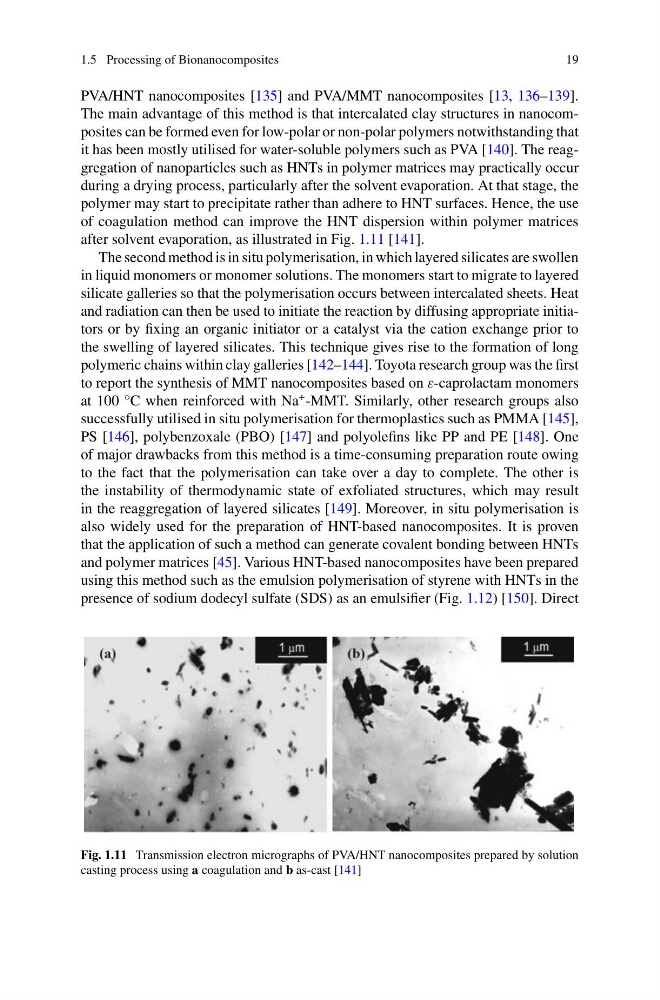
it has been mostly utilised for water-soluble polymers such as PVA [140]. The reaggregation of nanoparticles such as HNTs in polymer matrices may practically occur
during a drying process, particularly after the solvent evaporation. At that stage, the
polymer may start to precipitate rather than adhere to HNT surfaces. Hence, the use
of coagulation method can improve the HNT dispersion within polymer matrices
after solvent evaporation, as illustrated in Fig. 1.11 [141].
The second method is in situ polymerisation, in which layered silicates are swollen
in liquid monomers or monomer solutions. The monomers start to migrate to layered
silicate galleries so that the polymerisation occurs between intercalated sheets. Heat
and radiation can then be used to initiate the reaction by diffusing appropriate initiators or by fixing an organic initiator or a catalyst via the cation exchange prior to
the swelling of layered silicates. This technique gives rise to the formation of long
polymeric chains within clay galleries [142–144]. Toyota research group was the first
to report the synthesis of MMT nanocomposites based on ε-caprolactam monomers
at 100 °C when reinforced with Na
+ -MMT. Similarly, other research groups also
successfully utilised in situ polymerisation for thermoplastics such as PMMA [145],
PS [146], polybenzoxale (PBO) [147] and polyolefins like PP and PE [148]. One
of major drawbacks from this method is a time-consuming preparation route owing
to the fact that the polymerisation can take over a day to complete. The other is
the instability of thermodynamic state of exfoliated structures, which may result
in the reaggregation of layered silicates [149]. Moreover, in situ polymerisation is
also widely used for the preparation of HNT-based nanocomposites. It is proven
that the application of such a method can generate covalent bonding between HNTs
and polymer matrices [45]. Various HNT-based nanocomposites have been prepared
using this method such as the emulsion polymerisation of styrene with HNTs in the
presence of sodium dodecyl sulfate (SDS) as an emulsifier (Fig. 1.12) [150]. Direct
Fig. 1.11 Transmission electron micrographs of PVA/HNT nanocomposites prepared by solution
casting process using a coagulation and b as-cast [141]
19
PVA/HNT nanocomposites [135] and PVA/MMT nanocomposites [13, 136–139].
The main advantage of this method is that intercalated clay structures in nanocomposites can be formed even for low-polar or non-polar polymers notwithstanding that
it has been mostly utilised for water-soluble polymers such as PVA [140]. The reaggregation of nanoparticles such as HNTs in polymer matrices may practically occur
during a drying process, particularly after the solvent evaporation. At that stage, the
polymer may start to precipitate rather than adhere to HNT surfaces. Hence, the use
of coagulation method can improve the HNT dispersion within polymer matrices
after solvent evaporation, as illustrated in Fig. 1.11 [141].
The second method is in situ polymerisation, in which layered silicates are swollen
in liquid monomers or monomer solutions. The monomers start to migrate to layered
silicate galleries so that the polymerisation occurs between intercalated sheets. Heat
and radiation can then be used to initiate the reaction by diffusing appropriate initiators or by fixing an organic initiator or a catalyst via the cation exchange prior to
the swelling of layered silicates. This technique gives rise to the formation of long
polymeric chains within clay galleries [142–144]. Toyota research group was the first
to report the synthesis of MMT nanocomposites based on ε-caprolactam monomers
at 100 °C when reinforced with Na
+ -MMT. Similarly, other research groups also
successfully utilised in situ polymerisation for thermoplastics such as PMMA [145],
PS [146], polybenzoxale (PBO) [147] and polyolefins like PP and PE [148]. One
of major drawbacks from this method is a time-consuming preparation route owing
to the fact that the polymerisation can take over a day to complete. The other is
the instability of thermodynamic state of exfoliated structures, which may result
in the reaggregation of layered silicates [149]. Moreover, in situ polymerisation is
also widely used for the preparation of HNT-based nanocomposites. It is proven
that the application of such a method can generate covalent bonding between HNTs
and polymer matrices [45]. Various HNT-based nanocomposites have been prepared
using this method such as the emulsion polymerisation of styrene with HNTs in the
presence of sodium dodecyl sulfate (SDS) as an emulsifier (Fig. 1.12) [150]. Direct
Fig. 1.11 Transmission electron micrographs of PVA/HNT nanocomposites prepared by solution
casting process using a coagulation and b as-cast [141]