

16
1 Introduction to PVA-Based Bionanocomposite Films
pyrolysis at 1000–1500 °C possessed the same porous features of fresh bamboos,
as well as exhibited a wide range of pore distributions from 1 nm to 1 μm in size
[113]. On the other hand, rough walls of basic units inside BCs, namely parenchyma,
along with their smooth outer surfaces can make entire charcoals very hard. This is
because BCs consist of carbon with a small amount of minerals. The graphitisation
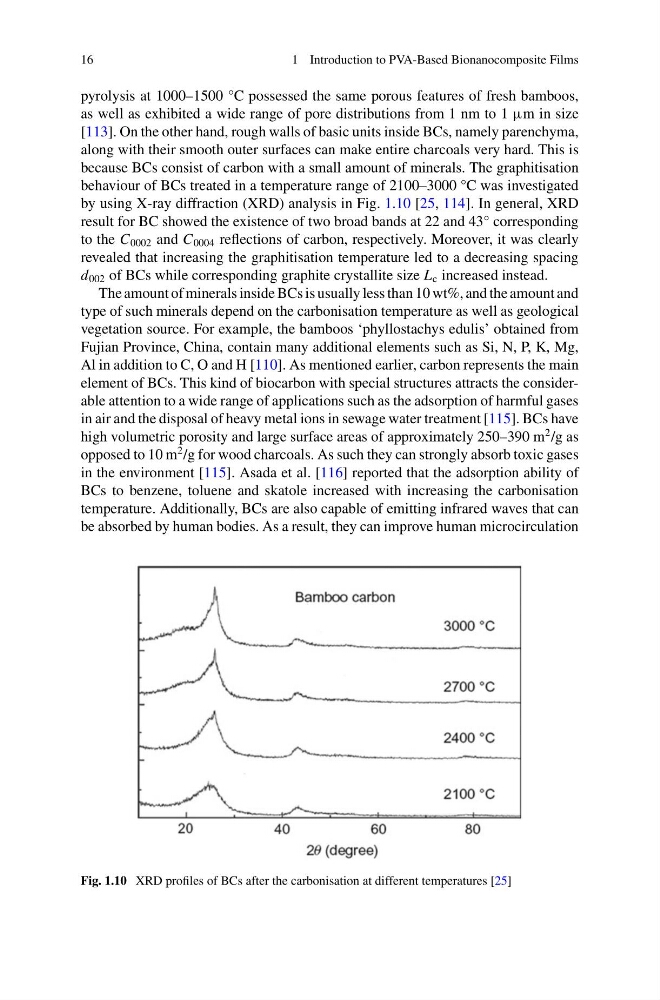
behaviour of BCs treated in a temperature range of 2100–3000 °C was investigated
by using X-ray diffraction (XRD) analysis in Fig. 1.10 [25, 114]. In general, XRD
result for BC showed the existence of two broad bands at 22 and 43° corresponding
to the C 0002 and C 0004 reflections of carbon, respectively. Moreover, it was clearly
revealed that increasing the graphitisation temperature led to a decreasing spacing
d 002 of BCs while corresponding graphite crystallite size L c increased instead.
The amount of minerals inside BCs is usually less than 10 wt%, and the amount and
type of such minerals depend on the carbonisation temperature as well as geological
vegetation source. For example, the bamboos ‘phyllostachys edulis’ obtained from
Fujian Province, China, contain many additional elements such as Si, N, P, K, Mg,
Al in addition to C, O and H [110]. As mentioned earlier, carbon represents the main
element of BCs. This kind of biocarbon with special structures attracts the considerable attention to a wide range of applications such as the adsorption of harmful gases
in air and the disposal of heavy metal ions in sewage water treatment [115]. BCs have
high volumetric porosity and large surface areas of approximately 250–390 m
2 /g as
opposed to 10 m
2 /g for wood charcoals. As such they can strongly absorb toxic gases
in the environment [115]. Asada et al. [116] reported that the adsorption ability of
BCs to benzene, toluene and skatole increased with increasing the carbonisation
temperature. Additionally, BCs are also capable of emitting infrared waves that can
be absorbed by human bodies. As a result, they can improve human microcirculation
Fig. 1.10 XRD profiles of BCs after the carbonisation at different temperatures [25]
1 Introduction to PVA-Based Bionanocomposite Films
pyrolysis at 1000–1500 °C possessed the same porous features of fresh bamboos,
as well as exhibited a wide range of pore distributions from 1 nm to 1 μm in size
[113]. On the other hand, rough walls of basic units inside BCs, namely parenchyma,
along with their smooth outer surfaces can make entire charcoals very hard. This is
because BCs consist of carbon with a small amount of minerals. The graphitisation
behaviour of BCs treated in a temperature range of 2100–3000 °C was investigated
by using X-ray diffraction (XRD) analysis in Fig. 1.10 [25, 114]. In general, XRD
result for BC showed the existence of two broad bands at 22 and 43° corresponding
to the C 0002 and C 0004 reflections of carbon, respectively. Moreover, it was clearly
revealed that increasing the graphitisation temperature led to a decreasing spacing
d 002 of BCs while corresponding graphite crystallite size L c increased instead.
The amount of minerals inside BCs is usually less than 10 wt%, and the amount and
type of such minerals depend on the carbonisation temperature as well as geological
vegetation source. For example, the bamboos ‘phyllostachys edulis’ obtained from
Fujian Province, China, contain many additional elements such as Si, N, P, K, Mg,
Al in addition to C, O and H [110]. As mentioned earlier, carbon represents the main
element of BCs. This kind of biocarbon with special structures attracts the considerable attention to a wide range of applications such as the adsorption of harmful gases
in air and the disposal of heavy metal ions in sewage water treatment [115]. BCs have
high volumetric porosity and large surface areas of approximately 250–390 m
2 /g as
opposed to 10 m
2 /g for wood charcoals. As such they can strongly absorb toxic gases
in the environment [115]. Asada et al. [116] reported that the adsorption ability of
BCs to benzene, toluene and skatole increased with increasing the carbonisation
temperature. Additionally, BCs are also capable of emitting infrared waves that can
be absorbed by human bodies. As a result, they can improve human microcirculation
Fig. 1.10 XRD profiles of BCs after the carbonisation at different temperatures [25]