

14
1 Introduction to PVA-Based Bionanocomposite Films
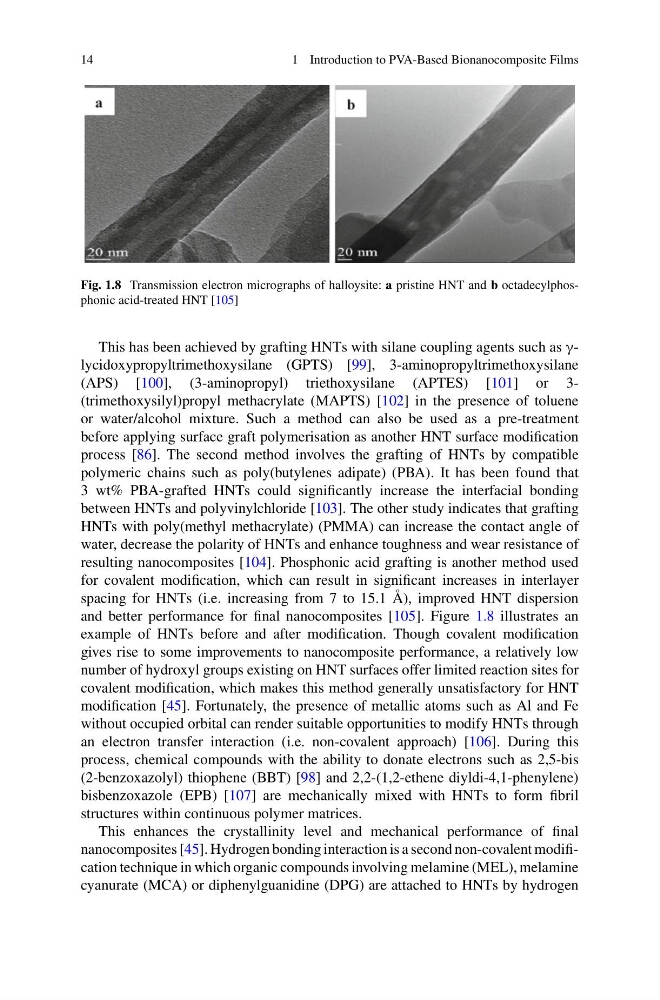
Fig. 1.8 Transmission electron micrographs of halloysite: a pristine HNT and b octadecylphosphonic acid-treated HNT [105]
This has been achieved by grafting HNTs with silane coupling agents such as γlycidoxypropyltrimethoxysilane (GPTS) [99], 3-aminopropyltrimethoxysilane
(APS) [100], (3-aminopropyl) triethoxysilane (APTES) [101] or 3(trimethoxysilyl)propyl methacrylate (MAPTS) [102] in the presence of toluene
or water/alcohol mixture. Such a method can also be used as a pre-treatment
before applying surface graft polymerisation as another HNT surface modification
process [86]. The second method involves the grafting of HNTs by compatible
polymeric chains such as poly(butylenes adipate) (PBA). It has been found that
3 wt% PBA-grafted HNTs could significantly increase the interfacial bonding
between HNTs and polyvinylchloride [103]. The other study indicates that grafting
HNTs with poly(methyl methacrylate) (PMMA) can increase the contact angle of
water, decrease the polarity of HNTs and enhance toughness and wear resistance of
resulting nanocomposites [104]. Phosphonic acid grafting is another method used
for covalent modification, which can result in significant increases in interlayer
spacing for HNTs (i.e. increasing from 7 to 15.1 Å), improved HNT dispersion
and better performance for final nanocomposites [105]. Figure 1.8 illustrates an
example of HNTs before and after modification. Though covalent modification
gives rise to some improvements to nanocomposite performance, a relatively low
number of hydroxyl groups existing on HNT surfaces offer limited reaction sites for
covalent modification, which makes this method generally unsatisfactory for HNT
modification [45]. Fortunately, the presence of metallic atoms such as Al and Fe
without occupied orbital can render suitable opportunities to modify HNTs through
an electron transfer interaction (i.e. non-covalent approach) [106]. During this
process, chemical compounds with the ability to donate electrons such as 2,5-bis
(2-benzoxazolyl) thiophene (BBT) [98] and 2,2-(1,2-ethene diyldi-4,1-phenylene)
bisbenzoxazole (EPB) [107] are mechanically mixed with HNTs to form fibril
structures within continuous polymer matrices.
This enhances the crystallinity level and mechanical performance of final
nanocomposites [45]. Hydrogen bonding interaction is a second non-covalent modification technique in which organic compounds involving melamine (MEL), melamine
cyanurate (MCA) or diphenylguanidine (DPG) are attached to HNTs by hydrogen
1 Introduction to PVA-Based Bionanocomposite Films
Fig. 1.8 Transmission electron micrographs of halloysite: a pristine HNT and b octadecylphosphonic acid-treated HNT [105]
This has been achieved by grafting HNTs with silane coupling agents such as γlycidoxypropyltrimethoxysilane (GPTS) [99], 3-aminopropyltrimethoxysilane
(APS) [100], (3-aminopropyl) triethoxysilane (APTES) [101] or 3(trimethoxysilyl)propyl methacrylate (MAPTS) [102] in the presence of toluene
or water/alcohol mixture. Such a method can also be used as a pre-treatment
before applying surface graft polymerisation as another HNT surface modification
process [86]. The second method involves the grafting of HNTs by compatible
polymeric chains such as poly(butylenes adipate) (PBA). It has been found that
3 wt% PBA-grafted HNTs could significantly increase the interfacial bonding
between HNTs and polyvinylchloride [103]. The other study indicates that grafting
HNTs with poly(methyl methacrylate) (PMMA) can increase the contact angle of
water, decrease the polarity of HNTs and enhance toughness and wear resistance of
resulting nanocomposites [104]. Phosphonic acid grafting is another method used
for covalent modification, which can result in significant increases in interlayer
spacing for HNTs (i.e. increasing from 7 to 15.1 Å), improved HNT dispersion
and better performance for final nanocomposites [105]. Figure 1.8 illustrates an
example of HNTs before and after modification. Though covalent modification
gives rise to some improvements to nanocomposite performance, a relatively low
number of hydroxyl groups existing on HNT surfaces offer limited reaction sites for
covalent modification, which makes this method generally unsatisfactory for HNT
modification [45]. Fortunately, the presence of metallic atoms such as Al and Fe
without occupied orbital can render suitable opportunities to modify HNTs through
an electron transfer interaction (i.e. non-covalent approach) [106]. During this
process, chemical compounds with the ability to donate electrons such as 2,5-bis
(2-benzoxazolyl) thiophene (BBT) [98] and 2,2-(1,2-ethene diyldi-4,1-phenylene)
bisbenzoxazole (EPB) [107] are mechanically mixed with HNTs to form fibril
structures within continuous polymer matrices.
This enhances the crystallinity level and mechanical performance of final
nanocomposites [45]. Hydrogen bonding interaction is a second non-covalent modification technique in which organic compounds involving melamine (MEL), melamine
cyanurate (MCA) or diphenylguanidine (DPG) are attached to HNTs by hydrogen