

10
1 Introduction to PVA-Based Bionanocomposite Films
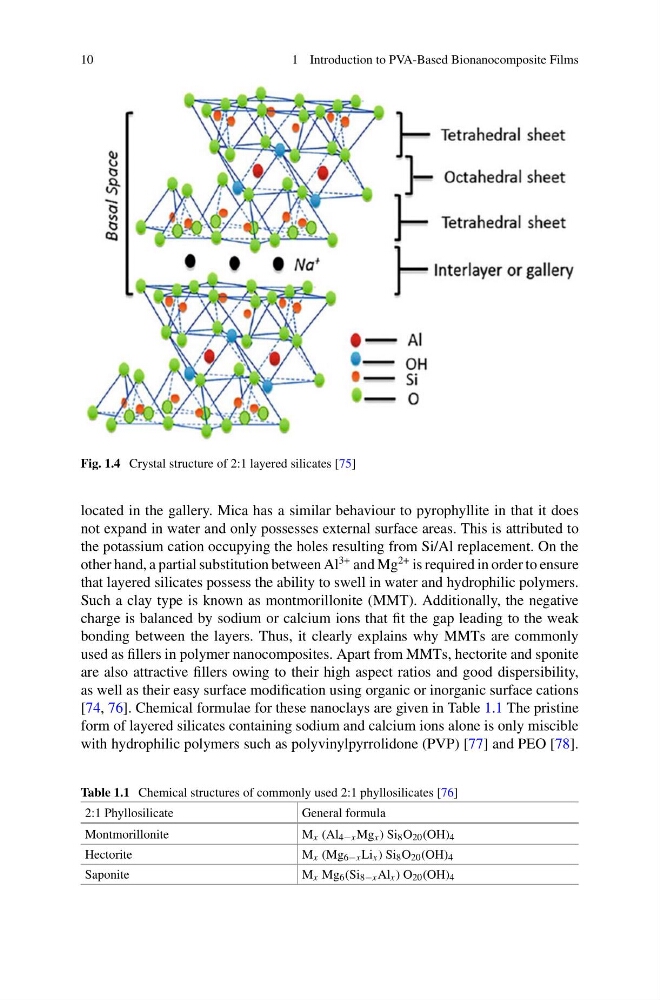
Fig. 1.4 Crystal structure of 2:1 layered silicates [75]
located in the gallery. Mica has a similar behaviour to pyrophyllite in that it does
not expand in water and only possesses external surface areas. This is attributed to
the potassium cation occupying the holes resulting from Si/Al replacement. On the
other hand, a partial substitution between Al
3+ and Mg
2+ is required in order to ensure
that layered silicates possess the ability to swell in water and hydrophilic polymers.
Such a clay type is known as montmorillonite (MMT). Additionally, the negative
charge is balanced by sodium or calcium ions that fit the gap leading to the weak
bonding between the layers. Thus, it clearly explains why MMTs are commonly
used as fillers in polymer nanocomposites. Apart from MMTs, hectorite and sponite
are also attractive fillers owing to their high aspect ratios and good dispersibility,
as well as their easy surface modification using organic or inorganic surface cations
[74, 76]. Chemical formulae for these nanoclays are given in Table 1.1 The pristine
form of layered silicates containing sodium and calcium ions alone is only miscible
with hydrophilic polymers such as polyvinylpyrrolidone (PVP) [77] and PEO [78].
Table 1.1 Chemical structures of commonly used 2:1 phyllosilicates [76]
2:1 Phyllosilicate
General formula
Montmorillonite
M x (Al 4−x Mg x ) Si 8 O 20 (OH) 4
Hectorite
M x (Mg 6−x Li x ) Si 8 O 20 (OH) 4
Saponite
M x Mg 6 (Si 8−x Al x ) O 20 (OH) 4
1 Introduction to PVA-Based Bionanocomposite Films
Fig. 1.4 Crystal structure of 2:1 layered silicates [75]
located in the gallery. Mica has a similar behaviour to pyrophyllite in that it does
not expand in water and only possesses external surface areas. This is attributed to
the potassium cation occupying the holes resulting from Si/Al replacement. On the
other hand, a partial substitution between Al
3+ and Mg
2+ is required in order to ensure
that layered silicates possess the ability to swell in water and hydrophilic polymers.
Such a clay type is known as montmorillonite (MMT). Additionally, the negative
charge is balanced by sodium or calcium ions that fit the gap leading to the weak
bonding between the layers. Thus, it clearly explains why MMTs are commonly
used as fillers in polymer nanocomposites. Apart from MMTs, hectorite and sponite
are also attractive fillers owing to their high aspect ratios and good dispersibility,
as well as their easy surface modification using organic or inorganic surface cations
[74, 76]. Chemical formulae for these nanoclays are given in Table 1.1 The pristine
form of layered silicates containing sodium and calcium ions alone is only miscible
with hydrophilic polymers such as polyvinylpyrrolidone (PVP) [77] and PEO [78].
Table 1.1 Chemical structures of commonly used 2:1 phyllosilicates [76]
2:1 Phyllosilicate
General formula
Montmorillonite
M x (Al 4−x Mg x ) Si 8 O 20 (OH) 4
Hectorite
M x (Mg 6−x Li x ) Si 8 O 20 (OH) 4
Saponite
M x Mg 6 (Si 8−x Al x ) O 20 (OH) 4