

Appendix
Interphase Dimension Measurement Via
AFM
PVA/NBC Bionanocomposite Films
According to our previous work [1, 2], NBCs are regarded as anisotropic particles
resulting in the interaction with polymer matrices to generate interphase. Interphase
could also be anisotropic between PVA/NBC phases. The variation of interphase
dimensions leads to different nanomechanical properties to influence overall material
performance of bionanocomposites. A simple approach to measure 3D interphase
dimensions to determine interphase surface area and interphase volume based on
nanomechanical properties has been developed as follows:
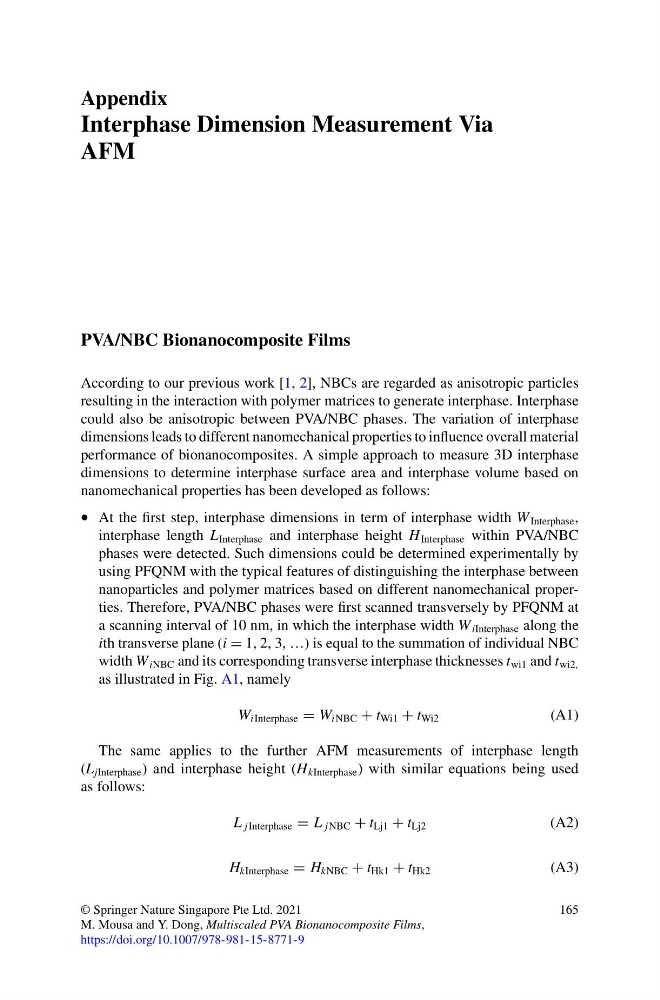
• At the first step, interphase dimensions in term of interphase width W Interphase ,
interphase length L Interphase and interphase height H Interphase within PVA/NBC
phases were detected. Such dimensions could be determined experimentally by
using PFQNM with the typical features of distinguishing the interphase between
nanoparticles and polymer matrices based on different nanomechanical properties. Therefore, PVA/NBC phases were first scanned transversely by PFQNM at
a scanning interval of 10 nm, in which the interphase width W iInterphase along the
ith transverse plane (i = 1, 2, 3, …) is equal to the summation of individual NBC
width W iNBC and its corresponding transverse interphase thicknesses t wi1 and t wi2,
as illustrated in Fig. A1, namely
W iInterphase = W iNBC + t Wi1 + t Wi2
(A1)
The same applies to the further AFM measurements of interphase length
(L jInterphase ) and interphase height (H kInterphase ) with similar equations being used
as follows:
L jInterphase = L jNBC + t Lj1 + t Lj2
(A2)
H kInterphase = H kNBC + t Hk1 + t Hk2
(A3)
© Springer Nature Singapore Pte Ltd. 2021
M. Mousa and Y. Dong, Multiscaled PVA Bionanocomposite Films,
https://doi.org/10.1007/978-981-15-8771-9
165
Interphase Dimension Measurement Via
AFM
PVA/NBC Bionanocomposite Films
According to our previous work [1, 2], NBCs are regarded as anisotropic particles
resulting in the interaction with polymer matrices to generate interphase. Interphase
could also be anisotropic between PVA/NBC phases. The variation of interphase
dimensions leads to different nanomechanical properties to influence overall material
performance of bionanocomposites. A simple approach to measure 3D interphase
dimensions to determine interphase surface area and interphase volume based on
nanomechanical properties has been developed as follows:
• At the first step, interphase dimensions in term of interphase width W Interphase ,
interphase length L Interphase and interphase height H Interphase within PVA/NBC
phases were detected. Such dimensions could be determined experimentally by
using PFQNM with the typical features of distinguishing the interphase between
nanoparticles and polymer matrices based on different nanomechanical properties. Therefore, PVA/NBC phases were first scanned transversely by PFQNM at
a scanning interval of 10 nm, in which the interphase width W iInterphase along the
ith transverse plane (i = 1, 2, 3, …) is equal to the summation of individual NBC
width W iNBC and its corresponding transverse interphase thicknesses t wi1 and t wi2,
as illustrated in Fig. A1, namely
W iInterphase = W iNBC + t Wi1 + t Wi2
(A1)
The same applies to the further AFM measurements of interphase length
(L jInterphase ) and interphase height (H kInterphase ) with similar equations being used
as follows:
L jInterphase = L jNBC + t Lj1 + t Lj2
(A2)
H kInterphase = H kNBC + t Hk1 + t Hk2
(A3)
© Springer Nature Singapore Pte Ltd. 2021
M. Mousa and Y. Dong, Multiscaled PVA Bionanocomposite Films,
https://doi.org/10.1007/978-981-15-8771-9
165