

1.3 Poly(Vinyl Alcohol) (PVA)
7
acidic catalysts. As such, the most recommended process is the transesterification
in the methanol using a proper amount of sodium methoxide as the catalysts. The
residual content of acetyl groups can be controlled by manipulating catalyst content,
reaction temperature and reaction time. Moreover, the types of catalysts and solvents
used are selected based on the distribution nature of acetyl groups in the partial
saponification of PVA. For example, acetyl groups are distributed in a blockwise
manner in case of alkaline saponification while they distributed statistically with
respect to acidic saponification [62].
PVA properties are determined from molecular weight and degree of hydrolysis,
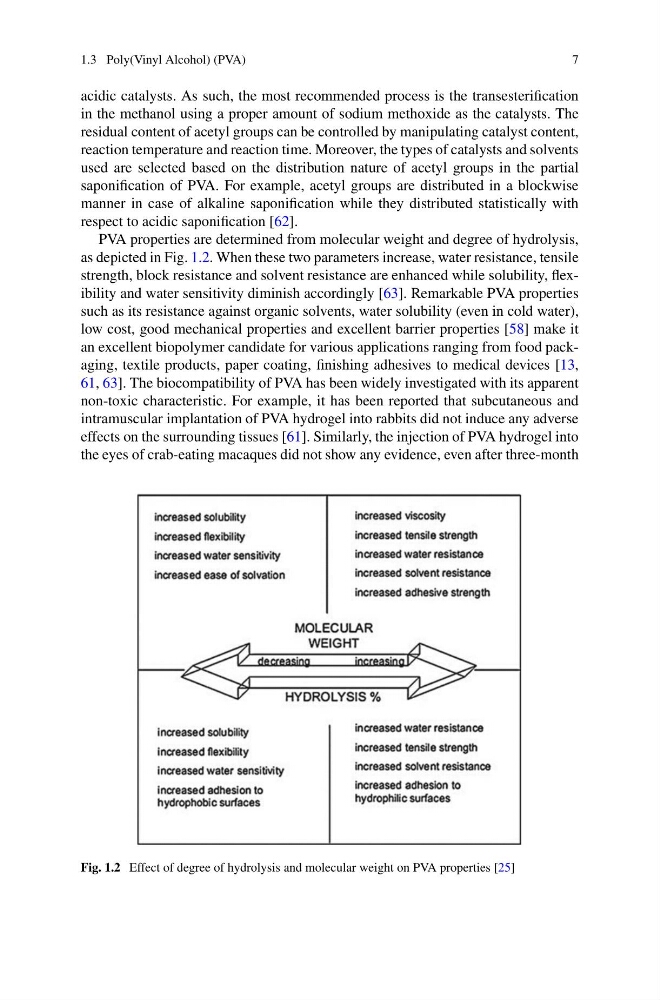
as depicted in Fig. 1.2. When these two parameters increase, water resistance, tensile
strength, block resistance and solvent resistance are enhanced while solubility, flexibility and water sensitivity diminish accordingly [63]. Remarkable PVA properties
such as its resistance against organic solvents, water solubility (even in cold water),
low cost, good mechanical properties and excellent barrier properties [58] make it
an excellent biopolymer candidate for various applications ranging from food packaging, textile products, paper coating, finishing adhesives to medical devices [13,
61, 63]. The biocompatibility of PVA has been widely investigated with its apparent
non-toxic characteristic. For example, it has been reported that subcutaneous and
intramuscular implantation of PVA hydrogel into rabbits did not induce any adverse
effects on the surrounding tissues [61]. Similarly, the injection of PVA hydrogel into
the eyes of crab-eating macaques did not show any evidence, even after three-month
Fig. 1.2 Effect of degree of hydrolysis and molecular weight on PVA properties [25]
7
acidic catalysts. As such, the most recommended process is the transesterification
in the methanol using a proper amount of sodium methoxide as the catalysts. The
residual content of acetyl groups can be controlled by manipulating catalyst content,
reaction temperature and reaction time. Moreover, the types of catalysts and solvents
used are selected based on the distribution nature of acetyl groups in the partial
saponification of PVA. For example, acetyl groups are distributed in a blockwise
manner in case of alkaline saponification while they distributed statistically with
respect to acidic saponification [62].
PVA properties are determined from molecular weight and degree of hydrolysis,
as depicted in Fig. 1.2. When these two parameters increase, water resistance, tensile
strength, block resistance and solvent resistance are enhanced while solubility, flexibility and water sensitivity diminish accordingly [63]. Remarkable PVA properties
such as its resistance against organic solvents, water solubility (even in cold water),
low cost, good mechanical properties and excellent barrier properties [58] make it
an excellent biopolymer candidate for various applications ranging from food packaging, textile products, paper coating, finishing adhesives to medical devices [13,
61, 63]. The biocompatibility of PVA has been widely investigated with its apparent
non-toxic characteristic. For example, it has been reported that subcutaneous and
intramuscular implantation of PVA hydrogel into rabbits did not induce any adverse
effects on the surrounding tissues [61]. Similarly, the injection of PVA hydrogel into
the eyes of crab-eating macaques did not show any evidence, even after three-month
Fig. 1.2 Effect of degree of hydrolysis and molecular weight on PVA properties [25]