

6.3 Prediction of Elastic Moduli of PVA-Based Bionanocomposites
153
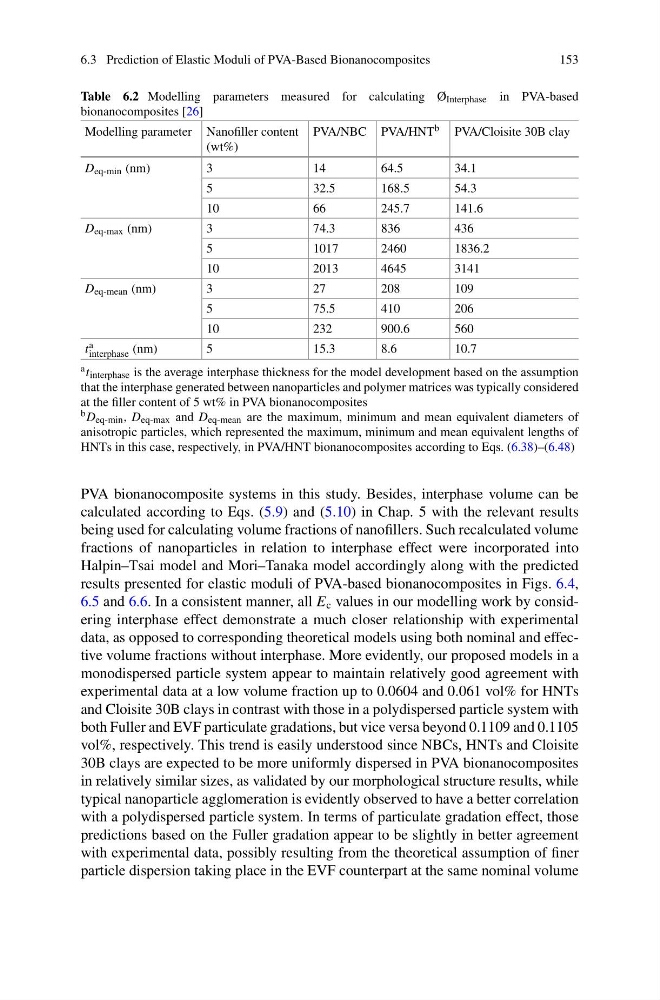
Table 6.2 Modelling parameters measured for calculating Ø Interphase in PVA-based
bionanocomposites [26]
Modelling parameter Nanofiller content
(wt%)
PVA/NBC PVA/HNT b PVA/Cloisite 30B clay
D eq-min (nm)
3
14
64.5
34.1
5
32.5
168.5
54.3
10
66
245.7
141.6
D eq-max (nm)
3
74.3
836
436
5
1017
2460
1836.2
10
2013
4645
3141
D eq-mean (nm)
3
27
208
109
5
75.5
410
206
10
232
900.6
560
t a
interphase (nm)
5
15.3
8.6
10.7
a t interphase is the average interphase thickness for the model development based on the assumption
that the interphase generated between nanoparticles and polymer matrices was typically considered
at the filler content of 5 wt% in PVA bionanocomposites
b D eq-min , D eq-max and D eq-mean are the maximum, minimum and mean equivalent diameters of
anisotropic particles, which represented the maximum, minimum and mean equivalent lengths of
HNTs in this case, respectively, in PVA/HNT bionanocomposites according to Eqs. (6.38)–(6.48)
PVA bionanocomposite systems in this study. Besides, interphase volume can be
calculated according to Eqs. (5.9) and (5.10) in Chap. 5 with the relevant results
being used for calculating volume fractions of nanofillers. Such recalculated volume
fractions of nanoparticles in relation to interphase effect were incorporated into
Halpin–Tsai model and Mori–Tanaka model accordingly along with the predicted
results presented for elastic moduli of PVA-based bionanocomposites in Figs. 6.4,
6.5 and 6.6. In a consistent manner, all E c values in our modelling work by considering interphase effect demonstrate a much closer relationship with experimental
data, as opposed to corresponding theoretical models using both nominal and effective volume fractions without interphase. More evidently, our proposed models in a
monodispersed particle system appear to maintain relatively good agreement with
experimental data at a low volume fraction up to 0.0604 and 0.061 vol% for HNTs
and Cloisite 30B clays in contrast with those in a polydispersed particle system with
both Fuller and EVF particulate gradations, but vice versa beyond 0.1109 and 0.1105
vol%, respectively. This trend is easily understood since NBCs, HNTs and Cloisite
30B clays are expected to be more uniformly dispersed in PVA bionanocomposites
in relatively similar sizes, as validated by our morphological structure results, while
typical nanoparticle agglomeration is evidently observed to have a better correlation
with a polydispersed particle system. In terms of particulate gradation effect, those
predictions based on the Fuller gradation appear to be slightly in better agreement
with experimental data, possibly resulting from the theoretical assumption of finer
particle dispersion taking place in the EVF counterpart at the same nominal volume
153
Table 6.2 Modelling parameters measured for calculating Ø Interphase in PVA-based
bionanocomposites [26]
Modelling parameter Nanofiller content
(wt%)
PVA/NBC PVA/HNT b PVA/Cloisite 30B clay
D eq-min (nm)
3
14
64.5
34.1
5
32.5
168.5
54.3
10
66
245.7
141.6
D eq-max (nm)
3
74.3
836
436
5
1017
2460
1836.2
10
2013
4645
3141
D eq-mean (nm)
3
27
208
109
5
75.5
410
206
10
232
900.6
560
t a
interphase (nm)
5
15.3
8.6
10.7
a t interphase is the average interphase thickness for the model development based on the assumption
that the interphase generated between nanoparticles and polymer matrices was typically considered
at the filler content of 5 wt% in PVA bionanocomposites
b D eq-min , D eq-max and D eq-mean are the maximum, minimum and mean equivalent diameters of
anisotropic particles, which represented the maximum, minimum and mean equivalent lengths of
HNTs in this case, respectively, in PVA/HNT bionanocomposites according to Eqs. (6.38)–(6.48)
PVA bionanocomposite systems in this study. Besides, interphase volume can be
calculated according to Eqs. (5.9) and (5.10) in Chap. 5 with the relevant results
being used for calculating volume fractions of nanofillers. Such recalculated volume
fractions of nanoparticles in relation to interphase effect were incorporated into
Halpin–Tsai model and Mori–Tanaka model accordingly along with the predicted
results presented for elastic moduli of PVA-based bionanocomposites in Figs. 6.4,
6.5 and 6.6. In a consistent manner, all E c values in our modelling work by considering interphase effect demonstrate a much closer relationship with experimental
data, as opposed to corresponding theoretical models using both nominal and effective volume fractions without interphase. More evidently, our proposed models in a
monodispersed particle system appear to maintain relatively good agreement with
experimental data at a low volume fraction up to 0.0604 and 0.061 vol% for HNTs
and Cloisite 30B clays in contrast with those in a polydispersed particle system with
both Fuller and EVF particulate gradations, but vice versa beyond 0.1109 and 0.1105
vol%, respectively. This trend is easily understood since NBCs, HNTs and Cloisite
30B clays are expected to be more uniformly dispersed in PVA bionanocomposites
in relatively similar sizes, as validated by our morphological structure results, while
typical nanoparticle agglomeration is evidently observed to have a better correlation
with a polydispersed particle system. In terms of particulate gradation effect, those
predictions based on the Fuller gradation appear to be slightly in better agreement
with experimental data, possibly resulting from the theoretical assumption of finer
particle dispersion taking place in the EVF counterpart at the same nominal volume