

6.2 Theory
147
∅ Interphase =
1 − ∅ p-nominal
1 − exp
−
6∅ p-nominal λ
3
1 − ∅ p-nominal
1
Sλ
2
+
1
λ
2 +
3∅ p-nominal
S 2
1 − ∅ p-nominal
+
4
3
+
4∅ p-nominal
S
1 − ∅ p-nominal
+
4m∅
2
p-nominal
3S 3
1 − ∅ p-nominal
2
(6.37)
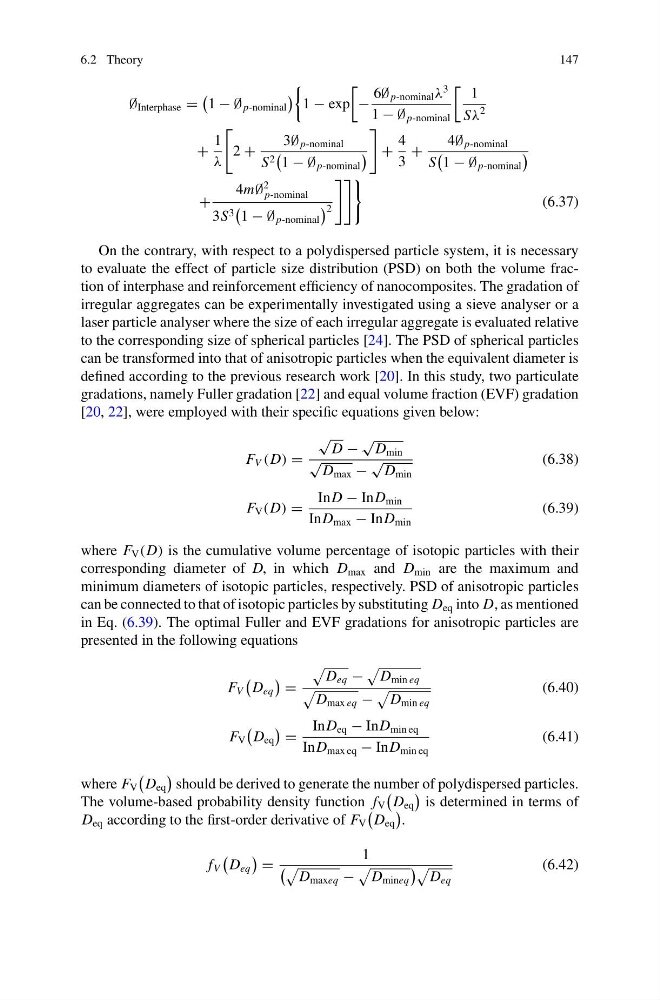
On the contrary, with respect to a polydispersed particle system, it is necessary
to evaluate the effect of particle size distribution (PSD) on both the volume fraction of interphase and reinforcement efficiency of nanocomposites. The gradation of
irregular aggregates can be experimentally investigated using a sieve analyser or a
laser particle analyser where the size of each irregular aggregate is evaluated relative
to the corresponding size of spherical particles [24]. The PSD of spherical particles
can be transformed into that of anisotropic particles when the equivalent diameter is
defined according to the previous research work [20]. In this study, two particulate
gradations, namely Fuller gradation [22] and equal volume fraction (EVF) gradation
[20, 22], were employed with their specific equations given below:
F V (D) =
√
D −
√
D min
√
D max −
√
D min
(6.38)
F V (D) =
InD − InD min
InD max − InD min
(6.39)
where F V (D) is the cumulative volume percentage of isotopic particles with their
corresponding diameter of D, in which D max and D min are the maximum and
minimum diameters of isotopic particles, respectively. PSD of anisotropic particles
can be connected to that of isotopic particles by substituting D eq into D, as mentioned
in Eq. (6.39). The optimal Fuller and EVF gradations for anisotropic particles are
presented in the following equations
F V
D eq
=
D eq −
D min eq
D max eq −
D min eq
(6.40)
F V
D eq
=
InD eq − InD min eq
InD max eq − InD min eq
(6.41)
where F V
D eq
should be derived to generate the number of polydispersed particles.
The volume-based probability density function f V
D eq
is determined in terms of
D eq according to the first-order derivative of F V
D eq
.
f V
D eq
=
1
D maxeq −
D mineq
D eq
(6.42)
147
∅ Interphase =
1 − ∅ p-nominal
1 − exp
−
6∅ p-nominal λ
3
1 − ∅ p-nominal
1
Sλ
2
+
1
λ
2 +
3∅ p-nominal
S 2
1 − ∅ p-nominal
+
4
3
+
4∅ p-nominal
S
1 − ∅ p-nominal
+
4m∅
2
p-nominal
3S 3
1 − ∅ p-nominal
2
(6.37)
On the contrary, with respect to a polydispersed particle system, it is necessary
to evaluate the effect of particle size distribution (PSD) on both the volume fraction of interphase and reinforcement efficiency of nanocomposites. The gradation of
irregular aggregates can be experimentally investigated using a sieve analyser or a
laser particle analyser where the size of each irregular aggregate is evaluated relative
to the corresponding size of spherical particles [24]. The PSD of spherical particles
can be transformed into that of anisotropic particles when the equivalent diameter is
defined according to the previous research work [20]. In this study, two particulate
gradations, namely Fuller gradation [22] and equal volume fraction (EVF) gradation
[20, 22], were employed with their specific equations given below:
F V (D) =
√
D −
√
D min
√
D max −
√
D min
(6.38)
F V (D) =
InD − InD min
InD max − InD min
(6.39)
where F V (D) is the cumulative volume percentage of isotopic particles with their
corresponding diameter of D, in which D max and D min are the maximum and
minimum diameters of isotopic particles, respectively. PSD of anisotropic particles
can be connected to that of isotopic particles by substituting D eq into D, as mentioned
in Eq. (6.39). The optimal Fuller and EVF gradations for anisotropic particles are
presented in the following equations
F V
D eq
=
D eq −
D min eq
D max eq −
D min eq
(6.40)
F V
D eq
=
InD eq − InD min eq
InD max eq − InD min eq
(6.41)
where F V
D eq
should be derived to generate the number of polydispersed particles.
The volume-based probability density function f V
D eq
is determined in terms of
D eq according to the first-order derivative of F V
D eq
.
f V
D eq
=
1
D maxeq −
D mineq
D eq
(6.42)