

98
4 PVA Bionanocomposite Films with Different Particle …
4.7 Mechanical Properties
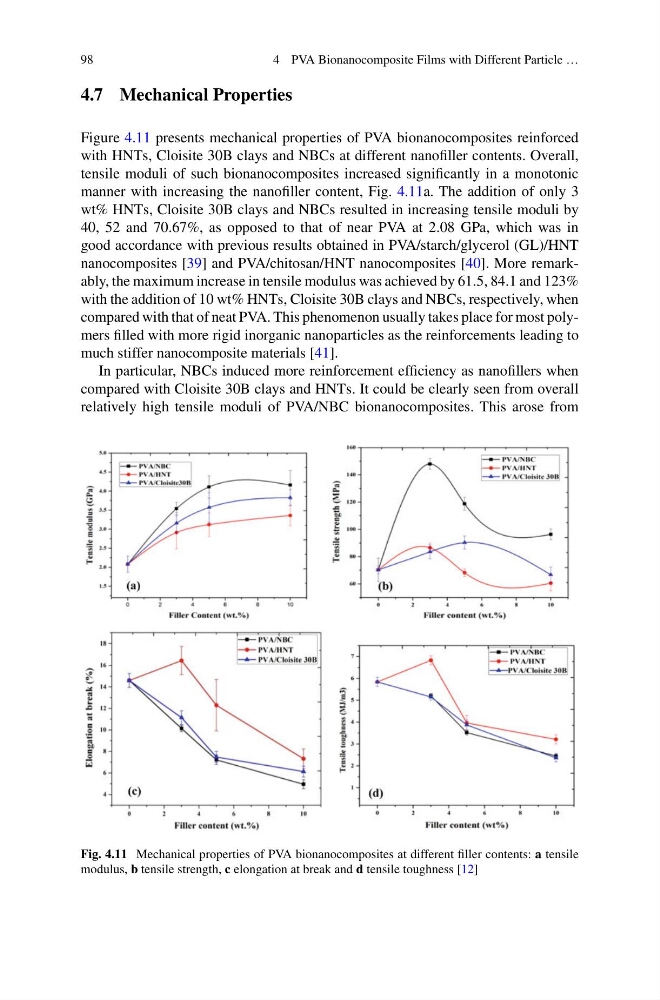
Figure 4.11 presents mechanical properties of PVA bionanocomposites reinforced
with HNTs, Cloisite 30B clays and NBCs at different nanofiller contents. Overall,
tensile moduli of such bionanocomposites increased significantly in a monotonic
manner with increasing the nanofiller content, Fig. 4.11a. The addition of only 3
wt% HNTs, Cloisite 30B clays and NBCs resulted in increasing tensile moduli by
40, 52 and 70.67%, as opposed to that of near PVA at 2.08 GPa, which was in
good accordance with previous results obtained in PVA/starch/glycerol (GL)/HNT
nanocomposites [39] and PVA/chitosan/HNT nanocomposites [40]. More remarkably, the maximum increase in tensile modulus was achieved by 61.5, 84.1 and 123%
with the addition of 10 wt% HNTs, Cloisite 30B clays and NBCs, respectively, when
compared with that of neat PVA. This phenomenon usually takes place for most polymers filled with more rigid inorganic nanoparticles as the reinforcements leading to
much stiffer nanocomposite materials [41].
In particular, NBCs induced more reinforcement efficiency as nanofillers when
compared with Cloisite 30B clays and HNTs. It could be clearly seen from overall
relatively high tensile moduli of PVA/NBC bionanocomposites. This arose from
Fig. 4.11 Mechanical properties of PVA bionanocomposites at different filler contents: a tensile
modulus, b tensile strength, c elongation at break and d tensile toughness [12]
4 PVA Bionanocomposite Films with Different Particle …
4.7 Mechanical Properties
Figure 4.11 presents mechanical properties of PVA bionanocomposites reinforced
with HNTs, Cloisite 30B clays and NBCs at different nanofiller contents. Overall,
tensile moduli of such bionanocomposites increased significantly in a monotonic
manner with increasing the nanofiller content, Fig. 4.11a. The addition of only 3
wt% HNTs, Cloisite 30B clays and NBCs resulted in increasing tensile moduli by
40, 52 and 70.67%, as opposed to that of near PVA at 2.08 GPa, which was in
good accordance with previous results obtained in PVA/starch/glycerol (GL)/HNT
nanocomposites [39] and PVA/chitosan/HNT nanocomposites [40]. More remarkably, the maximum increase in tensile modulus was achieved by 61.5, 84.1 and 123%
with the addition of 10 wt% HNTs, Cloisite 30B clays and NBCs, respectively, when
compared with that of neat PVA. This phenomenon usually takes place for most polymers filled with more rigid inorganic nanoparticles as the reinforcements leading to
much stiffer nanocomposite materials [41].
In particular, NBCs induced more reinforcement efficiency as nanofillers when
compared with Cloisite 30B clays and HNTs. It could be clearly seen from overall
relatively high tensile moduli of PVA/NBC bionanocomposites. This arose from
Fig. 4.11 Mechanical properties of PVA bionanocomposites at different filler contents: a tensile
modulus, b tensile strength, c elongation at break and d tensile toughness [12]