

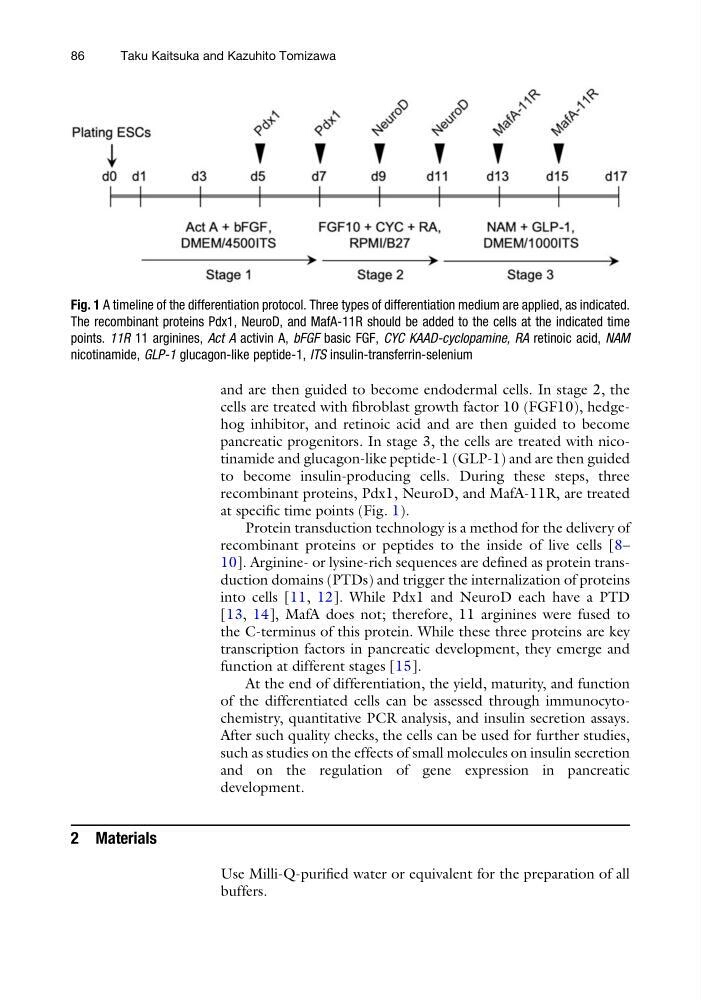
and are then guided to become endodermal cells. In stage 2, the
cells are treated with fibroblast growth factor 10 (FGF10), hedgehog inhibitor, and retinoic acid and are then guided to become
pancreatic progenitors. In stage 3, the cells are treated with nicotinamide and glucagon-like peptide-1 (GLP-1) and are then guided
to become insulin-producing cells. During these steps, three
recombinant proteins, Pdx1, NeuroD, and MafA-11R, are treated
at specific time points (Fig. 1).
Protein transduction technology is a method for the delivery of
recombinant proteins or peptides to the inside of live cells [8–
10]. Arginine- or lysine-rich sequences are defined as protein transduction domains (PTDs) and trigger the internalization of proteins
into cells [11, 12]. While Pdx1 and NeuroD each have a PTD
[13, 14], MafA does not; therefore, 11 arginines were fused to
the C-terminus of this protein. While these three proteins are key
transcription factors in pancreatic development, they emerge and
function at different stages [15].
At the end of differentiation, the yield, maturity, and function
of the differentiated cells can be assessed through immunocytochemistry, quantitative PCR analysis, and insulin secretion assays.
After such quality checks, the cells can be used for further studies,
such as studies on the effects of small molecules on insulin secretion
and on the regulation of gene expression in pancreatic
development.
2 Materials
Use Milli-Q-purified water or equivalent for the preparation of all
buffers.
Fig. 1 A timeline of the differentiation protocol. Three types of differentiation medium are applied, as indicated.
The recombinant proteins Pdx1, NeuroD, and MafA-11R should be added to the cells at the indicated time
points. 11R 11 arginines, Act A activin A, bFGF basic FGF, CYC KAAD-cyclopamine, RA retinoic acid, NAM
nicotinamide, GLP-1 glucagon-like peptide-1, ITS insulin-transferrin-selenium
86
Taku Kaitsuka and Kazuhito Tomizawa
cells are treated with fibroblast growth factor 10 (FGF10), hedgehog inhibitor, and retinoic acid and are then guided to become
pancreatic progenitors. In stage 3, the cells are treated with nicotinamide and glucagon-like peptide-1 (GLP-1) and are then guided
to become insulin-producing cells. During these steps, three
recombinant proteins, Pdx1, NeuroD, and MafA-11R, are treated
at specific time points (Fig. 1).
Protein transduction technology is a method for the delivery of
recombinant proteins or peptides to the inside of live cells [8–
10]. Arginine- or lysine-rich sequences are defined as protein transduction domains (PTDs) and trigger the internalization of proteins
into cells [11, 12]. While Pdx1 and NeuroD each have a PTD
[13, 14], MafA does not; therefore, 11 arginines were fused to
the C-terminus of this protein. While these three proteins are key
transcription factors in pancreatic development, they emerge and
function at different stages [15].
At the end of differentiation, the yield, maturity, and function
of the differentiated cells can be assessed through immunocytochemistry, quantitative PCR analysis, and insulin secretion assays.
After such quality checks, the cells can be used for further studies,
such as studies on the effects of small molecules on insulin secretion
and on the regulation of gene expression in pancreatic
development.
2 Materials
Use Milli-Q-purified water or equivalent for the preparation of all
buffers.
Fig. 1 A timeline of the differentiation protocol. Three types of differentiation medium are applied, as indicated.
The recombinant proteins Pdx1, NeuroD, and MafA-11R should be added to the cells at the indicated time
points. 11R 11 arginines, Act A activin A, bFGF basic FGF, CYC KAAD-cyclopamine, RA retinoic acid, NAM
nicotinamide, GLP-1 glucagon-like peptide-1, ITS insulin-transferrin-selenium
86
Taku Kaitsuka and Kazuhito Tomizawa