

Unfortunately, the prospect of employing this class of vectors
has been limited by low gene delivery efficiency [10, 11], while
methods to improve the efficiency of the vector to render them
clinically or physiologically viable remain poorly understood
[12]. The vectors’ ability to successfully adhere to the membrane
of the target cell and internalize into the cytoplasm, which is
directly correlated to its gene delivery efficiency remains fairly
unsatisfactory, and is not yet a practical solution for molecule
delivery in vivo [12].
There have been few successful attempts to improve viral and
nonviral vector efficiency by co-delivery with exogenous reagents
[13]. In these cases, peptides, oligonucleotides, and viral vectors
were able to deliver reporter DNA with higher efficiency when they
were complexed with cationic lipids. However, not many reagents
have been investigated to aid the ability of bacterial vectors to
deliver DNA efficiently. Antibiotics such as Polymyxin B have
been shown to aid the bacterial invasion process by attenuating
bacterial cells [10], and the transfection reagent Lipofectamine has
been shown to have similar effects on the gene delivery efficiency of
the vector [11].
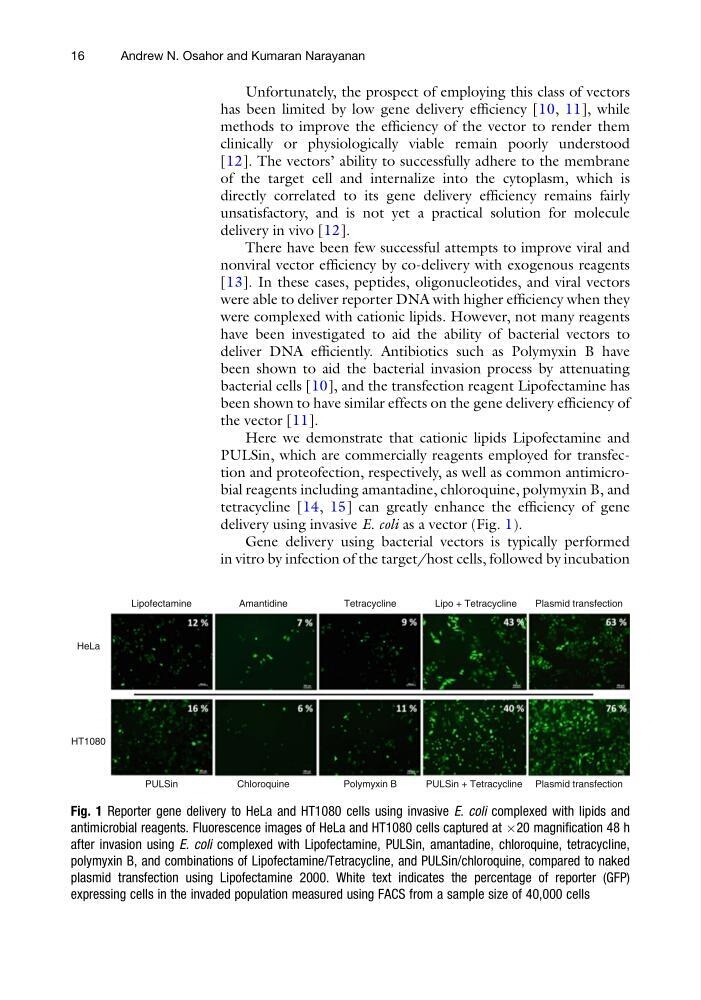
Here we demonstrate that cationic lipids Lipofectamine and
PULSin, which are commercially reagents employed for transfection and proteofection, respectively, as well as common antimicrobial reagents including amantadine, chloroquine, polymyxin B, and
tetracycline [14, 15] can greatly enhance the efficiency of gene
delivery using invasive E. coli as a vector (Fig. 1).
Gene delivery using bacterial vectors is typically performed
in vitro by infection of the target/host cells, followed by incubation
HeLa
HT1080
Lipofectamine
Amantidine
Tetracycline
Lipo + Tetracycline
Plasmid transfection
Plasmid transfection
PULSin
Chloroquine
Polymyxin B
PULSin + Tetracycline
Fig. 1 Reporter gene delivery to HeLa and HT1080 cells using invasive E. coli complexed with lipids and
antimicrobial reagents. Fluorescence images of HeLa and HT1080 cells captured at Â20 magnification 48 h
after invasion using E. coli complexed with Lipofectamine, PULSin, amantadine, chloroquine, tetracycline,
polymyxin B, and combinations of Lipofectamine/Tetracycline, and PULSin/chloroquine, compared to naked
plasmid transfection using Lipofectamine 2000. White text indicates the percentage of reporter (GFP)
expressing cells in the invaded population measured using FACS from a sample size of 40,000 cells
16
Andrew N. Osahor and Kumaran Narayanan
has been limited by low gene delivery efficiency [10, 11], while
methods to improve the efficiency of the vector to render them
clinically or physiologically viable remain poorly understood
[12]. The vectors’ ability to successfully adhere to the membrane
of the target cell and internalize into the cytoplasm, which is
directly correlated to its gene delivery efficiency remains fairly
unsatisfactory, and is not yet a practical solution for molecule
delivery in vivo [12].
There have been few successful attempts to improve viral and
nonviral vector efficiency by co-delivery with exogenous reagents
[13]. In these cases, peptides, oligonucleotides, and viral vectors
were able to deliver reporter DNA with higher efficiency when they
were complexed with cationic lipids. However, not many reagents
have been investigated to aid the ability of bacterial vectors to
deliver DNA efficiently. Antibiotics such as Polymyxin B have
been shown to aid the bacterial invasion process by attenuating
bacterial cells [10], and the transfection reagent Lipofectamine has
been shown to have similar effects on the gene delivery efficiency of
the vector [11].
Here we demonstrate that cationic lipids Lipofectamine and
PULSin, which are commercially reagents employed for transfection and proteofection, respectively, as well as common antimicrobial reagents including amantadine, chloroquine, polymyxin B, and
tetracycline [14, 15] can greatly enhance the efficiency of gene
delivery using invasive E. coli as a vector (Fig. 1).
Gene delivery using bacterial vectors is typically performed
in vitro by infection of the target/host cells, followed by incubation
HeLa
HT1080
Lipofectamine
Amantidine
Tetracycline
Lipo + Tetracycline
Plasmid transfection
Plasmid transfection
PULSin
Chloroquine
Polymyxin B
PULSin + Tetracycline
Fig. 1 Reporter gene delivery to HeLa and HT1080 cells using invasive E. coli complexed with lipids and
antimicrobial reagents. Fluorescence images of HeLa and HT1080 cells captured at Â20 magnification 48 h
after invasion using E. coli complexed with Lipofectamine, PULSin, amantadine, chloroquine, tetracycline,
polymyxin B, and combinations of Lipofectamine/Tetracycline, and PULSin/chloroquine, compared to naked
plasmid transfection using Lipofectamine 2000. White text indicates the percentage of reporter (GFP)
expressing cells in the invaded population measured using FACS from a sample size of 40,000 cells
16
Andrew N. Osahor and Kumaran Narayanan