

12. Check the plasmid integrity by gel electrophoresis. Load the
mixture of the extracted plasmid (see Note 3) and Novel juice
on 0.7% agarose gel using 100 V for 30 min (see Note 4).
13. Store the plasmid at À20
C.
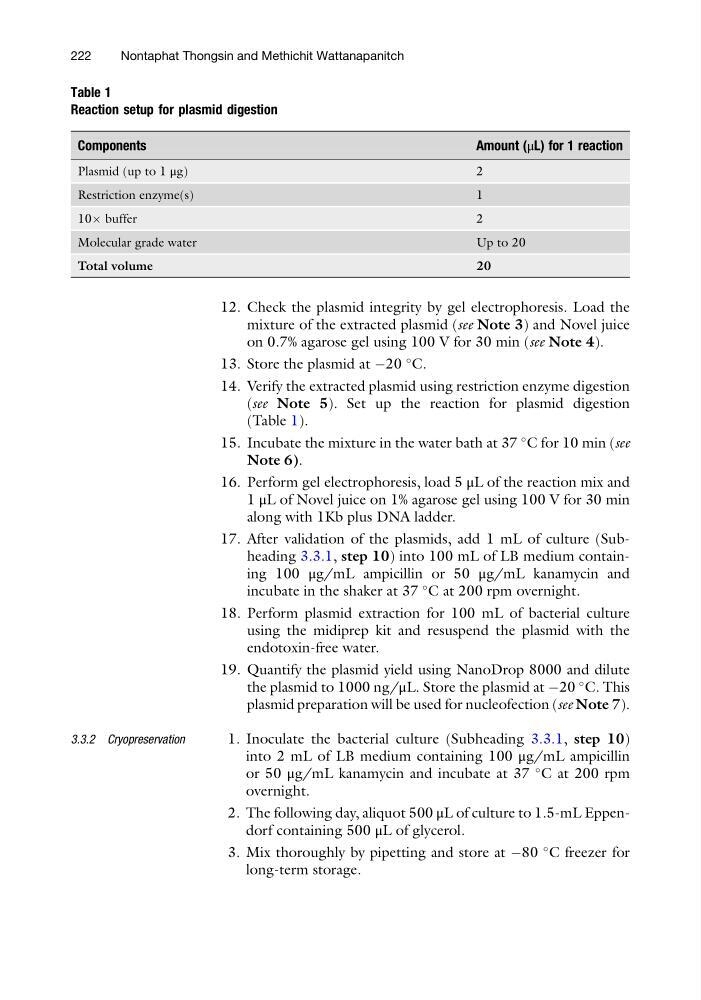
14. Verify the extracted plasmid using restriction enzyme digestion
(see Note 5). Set up the reaction for plasmid digestion
(Table 1).
15. Incubate the mixture in the water bath at 37
C for 10 min (see
Note 6).
16. Perform gel electrophoresis, load 5 μL of the reaction mix and
1 μL of Novel juice on 1% agarose gel using 100 V for 30 min
along with 1Kb plus DNA ladder.
17. After validation of the plasmids, add 1 mL of culture (Subheading 3.3.1, step 10) into 100 mL of LB medium containing 100 μg/mL ampicillin or 50 μg/mL kanamycin and
incubate in the shaker at 37
C at 200 rpm overnight.
18. Perform plasmid extraction for 100 mL of bacterial culture
using the midiprep kit and resuspend the plasmid with the
endotoxin-free water.
19. Quantify the plasmid yield using NanoDrop 8000 and dilute
the plasmid to 1000 ng/μL. Store the plasmid at À20
C. This
plasmid preparation will be used for nucleofection (see Note 7).
3.3.2 Cryopreservation
1. Inoculate the bacterial culture (Subheading 3.3.1, step 10)
into 2 mL of LB medium containing 100 μg/mL ampicillin
or 50 μg/mL kanamycin and incubate at 37
C at 200 rpm
overnight.
2. The following day, aliquot 500 μL of culture to 1.5-mL Eppendorf containing 500 μL of glycerol.
3. Mix thoroughly by pipetting and store at À80
C freezer for
long-term storage.
Table 1
Reaction setup for plasmid digestion
Components
Amount (μL) for 1 reaction
Plasmid (up to 1 μg)
2
Restriction enzyme(s)
1
10Â buffer
2
Molecular grade water
Up to 20
Total volume
20
222
Nontaphat Thongsin and Methichit Wattanapanitch
mixture of the extracted plasmid (see Note 3) and Novel juice
on 0.7% agarose gel using 100 V for 30 min (see Note 4).
13. Store the plasmid at À20
C.
14. Verify the extracted plasmid using restriction enzyme digestion
(see Note 5). Set up the reaction for plasmid digestion
(Table 1).
15. Incubate the mixture in the water bath at 37
C for 10 min (see
Note 6).
16. Perform gel electrophoresis, load 5 μL of the reaction mix and
1 μL of Novel juice on 1% agarose gel using 100 V for 30 min
along with 1Kb plus DNA ladder.
17. After validation of the plasmids, add 1 mL of culture (Subheading 3.3.1, step 10) into 100 mL of LB medium containing 100 μg/mL ampicillin or 50 μg/mL kanamycin and
incubate in the shaker at 37
C at 200 rpm overnight.
18. Perform plasmid extraction for 100 mL of bacterial culture
using the midiprep kit and resuspend the plasmid with the
endotoxin-free water.
19. Quantify the plasmid yield using NanoDrop 8000 and dilute
the plasmid to 1000 ng/μL. Store the plasmid at À20
C. This
plasmid preparation will be used for nucleofection (see Note 7).
3.3.2 Cryopreservation
1. Inoculate the bacterial culture (Subheading 3.3.1, step 10)
into 2 mL of LB medium containing 100 μg/mL ampicillin
or 50 μg/mL kanamycin and incubate at 37
C at 200 rpm
overnight.
2. The following day, aliquot 500 μL of culture to 1.5-mL Eppendorf containing 500 μL of glycerol.
3. Mix thoroughly by pipetting and store at À80
C freezer for
long-term storage.
Table 1
Reaction setup for plasmid digestion
Components
Amount (μL) for 1 reaction
Plasmid (up to 1 μg)
2
Restriction enzyme(s)
1
10Â buffer
2
Molecular grade water
Up to 20
Total volume
20
222
Nontaphat Thongsin and Methichit Wattanapanitch