

3.7 Mammalian Cell
Cytotoxicity
of the E. coli Vector
1. Prepare murine macrophage cells (RAW264.7) as described in
Subheading 3.6 following steps 1–9.
2. Prepare bacterial vectors combined with macrophage as
described in Subheading 3.6 following steps 10–14.
3. Carefully remove the macrophage medium in both 96-well
plates and replace it with 50 μL of each respective bacterialRPMI dilution (to generate the resulting MOI values) and
incubate at 30
C in a 5% CO 2 incubator. Also include a sample
of macrophage which have no bacteria added as a control.
4. After 24 h of incubation, add MTT (3-(4,5-dimethylthiazol-2yl)-2,5-diphenyl-2H-tetrazolium bromide) solution (5 mg/
mL) to each well at 10% (v/v) and incubate for 3 h at 37
C
and 5% CO 2 . Include a negative control containing the cell
culture medium alone. Also assemble varying solutions containing cell concentrations ranging from 10
3 –10
6 cells per mL
to establish a standard curve for the assay.
5. Aspirate the solution and resuspend the cells in 1Â volume of
dimethyl sulfoxide (DMSO) and incubate on a shaker for 1 h at
200 rpm agitation.
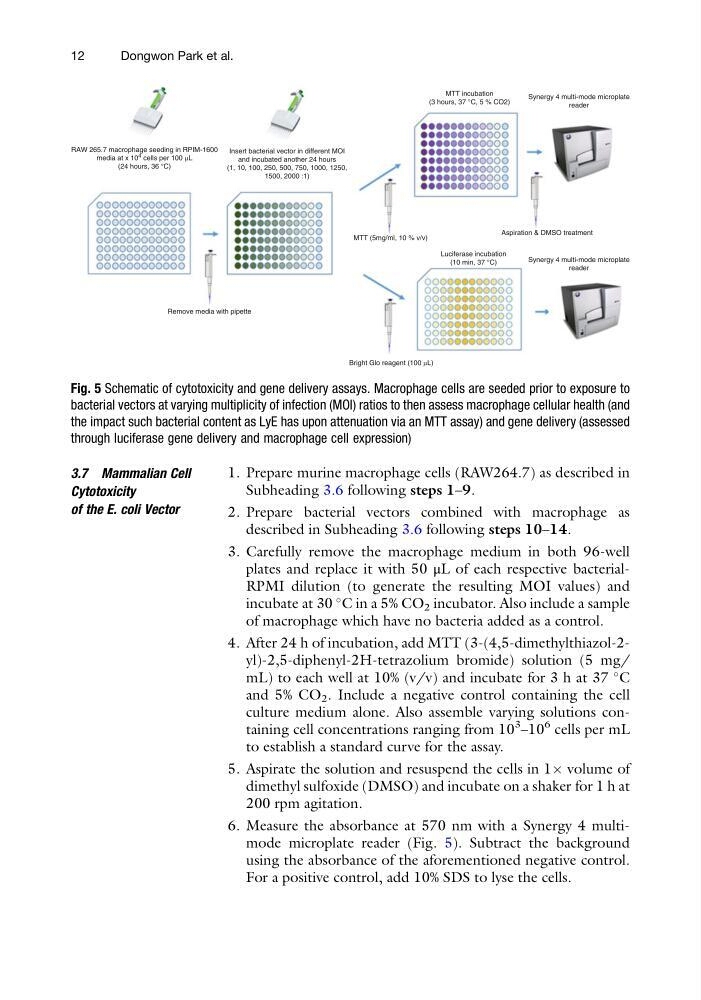
6. Measure the absorbance at 570 nm with a Synergy 4 multimode microplate reader (Fig. 5). Subtract the background
using the absorbance of the aforementioned negative control.
For a positive control, add 10% SDS to lyse the cells.
RAW 265.7 macrophage seeding in RPIM-1600
media at x 10 4 cells per 100 µL
(24 hours, 36 °C)
Insert bacterial vector in different MOI
and incubated another 24 hours
(1, 10, 100, 250, 500, 750, 1000, 1250,
1500, 2000 :1)
Remove media with pipette
MTT (5mg/ml, 10 % v/v)
Luciferase incubation
(10 min, 37 °C)
Bright Glo reagent (100 µL)
Aspiration & DMSO treatment
Synergy 4 multi-mode microplate
reader
Synergy 4 multi-mode microplate
reader
MTT incubation
(3 hours, 37 °C, 5 % CO2)
Fig. 5 Schematic of cytotoxicity and gene delivery assays. Macrophage cells are seeded prior to exposure to
bacterial vectors at varying multiplicity of infection (MOI) ratios to then assess macrophage cellular health (and
the impact such bacterial content as LyE has upon attenuation via an MTT assay) and gene delivery (assessed
through luciferase gene delivery and macrophage cell expression)
12
Dongwon Park et al.
Cytotoxicity
of the E. coli Vector
1. Prepare murine macrophage cells (RAW264.7) as described in
Subheading 3.6 following steps 1–9.
2. Prepare bacterial vectors combined with macrophage as
described in Subheading 3.6 following steps 10–14.
3. Carefully remove the macrophage medium in both 96-well
plates and replace it with 50 μL of each respective bacterialRPMI dilution (to generate the resulting MOI values) and
incubate at 30
C in a 5% CO 2 incubator. Also include a sample
of macrophage which have no bacteria added as a control.
4. After 24 h of incubation, add MTT (3-(4,5-dimethylthiazol-2yl)-2,5-diphenyl-2H-tetrazolium bromide) solution (5 mg/
mL) to each well at 10% (v/v) and incubate for 3 h at 37
C
and 5% CO 2 . Include a negative control containing the cell
culture medium alone. Also assemble varying solutions containing cell concentrations ranging from 10
3 –10
6 cells per mL
to establish a standard curve for the assay.
5. Aspirate the solution and resuspend the cells in 1Â volume of
dimethyl sulfoxide (DMSO) and incubate on a shaker for 1 h at
200 rpm agitation.
6. Measure the absorbance at 570 nm with a Synergy 4 multimode microplate reader (Fig. 5). Subtract the background
using the absorbance of the aforementioned negative control.
For a positive control, add 10% SDS to lyse the cells.
RAW 265.7 macrophage seeding in RPIM-1600
media at x 10 4 cells per 100 µL
(24 hours, 36 °C)
Insert bacterial vector in different MOI
and incubated another 24 hours
(1, 10, 100, 250, 500, 750, 1000, 1250,
1500, 2000 :1)
Remove media with pipette
MTT (5mg/ml, 10 % v/v)
Luciferase incubation
(10 min, 37 °C)
Bright Glo reagent (100 µL)
Aspiration & DMSO treatment
Synergy 4 multi-mode microplate
reader
Synergy 4 multi-mode microplate
reader
MTT incubation
(3 hours, 37 °C, 5 % CO2)
Fig. 5 Schematic of cytotoxicity and gene delivery assays. Macrophage cells are seeded prior to exposure to
bacterial vectors at varying multiplicity of infection (MOI) ratios to then assess macrophage cellular health (and
the impact such bacterial content as LyE has upon attenuation via an MTT assay) and gene delivery (assessed
through luciferase gene delivery and macrophage cell expression)
12
Dongwon Park et al.